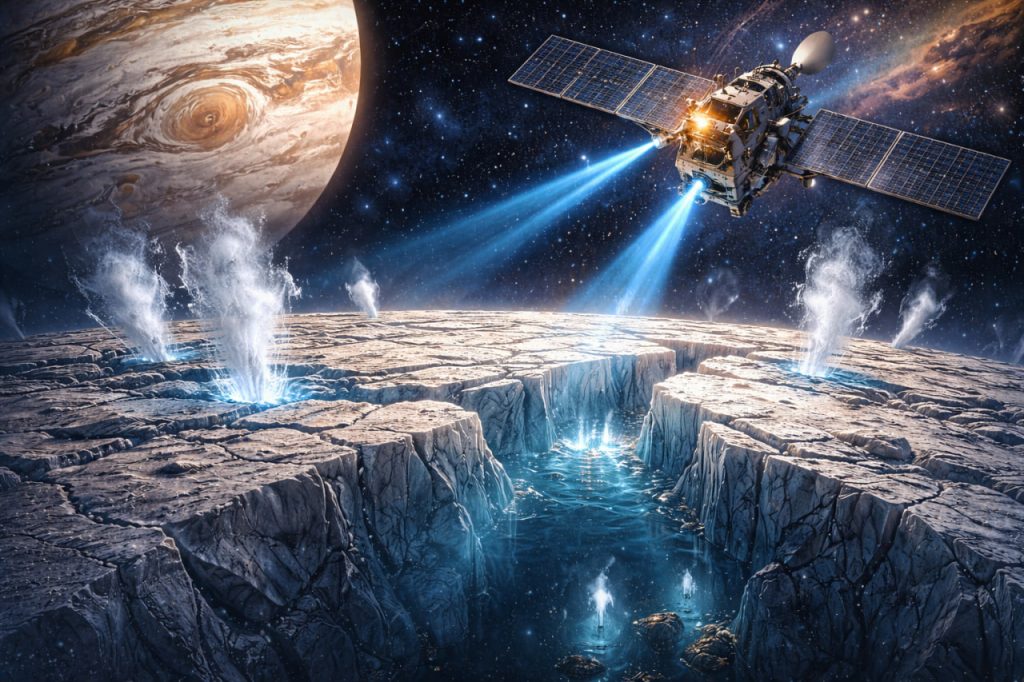
The Europa Clipper mission is one of NASA’s most ambitious projects aimed at exploring the possibility of life beyond Earth. Its target is Europa, one of Jupiter’s moons, which is believed to hide a vast ocean beneath its thick icy crust. Scientists consider Europa one of the most promising places in the solar system to search for extraterrestrial life, thanks to the presence of water, energy sources, and potentially suitable chemical conditions. Rather than landing on the surface, the spacecraft will perform multiple flybys, collecting detailed data about the moon’s structure and environment. This mission represents a major step forward in the search for life in our cosmic neighborhood.
Why Europa Is So Important
Europa stands out because it likely contains a global subsurface ocean beneath its frozen surface. This ocean may have more water than all of Earth’s oceans combined. The interaction between the ocean and Europa’s rocky core could create chemical energy, similar to environments on Earth where life thrives without sunlight. According to planetary scientist Dr. Alan Brooks:
“Europa may have all the ingredients necessary for life —
water, energy, and the right chemistry beneath its icy shell.”
This makes it one of the most compelling targets for astrobiology.
Mission Goals and Instruments
The Europa Clipper spacecraft is designed to study Europa in detail without landing. It will carry advanced instruments to analyze the moon’s ice shell, subsurface ocean, and surface composition. These tools will help determine the thickness of the ice, detect possible water plumes, and identify chemical compounds that could support life. By performing dozens of close flybys, the mission will build a comprehensive picture of Europa’s environment.
Searching for Signs of Life
Although the mission will not directly detect life, it aims to identify biosignatures—chemical or physical indicators that life could exist. Scientists will look for organic molecules, energy sources, and conditions suitable for living organisms. If these elements are present, Europa could become a future target for more advanced missions, including landers or subsurface probes.
Challenges of Exploring Europa
Exploring Europa is extremely challenging due to its location in Jupiter’s intense radiation environment. The spacecraft must be carefully designed to withstand high radiation levels while maintaining precise instruments. Additionally, the thick ice layer presents a barrier to directly accessing the ocean, making indirect observation essential.
A Step Toward Answering a Big Question
The Europa Clipper mission is part of a broader effort to answer one of humanity’s biggest questions: Are we alone in the universe? By studying Europa’s hidden ocean, scientists hope to better understand the conditions that make life possible. Even if no direct evidence of life is found, the mission will provide valuable insights into how planetary systems evolve.
Interesting Facts
- Europa is slightly smaller than Earth’s Moon.
- Its subsurface ocean may contain more water than Earth.
- The ice crust could be several kilometers thick.
- Europa orbits within Jupiter’s strong radiation belts.
- The mission involves multiple flybys instead of landing.
Glossary
- Europa — a moon of Jupiter with a संभावित subsurface ocean.
- Europa Clipper — NASA’s spacecraft designed to study Europa.
- Biosignatures — indicators that may suggest the presence of life.
- Subsurface Ocean — an ocean located beneath a planet or moon’s surface.
- Astrobiology — the study of life beyond Earth.