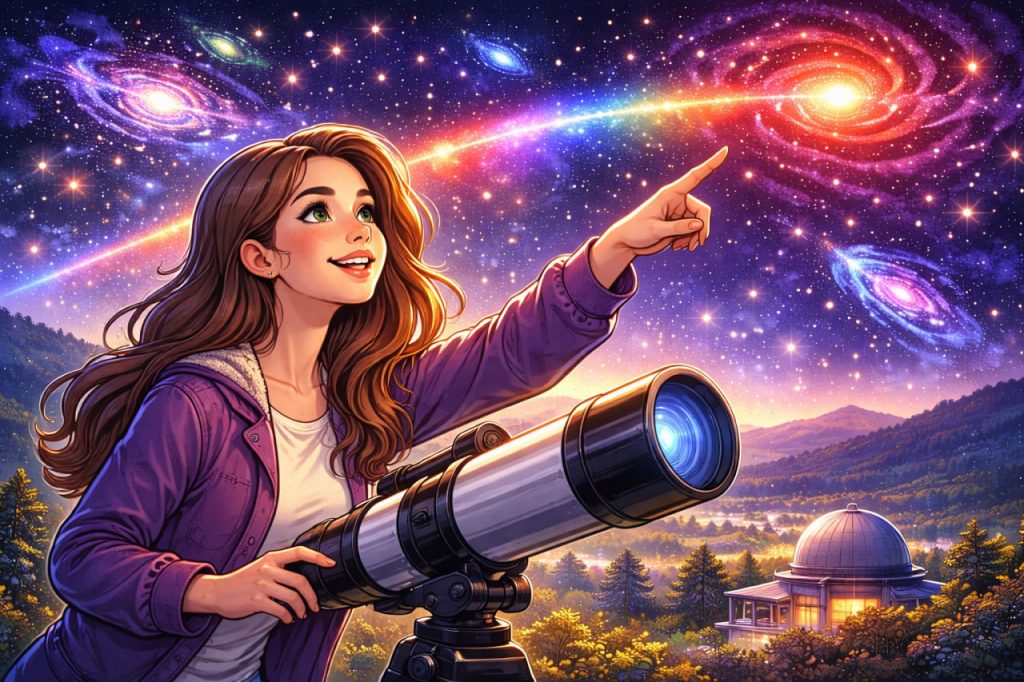
Redshift is one of the most important concepts in modern astronomy, helping scientists understand how the universe is expanding and evolving over time. It refers to the phenomenon where light from distant objects shifts toward the red end of the spectrum as it travels through space. This effect occurs because the universe itself is expanding, stretching the wavelength of light along with it. By measuring redshift, astronomers can determine how far away galaxies are and how fast they are moving away from us. This simple yet powerful concept has transformed our understanding of the cosmos, providing key evidence for the expanding universe and supporting the Big Bang theory. Redshift acts like a cosmic ruler, allowing scientists to map the structure and history of the universe.
What Causes Redshift
Redshift occurs when the wavelength of light becomes longer, shifting toward red colors in the visible spectrum. The most important type is cosmological redshift, which happens due to the expansion of space itself. As galaxies move farther apart, the light traveling between them stretches, increasing its wavelength. There is also Doppler redshift, caused by objects moving away from an observer, similar to how the pitch of a siren changes as an ambulance drives past. According to astrophysicist Dr. Daniel Reeves:
“Redshift is the universe’s way of showing us its motion —
a visible signature of space itself expanding.”
This makes redshift a direct observable effect of cosmic expansion.
How Scientists Measure Redshift
Astronomers measure redshift by analyzing the spectral lines of light emitted by stars and galaxies. Each chemical element produces a unique pattern of lines at specific wavelengths. When these lines appear shifted toward the red end of the spectrum, scientists can calculate how much the light has stretched. The degree of this shift is expressed as a value called z, which indicates how much the wavelength has increased. Larger redshift values correspond to greater distances and earlier periods in the universe’s history.
Redshift and the Expanding Universe
The discovery that distant galaxies show greater redshift was a breakthrough in cosmology. It revealed that the universe is not static but constantly expanding. This relationship between distance and redshift is described by Hubble’s Law, which shows that galaxies move away from each other at speeds proportional to their distance. This discovery provided strong evidence for the Big Bang and continues to shape our understanding of cosmic evolution.
Redshift as a Time Machine
Because light takes time to travel, observing distant galaxies means looking back in time. High redshift objects are seen as they were billions of years ago, allowing astronomers to study the early universe. This makes redshift a powerful tool for exploring cosmic history, from the formation of the first stars to the development of large-scale structures. The higher the redshift, the further back in time we are observing.
Beyond Redshift: Blueshift and Cosmic Motion
While most distant galaxies exhibit redshift, some nearby objects show blueshift, where light shifts toward shorter wavelengths. This occurs when objects move toward us rather than away. For example, the Andromeda galaxy is approaching the Milky Way, showing a measurable blueshift. Together, redshift and blueshift help scientists understand the motion of objects in space and the dynamic nature of the universe.
Interesting Facts
- The term “redshift” comes from the shift of light toward the red end of the spectrum.
- The farther a galaxy is, the greater its redshift tends to be.
- Redshift helped confirm that the universe is expanding.
- Some of the most distant galaxies have extremely high redshift values, showing the early universe.
- Redshift is used to study objects billions of light-years away.
Glossary
- Redshift — the stretching of light to longer wavelengths as objects move away or space expands.
- Spectral Lines — unique patterns of light emitted or absorbed by elements.
- Hubble’s Law — the relationship between a galaxy’s distance and its speed of recession.
- Cosmological Expansion — the increase in distance between objects due to the expansion of space.
- Blueshift — the shortening of light wavelengths when objects move closer.