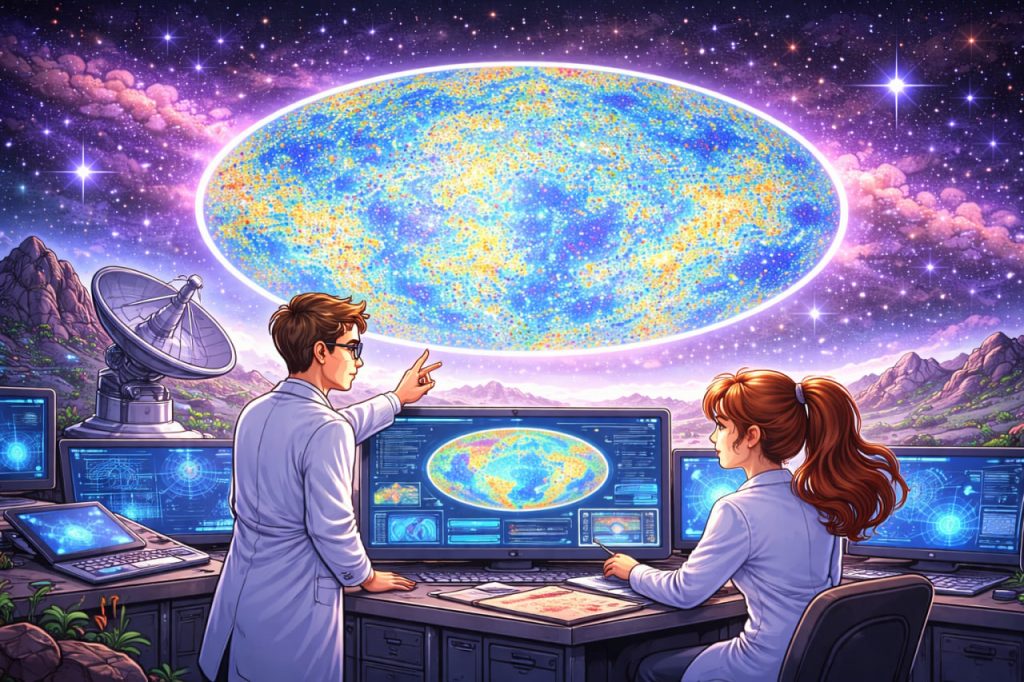
The cosmic microwave background (CMB) is one of the most important discoveries in modern cosmology, often described as the afterglow of the Big Bang. It is a faint radiation that fills the entire universe, detectable in every direction and providing a snapshot of the cosmos when it was only about 380,000 years old. At that early stage, the universe had cooled enough for electrons and protons to combine into neutral atoms, allowing light to travel freely for the first time. This moment, known as recombination, effectively released the radiation we now observe as the CMB. Studying this ancient signal allows scientists to understand the origin, structure, and evolution of the universe. It is not just a background noise—it is a detailed map of the early cosmos encoded in radiation.
How the Cosmic Microwave Background Formed
In the earliest moments after the Big Bang, the universe was an extremely hot and dense plasma where light could not travel freely. Photons constantly scattered off charged particles, making the universe opaque. As the universe expanded and cooled, it reached a point where atoms could form, and photons were no longer trapped. These photons began traveling through space, eventually stretching into the microwave range due to the expansion of the universe. Today, we detect this radiation as a nearly uniform glow across the sky. According to cosmologist Dr. Alan Reeves:
“The cosmic microwave background is the oldest light we can observe —
a fossil record of the universe’s earliest visible moment.”
This makes the CMB a crucial tool for understanding the universe’s infancy.
What the CMB Reveals About the Universe
Although the CMB appears uniform, it contains tiny variations in temperature known as anisotropies. These small fluctuations represent differences in density in the early universe, which later grew into galaxies and large-scale cosmic structures. By studying these patterns, scientists can determine key properties of the universe, including its age, composition, and geometry. The CMB also provides evidence for the presence of dark matter and dark energy, which together make up most of the universe.
Mapping the Early Universe
Advanced space missions have created detailed maps of the cosmic microwave background, revealing its structure with incredible precision. Satellites measure temperature differences of just a few millionths of a degree, allowing scientists to reconstruct the conditions of the early universe. These maps act like a blueprint, showing how matter was distributed before galaxies formed. The patterns observed in the CMB continue to guide cosmological theories and refine our understanding of how the universe evolved.
Why the CMB Is Still Important Today
Even though the CMB originates from the distant past, it remains essential for modern science. It serves as a baseline for testing cosmological models and understanding how the universe has expanded over time. Observations of the CMB support the Big Bang theory and provide insights into processes such as cosmic inflation. Without the CMB, our understanding of the universe’s origins would be far less precise.
The Expanding Universe and Redshift
As the universe expands, the wavelength of the CMB radiation stretches, shifting it from visible light into the microwave region. This phenomenon, known as redshift, is a key piece of evidence for the expansion of the universe. It shows how light changes over time as space itself grows. The continued observation of this radiation helps scientists track the history of cosmic expansion and refine models of the universe’s future.
Interesting Facts
- The CMB was discovered accidentally in 1965 by radio astronomers.
- Its temperature is extremely low—about 2.7 Kelvin above absolute zero.
- Tiny fluctuations in the CMB are only one part in 100,000.
- The CMB provides a snapshot of the universe when it was less than 1% of its current age.
- It is considered one of the strongest pieces of evidence for the Big Bang theory.
Glossary
- Cosmic Microwave Background (CMB) — radiation left over from the early universe after the Big Bang.
- Recombination — the period when electrons and protons formed neutral atoms, allowing light to travel freely.
- Anisotropies — tiny variations in temperature within the CMB.
- Redshift — the stretching of light waves as the universe expands.
- Dark Matter — invisible matter that influences the structure of the universe through gravity.