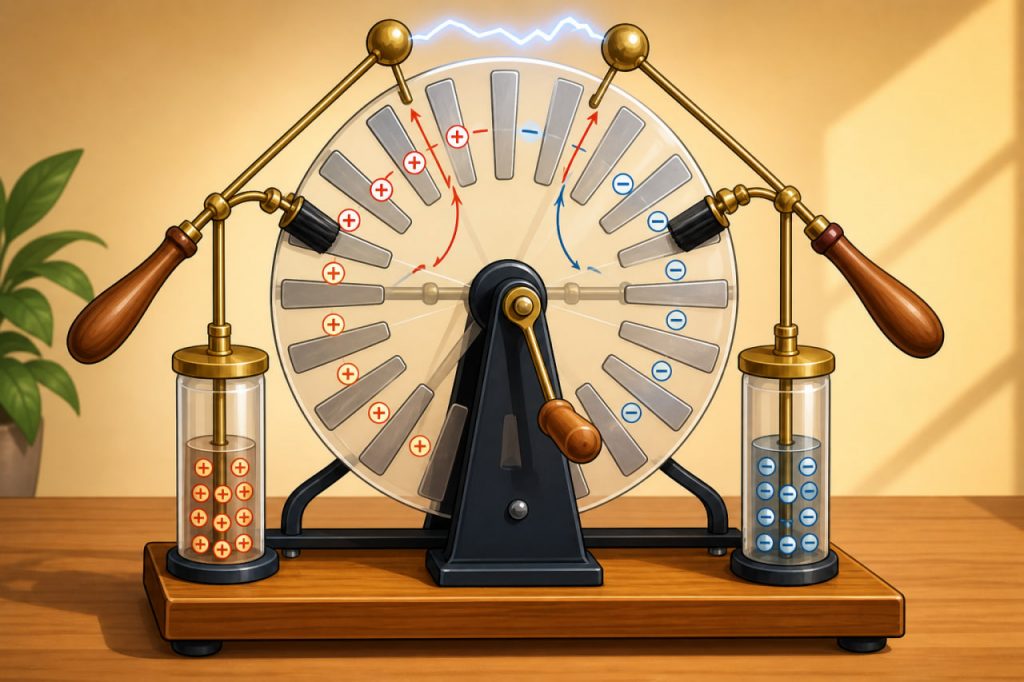
Electrostatic machines are devices that generate electricity through the buildup and separation of electric charges. Unlike modern electrical generators that rely on magnetic fields and continuous current, these machines produce high voltage static electricity with very low current. They played a key role in early scientific discoveries and remain important for education and demonstrations today.
What Is an Electrostatic Machine?
An electrostatic machine is a device designed to create and accumulate electric charge on surfaces. Instead of generating a steady flow of electricity, it builds up static charge until it discharges as a spark.
This means:
- Very high voltage can be produced
- Current remains low
- Visible electrical effects like sparks and arcs are common
These machines help visualize how electricity behaves.
Basic Principle of Operation
The core idea behind electrostatic machines is charge separation.
This can happen through:
- Friction (rubbing materials together)
- Induction (using electric fields to move charges without contact)
As charge builds up on conductors, an electric field forms. When the field becomes strong enough, the charge jumps through the air as a spark.
The Wimshurst Machine
One of the most well-known electrostatic machines is the Wimshurst machine.
It works using:
- Two rotating disks
- Metal sectors attached to the disks
- Brushes and collectors that gather charge
As the disks spin in opposite directions:
- Charges are separated and amplified
- Voltage increases rapidly
- Sparks can jump between electrodes
This design is simple but very effective.
The Van de Graaff Generator
Another famous example is the Van de Graaff generator, which uses a moving belt to transport charge.
How it works:
- A belt carries charge upward
- Charge accumulates on a metal dome
- Voltage increases as more charge builds up
This machine can produce large sparks and is often used in science demonstrations.
Why High Voltage but Low Current?
Electrostatic machines produce very high voltage, but the amount of charge involved is small.
As a result:
- The energy is limited
- Discharges are brief
- Effects are visible but usually not dangerous under controlled conditions
This makes them ideal for educational use.
Applications of Electrostatic Machines
Although they are often used for demonstrations, electrostatic machines have practical uses.
Scientific Research
They were used in early experiments on electricity and atomic physics.
Education
They help demonstrate:
- Electric fields
- Charge interaction
- Static electricity
Technology Development
They contributed to the development of high-voltage systems and particle accelerators.
Everyday Connection
Electrostatic machines amplify effects we experience daily.
Examples:
- Static shock when touching metal
- Clothes sticking together
- Hair standing up when rubbed
These everyday phenomena follow the same principles.
Limitations of Electrostatic Machines
Despite their usefulness, they have limitations:
- Cannot produce continuous power
- Sensitive to humidity (moist air reduces charge buildup)
- Limited practical energy output
Because of this, they are not used for large-scale electricity generation.
Why They Are Important
Electrostatic machines were among the first tools used to study electricity. They helped scientists understand how charges behave and laid the foundation for modern electrical science.
Today, they remain valuable for learning and demonstration, showing complex physical principles in a clear and visual way.
Interesting Facts
- Electrostatic machines can generate sparks several centimeters long.
- They were used before modern electrical generators were invented.
- Humidity greatly reduces their effectiveness.
- They helped scientists discover the nature of electric charge.
- Some designs are still used in classrooms today.
Glossary
- Electrostatic — Related to stationary electric charges.
- Voltage — The electrical potential difference.
- Current — The flow of electric charge.
- Induction — Charge movement caused by electric fields.
- Electric Field — A region where electric forces act.