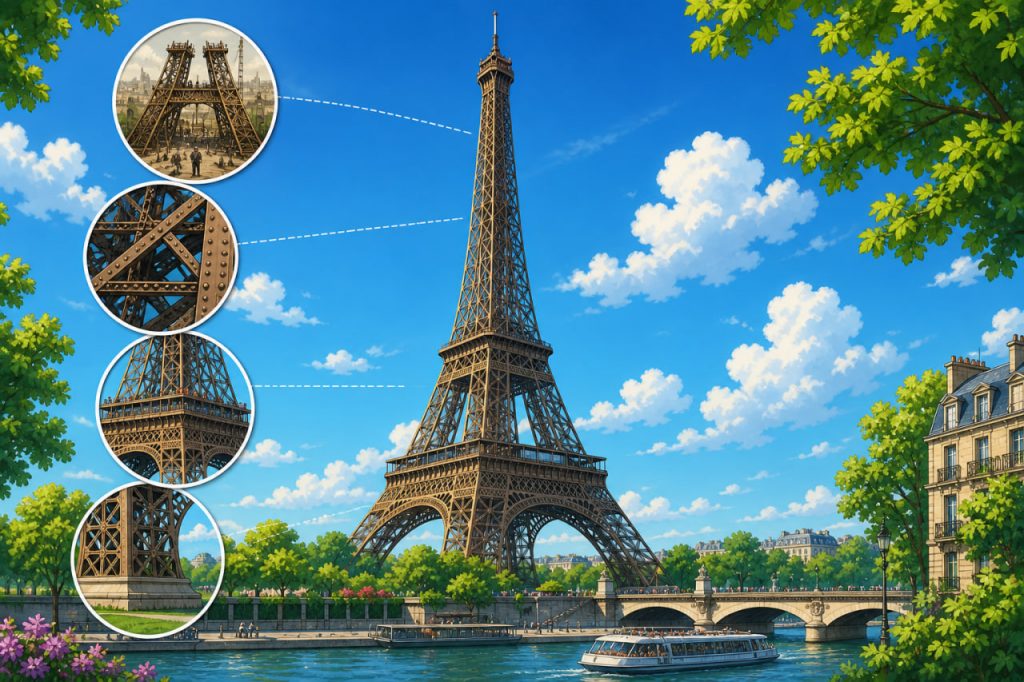
The Eiffel Tower is one of the most recognizable landmarks in the world and a symbol of both Paris and modern engineering. Built in the late 19th century, it demonstrated that iron structures could reach unprecedented heights. Today, it remains a masterpiece of design, attracting millions of visitors every year. Understanding how the Eiffel Tower was built reveals the innovation, precision, and bold vision that defined a new era of architecture.
The History Behind the Eiffel Tower
The Eiffel Tower was constructed for the 1889 World’s Fair (Exposition Universelle) in Paris, which celebrated the 100th anniversary of the French Revolution.
The tower was designed by engineer Gustave Eiffel and his team. At the time, many people criticized the project, calling it unnecessary or unattractive. However, after its completion, it quickly became one of the most admired structures in the world.
Structure and Design
The Eiffel Tower is made entirely of iron and stands approximately 330 meters tall, including its antennas.
Key structural features include:
- Four large curved legs forming a stable base
- A lattice framework made of interconnected iron beams
- Platforms at different levels for visitors
The open lattice design reduces wind resistance and allows the structure to remain stable despite its height.
Materials and Construction
The tower was built using wrought iron, a strong and flexible material ideal for large structures.
Construction involved:
- Over 18,000 individual metal parts
- More than 2.5 million rivets
- Precise prefabrication of components
Workers assembled the tower piece by piece, ensuring exact alignment at every stage.
Engineering Challenges
Building such a tall structure in the 1880s presented major challenges.
Engineers had to consider:
- Wind pressure at great heights
- Weight distribution across the structure
- Thermal expansion (iron expands with temperature changes)
The curved shape of the tower was carefully calculated to resist wind forces.
Structural engineer Stephen Sauvestre, who contributed to the design, helped refine the tower’s form to ensure both stability and aesthetic appeal.
Assembly Process
Construction of the Eiffel Tower took just over two years, which was remarkably fast for a project of this scale.
The process included:
- Laying strong foundations
- Assembling the four legs
- Connecting them at the first platform
- Gradually building upward
The use of prefabricated parts allowed for efficient assembly and high precision.
Why the Tower Is So Stable
The Eiffel Tower remains stable due to its design.
Key factors include:
- Wide base for support
- Lightweight lattice structure
- Curved form that distributes stress
The tower can sway slightly in strong winds, but this flexibility helps prevent damage.
Function Beyond Tourism
Although it is famous as a tourist attraction, the Eiffel Tower has served important practical purposes.
These include:
- Radio transmission
- Scientific experiments
- Weather observations
Its height made it ideal for communication technology in the early 20th century.
Cultural and Global Impact
The Eiffel Tower quickly became a symbol of innovation and modernity.
It represents:
- Engineering excellence
- Artistic design
- National pride
Today, it is one of the most visited monuments in the world and a global icon.
Why It Still Matters
The Eiffel Tower is more than just a landmark. It is a demonstration of what is possible when engineering and creativity come together.
It showed the world that:
- New materials could transform architecture
- Height limits could be pushed further
- Design could combine beauty and function
Interesting Facts
- The Eiffel Tower was originally intended to be temporary.
- It was the tallest structure in the world until 1930.
- The tower expands slightly in hot weather.
- It is repainted regularly to prevent rust.
- Millions of people visit it every year.
Glossary
- Lattice Structure — A framework made of interconnected elements.
- Wrought Iron — A form of iron that is tough and malleable.
- Rivet — A metal pin used to fasten parts together.
- Thermal Expansion — Expansion of materials when heated.
- Foundation — The base that supports a structure.