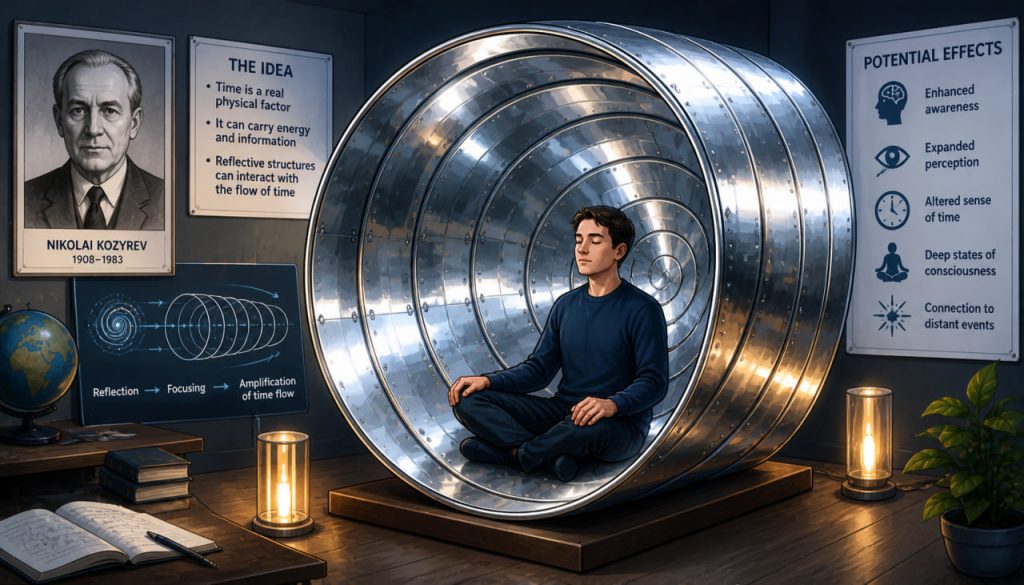
Kozyrev mirrors are one of the most mysterious and unconventional concepts associated with experimental physics and consciousness research. They are named after the Russian astrophysicist Nikolai Kozyrev, who proposed that time is not just a passive dimension but an active force that can influence physical processes.
Supporters of this idea believe that specially designed reflective structures—called Kozyrev mirrors—can interact with this “flow of time” and potentially enhance human perception.
Who Was Nikolai Kozyrev?
Nikolai Kozyrev was a Soviet scientist known for his work in astrophysics. He studied stars, energy processes, and the nature of time.
Kozyrev proposed that:
- Time is a real physical factor, not just a measurement
- It can carry energy and influence matter
- It may be detectable under certain conditions
This idea differs significantly from conventional physics, but it inspired further exploration.
What Are Kozyrev Mirrors?
Kozyrev mirrors are typically described as curved metallic or reflective structures, often made from aluminum sheets arranged in a spiral or cylindrical shape.
Their purpose is believed to be:
- Focusing or reflecting “time flow”
- Creating a special environment for perception
- Enhancing sensitivity to subtle phenomena
People who experiment with these mirrors often sit inside them, surrounded by reflective surfaces.
The Concept Behind the Mirrors
The core idea is that reflective surfaces can concentrate not only light but also more subtle forms of energy or information.
According to this perspective:
- The spiral shape may amplify certain effects
- Reflection may “focus” temporal or informational fields
- The human mind may become more sensitive inside such structures
This connects to broader theories about consciousness and its relationship with the universe.
Reported Experiences
Some individuals who have used Kozyrev mirrors report unusual experiences.
These may include:
- Altered perception of time
- Enhanced intuition or awareness
- Vivid mental imagery
- A sense of connection to distant places or events
These reports are subjective and vary widely, but they are central to the interest in Kozyrev mirrors.
Experiments and Research
In the late 20th century, researchers in Russia conducted experiments using Kozyrev mirrors.
They explored ideas such as:
- Non-local perception (receiving information beyond normal senses)
- Effects on human consciousness
- Interaction between mind and environment
Some experiments involved participants attempting to perceive distant locations or information while inside the mirror structures.
Connection to Consciousness
Kozyrev mirrors are often discussed in the context of consciousness research.
The idea suggests that:
- The human mind may interact with deeper layers of reality
- Certain environments may enhance this interaction
- Reflection and geometry may play a role in perception
This places Kozyrev mirrors at the intersection of physics, psychology, and philosophy.
Why the Idea Is So Fascinating
Kozyrev mirrors attract attention because they challenge conventional thinking about reality.
They raise questions such as:
- Is time more than a dimension?
- Can consciousness interact with physical processes in unexpected ways?
- Are there unknown aspects of perception still unexplored?
These questions continue to inspire curiosity and discussion.
Modern Interest
Today, Kozyrev mirrors remain a niche but intriguing topic.
They are explored by:
- Independent researchers
- Enthusiasts of alternative science
- People interested in consciousness and perception
While not widely accepted in mainstream science, they continue to be studied and discussed.
Interesting Facts
- Kozyrev believed stars generate energy through time-related processes.
- Mirror structures are often spiral-shaped rather than flat.
- Some experiments attempted long-distance information perception.
- The concept blends physics with philosophical ideas about time.
- Interest in Kozyrev mirrors has grown in recent years online.
Glossary
- Kozyrev Mirrors — Reflective structures believed to influence perception and time-related effects.
- Consciousness — Awareness and perception of reality.
- Non-local Perception — The idea of receiving information beyond normal sensory limits.
- Temporal Flow — The concept of time as an active process.
- Astrophysics — The study of physical processes in space.