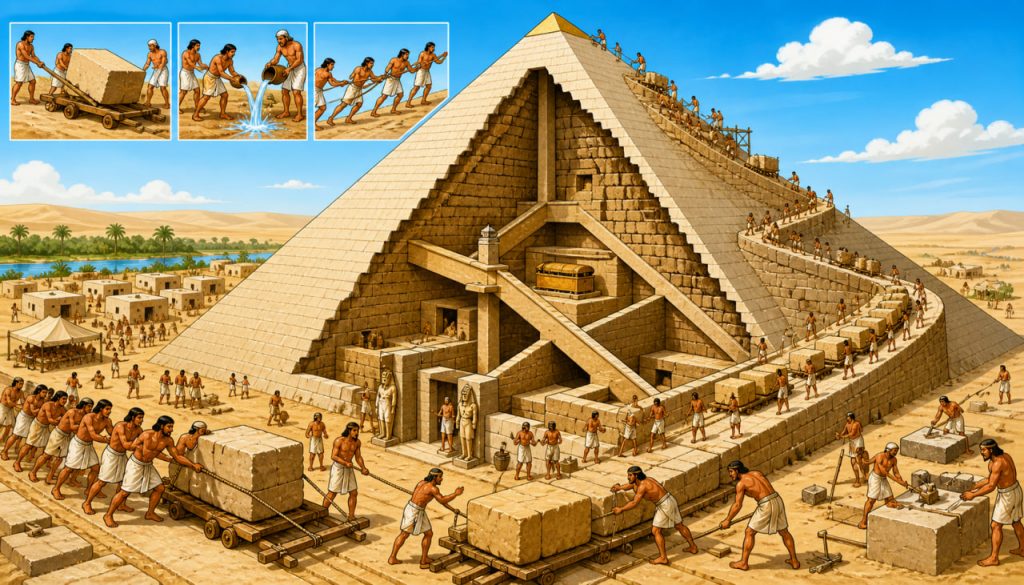
Pyramids are among the most impressive architectural achievements in human history. Found in regions such as Egypt and Mesoamerica, they continue to inspire curiosity and admiration. The most famous examples, like the pyramids of Giza, demonstrate an extraordinary level of planning, organization, and engineering skill. Understanding how pyramids are built helps us appreciate the ingenuity of ancient civilizations and their ability to solve complex construction challenges without modern technology.
The Basic Structure of a Pyramid
A pyramid is a structure with a broad base and sloping sides that meet at a point or a flat top. The most well-known pyramids, especially in Egypt, were built as tombs for pharaohs.
The structure typically includes:
- A square or rectangular base
- Four triangular sides
- An internal system of chambers and passages
These elements were carefully planned to ensure stability and longevity.
Materials Used in Construction
Ancient builders used materials that were locally available and durable.
In Egypt, pyramids were mainly built from:
- Limestone, used for the core blocks
- Granite, used for internal chambers and structural elements
- Polished outer casing stones for a smooth finish
These materials were chosen for their strength and ability to withstand time.
How Massive Stones Were Moved
One of the biggest mysteries is how ancient workers transported massive stone blocks, some weighing several tons.
Modern research suggests that:
- Stones were transported using sledges
- Workers poured water on sand to reduce friction
- Large teams coordinated movement using ropes and manpower
Archaeological evidence supports these methods, showing that simple physics and teamwork made large-scale transport possible.
Building Techniques and Ramps
To lift stones to higher levels, builders likely used ramp systems.
Proposed ramp types include:
- Straight ramps leading up one side
- Zigzag ramps along the pyramid edges
- Spiral ramps wrapping around the structure
These ramps allowed workers to gradually raise materials as the pyramid grew taller.
Precision and Alignment
One of the most remarkable aspects of pyramids is their precision.
The Great Pyramid of Giza, for example:
- Is aligned almost perfectly with the cardinal directions
- Has a base that is nearly perfectly level
- Shows minimal deviation in construction
Experts believe ancient builders used:
- Simple tools like plumb lines and measuring rods
- Observations of the sun and stars
Egyptologist Mark Lehner has stated:
“The pyramids are not just monuments—they are the result of careful planning, skilled labor, and a deep understanding of engineering.”
Internal Chambers and Design
Inside many pyramids are complex systems of corridors and chambers.
These may include:
- Burial chambers
- Ventilation shafts
- Passageways for rituals or symbolic purposes
The design was not random. It reflected religious beliefs about the afterlife and the journey of the soul.
Workforce and Organization
Contrary to popular myths, pyramids were not built by slaves but by skilled workers.
Evidence shows:
- Workers were organized into teams
- They were provided food, shelter, and medical care
- Construction required planning, logistics, and leadership
This demonstrates that pyramid building was a massive coordinated effort, similar to modern large-scale projects.
Why Pyramids Have Lasted So Long
Pyramids have survived for thousands of years due to their design.
Key reasons include:
- Wide base for stability
- Gradual slope reducing structural stress
- Durable materials resistant to erosion
Their shape naturally distributes weight, making them incredibly stable structures.
Different Types of Pyramids
Not all pyramids are the same.
- Egyptian pyramids are smooth-sided and pointed
- Step pyramids have layered levels
- Mesoamerican pyramids often have flat tops and temples
Each type reflects the culture and purpose behind its construction.
Why Pyramids Still Fascinate Us
Pyramids represent a combination of science, culture, and human ambition. They show that ancient societies were capable of solving complex problems and creating structures that last for millennia.
They continue to inspire research, debate, and admiration, reminding us of the enduring power of human creativity.
P.S. If you want to learn more about pyramids, please write in the comments
Interesting Facts
- The Great Pyramid of Giza was the tallest man-made structure for over 3,800 years.
- Some pyramid stones weigh more than 50 tons.
- Workers lived in organized communities near construction sites.
- The outer casing of pyramids was once smooth and reflective.
- Pyramid construction required decades of work.
Glossary
- Limestone — A sedimentary rock commonly used in construction.
- Granite — A very hard rock used for structural strength.
- Ramp — A sloped structure used to move heavy objects upward.
- Cardinal Directions — North, south, east, and west.
- Chamber — An internal room within a structure.