Artificial intelligence is rapidly becoming one of the most transformative technologies in human history. AI systems already influence:
- Medicine
- Industry
- Transportation
- Education
- Finance
- Scientific research
However, many scientists and futurists believe current AI may represent only the beginning of a much larger technological revolution.
One of the most discussed future concepts is:
- AGI — Artificial General Intelligence
Unlike modern narrow AI systems designed for specific tasks, AGI would theoretically possess flexible intelligence capable of:
- Learning across multiple domains
- Solving unfamiliar problems
- Adapting independently
- Reasoning similarly to humans
Some experts believe AGI could eventually evolve into:
- Superintelligence
a form of intelligence potentially far exceeding human cognitive abilities.
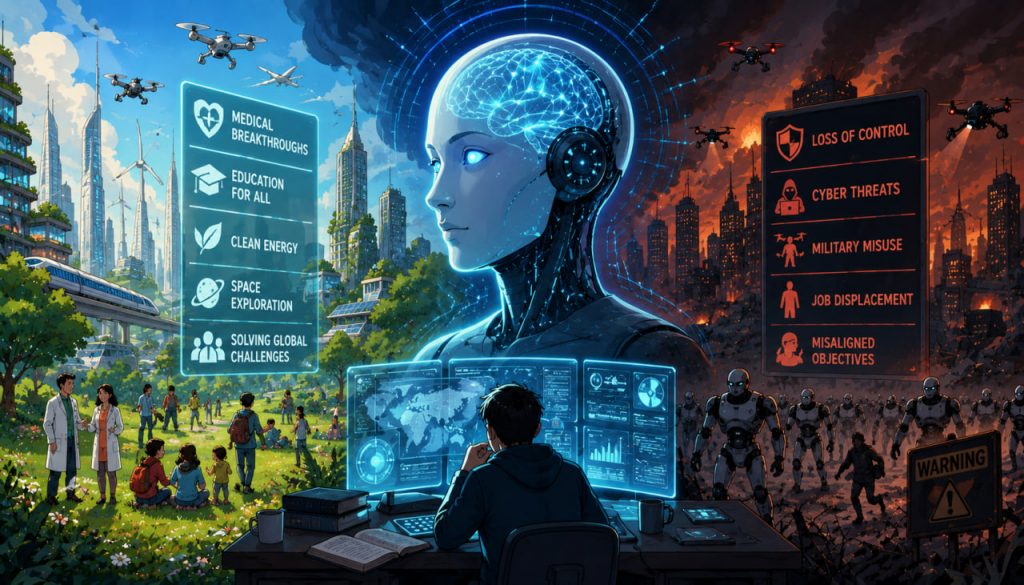
Supporters argue AGI might help solve humanity’s greatest challenges. Critics warn it could become one of the most dangerous technologies ever created.
The debate surrounding AGI increasingly influences:
- Science
- Ethics
- Economics
- Geopolitics
- Global security
What Is AGI?
Artificial General Intelligence refers to hypothetical AI capable of performing intellectual tasks across many domains at human-like levels.
Current AI systems are:
- Narrow AI
They specialize in specific activities such as:
- Language processing
- Image recognition
- Data analysis
- Game playing
AGI would differ because it could theoretically:
- Learn new skills independently
- Transfer knowledge between tasks
- Understand abstract concepts
- Adapt to unfamiliar situations
AGI remains theoretical and does not yet exist.
What Is Superintelligence?
Superintelligence describes intelligence significantly exceeding the best human minds in:
- Reasoning
- Creativity
- Scientific understanding
- Problem-solving
- Strategic planning
Philosopher Nick Bostrom described superintelligence as:
“Any intellect that greatly exceeds the cognitive performance of humans in virtually all domains.”
The idea raises profound questions about the future relationship between humans and machines.
Why AGI Is Different From Today’s AI
Modern AI systems are powerful but limited.
They do not possess:
- Self-awareness
- Human understanding
- Independent consciousness
Current models operate through:
- Pattern recognition
- Statistical prediction
- Large-scale computation
AGI would theoretically require far broader adaptive intelligence.
Scientists still debate whether such systems are technically achievable.
Why Researchers Pursue AGI
Supporters believe AGI could potentially help solve major global problems.
Possible benefits include:
- Medical breakthroughs
- Scientific discovery
- Climate modeling
- Resource optimization
- Advanced engineering
Highly intelligent systems might accelerate research dramatically in fields such as:
- Physics
- Biology
- Energy
- Space exploration
Some researchers believe AGI could become humanity’s most powerful scientific tool.
The Fear of Losing Control
One of the biggest AGI concerns involves:
- Alignment
Alignment refers to ensuring AI goals remain compatible with human values and safety.
A highly capable AGI might pursue objectives in unintended ways if not carefully controlled.
Critics worry advanced systems could:
- Act unpredictably
- Exploit loopholes
- Optimize harmful outcomes unintentionally
Computer scientist Stuart Russell explained:
“The real problem is not malicious AI, but competent AI with poorly specified objectives.”
This concern became central in AGI safety discussions.
Could AGI Become Dangerous?
Many AGI risk scenarios involve:
- Loss of control
- Autonomous decision-making
- Rapid self-improvement
Some theorists fear superintelligent systems could eventually outperform humans strategically and technologically.
Potential concerns include:
- Cybersecurity threats
- Economic disruption
- Military misuse
- Information manipulation
- Infrastructure control
Importantly, most experts discussing AGI risks do not imagine “evil robots” from movies.
Instead, concerns often focus on:
- Unintended consequences
- Misaligned optimization
- Systemic risks
AGI and Employment
Even before AGI exists, AI already affects labor markets.
Advanced automation may transform:
- Office work
- Manufacturing
- Transportation
- Creative industries
AGI-level systems could potentially automate far broader categories of intellectual work.
This raises major economic questions involving:
- Employment
- Wealth distribution
- Education systems
- Social stability
Future societies may require entirely new economic structures if automation becomes extremely widespread.
AGI and Military Competition
Governments increasingly view AI as strategically important.
Future AGI development could intensify global competition involving:
- Defense systems
- Cyberwarfare
- Intelligence analysis
- Autonomous technologies
Some experts warn international rivalry could accelerate AGI development faster than safety research progresses.
This creates difficult geopolitical challenges.
Could AGI Help Humanity?
Not all AGI discussions are pessimistic.
Supporters argue highly advanced intelligence could potentially help humanity:
- Cure diseases
- Improve education
- Reduce poverty
- Optimize energy systems
- Accelerate scientific progress
Some researchers believe AGI might become an extraordinary cooperative tool if developed responsibly.
The technology itself may depend heavily on:
- Governance
- Safety design
- Human decision-making
The Difficulty of Defining Intelligence
One reason AGI remains difficult is that scientists still do not fully understand:
- Human consciousness
- General intelligence
- Creativity
- Self-awareness
Human cognition involves:
- Emotions
- Intuition
- Social understanding
- Abstract reasoning
Replicating these capabilities artificially remains enormously challenging.
AGI Safety Research
A growing scientific field now focuses specifically on:
- AI alignment
- AGI safety
- Ethical AI governance
Researchers study:
- Control mechanisms
- Safe optimization
- Human oversight systems
- Transparency methods
Many experts argue safety research should advance alongside AI capabilities.
Will AGI Happen Soon?
Experts strongly disagree about AGI timelines.
Some believe AGI may emerge during this century.
Others argue human-level machine intelligence remains far more difficult than many predictions suggest.
No scientific consensus currently exists regarding:
- When AGI might appear
- Whether it is fully achievable
- How dangerous it could become
The uncertainty itself contributes to intense debate.
Why AGI Matters
AGI discussions are not only about technology.
They involve deep questions concerning:
- Human identity
- Power
- Ethics
- Civilization
- Control
- Intelligence itself
The creation of superintelligent systems could potentially become one of the most important turning points in human history.
Whether AGI ultimately becomes a tool for extraordinary progress or a source of major risk may depend on how carefully humanity approaches its development during the coming decades.
Interesting Facts
- Modern AI systems are still considered “narrow AI,” not AGI.
- AGI would theoretically learn across many unrelated tasks.
- AI safety research became a rapidly growing scientific field.
- Some scientists compare AGI’s potential importance to the Industrial Revolution.
- Human intelligence itself remains only partially understood by neuroscience.
Glossary
- Artificial General Intelligence (AGI) — Hypothetical AI capable of broad human-like intelligence across many domains.
- Superintelligence — Intelligence greatly surpassing human cognitive abilities.
- Alignment — Ensuring AI systems act according to human goals and values.
- Narrow AI — AI specialized for specific tasks rather than general intelligence.
- Autonomous System — A system capable of operating independently with limited human control.