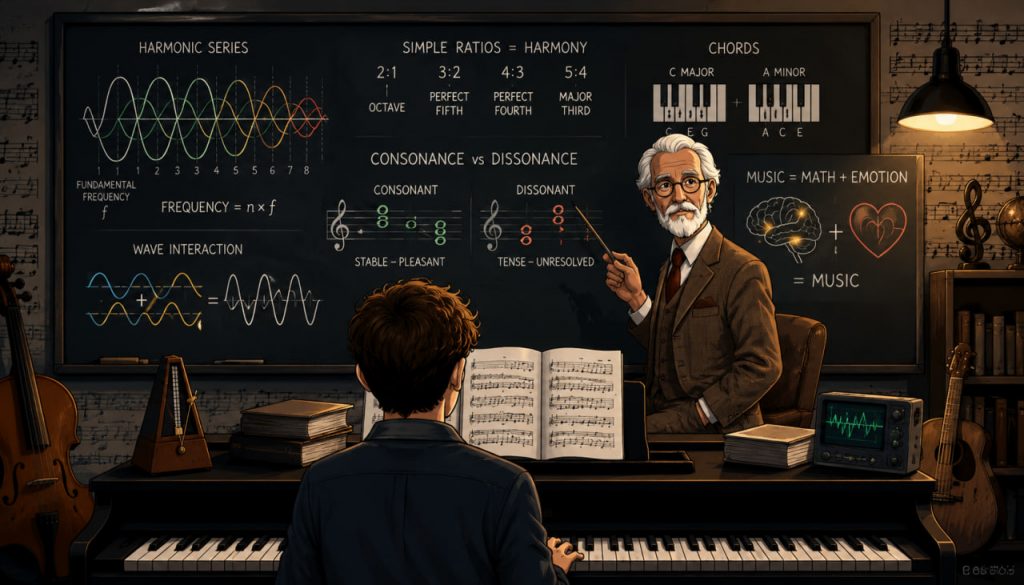
Music has fascinated humanity for thousands of years. Across cultures and civilizations, people discovered that certain combinations of sounds feel harmonious, emotional, and satisfying, while others create tension, discomfort, or instability.
But why does this happen?
The answer lies partly in:
- Mathematics
- Physics
- Human biology
- Brain perception
- Acoustic patterns
Music is deeply connected to numerical relationships between sound frequencies. Long before modern science existed, ancient thinkers noticed that musical harmony follows surprisingly precise mathematical structures.
Today, scientists and musicians continue studying why some chords sound:
- Pleasant
- Stable
- Emotional
- Beautiful
while others sound:
- Tense
- Dissonant
- Unresolved
- Chaotic
The mathematics of music reveals that human hearing is closely connected to physical patterns hidden inside sound itself.
What Is a Musical Chord?
A chord is a combination of multiple musical notes played together.
Each musical note corresponds to:
- A sound frequency
Frequency measures how quickly sound waves vibrate.
For example:
- Higher notes vibrate faster
- Lower notes vibrate slower
When several notes combine, their sound waves interact physically.
The relationships between these frequencies strongly affect how humans perceive harmony.
Ancient Discovery of Musical Ratios
The connection between mathematics and music was discovered thousands of years ago.
Ancient Greek philosopher Pythagoras studied vibrating strings and observed that pleasant musical intervals often followed simple numerical ratios.
Examples include:
- Octave → 2:1
- Perfect fifth → 3:2
- Perfect fourth → 4:3
These simple relationships produce stable sound interactions.
Pythagoras realized music was not random emotion alone — it also followed mathematical order.
This discovery became one of the foundations of music theory.
Why Simple Ratios Sound Pleasant
When sound frequencies relate through simple ratios, their wave patterns align more smoothly.
This creates:
- Less acoustic conflict
- More stable resonance
- Cleaner harmonic blending
The human brain often interprets these smoother interactions as:
- Pleasant
- Harmonious
- Balanced
For example:
- A perfect octave sounds highly stable because one frequency vibrates exactly twice as fast as another.
Simple mathematical relationships reduce interference between sound waves.
Consonance and Dissonance
Music theory often divides sound relationships into:
- Consonance
- Dissonance
Consonance
Consonant chords sound:
- Stable
- Pleasant
- Resolved
Examples include:
- Major chords
- Perfect fifths
- Octaves
Dissonance
Dissonant chords create:
- Tension
- Instability
- Emotional pressure
Examples include:
- Minor seconds
- Tritones
- Clashing intervals
Dissonance is not necessarily “bad.” In fact, tension often makes music emotionally powerful.
How the Human Brain Processes Harmony
Human hearing evolved to recognize patterns in sound.
The brain continuously analyzes:
- Frequency relationships
- Timing
- Rhythmic structures
- Harmonic interactions
Neuroscientists believe consonant sounds may require less processing effort because their wave structures align more predictably.
More dissonant combinations create complex wave interference that the brain interprets as:
- Tension
- Uncertainty
- Emotional intensity
Music perception therefore combines:
- Physics
- Neurology
- Psychology
Harmonics and Natural Resonance
Every musical note contains not only a main frequency, but also:
- Harmonics
- Overtones
These additional frequencies naturally appear during sound vibration.
Interestingly, many harmonics already follow simple mathematical relationships.
This may help explain why certain musical intervals feel naturally satisfying to human ears.
Composer Leonard Bernstein once said:
“Music is never quite the same as mathematics. But without mathematics, music would not exist.”
His observation reflects the deep connection between structure and emotion in music.
Why Major and Minor Chords Feel Different
Major and minor chords contain slightly different frequency relationships.
Major chords are often associated with:
- Brightness
- Stability
- Positivity
Minor chords frequently feel:
- Sad
- Reflective
- Emotional
Scientists continue studying why humans emotionally associate these patterns differently.
Some theories involve:
- Harmonic complexity
- Cultural learning
- Speech tone similarities
Music perception combines both biological and cultural influences.
Rhythm and Mathematical Patterns
Mathematics influences not only harmony, but also:
- Rhythm
- Tempo
- Musical structure
Rhythms often involve repeating numerical patterns and timing relationships.
Many musical traditions rely on:
- Symmetry
- Repetition
- Proportional timing
Complex rhythms may create excitement, while regular rhythms feel predictable and stable.
Why Different Cultures Hear Music Differently
Although mathematics shapes sound universally, musical preferences also depend partly on:
- Culture
- Experience
- Tradition
Some intervals considered dissonant in one musical system may sound normal in another.
Human brains adapt to familiar musical environments over time.
This means music perception involves both:
- Physical acoustics
- Learned interpretation
Tension and Emotional Storytelling in Music
Music uses both consonance and dissonance to create emotional movement.
Without tension, music may sound:
- Predictable
- Flat
- Emotionally limited
Composers intentionally use dissonance to create:
- Suspense
- Drama
- Anticipation
Resolution back into consonance often produces emotional satisfaction.
This tension-and-release structure appears across many musical traditions worldwide.
Mathematics in Modern Music Technology
Modern digital music production depends heavily on mathematics.
Audio engineering uses:
- Wave analysis
- Frequency processing
- Signal mathematics
- Digital algorithms
Streaming platforms, synthesizers, and music software all rely on advanced mathematical computation.
Mathematics became essential not only for music theory, but also for modern music technology itself.
Why Humans Love Music
Scientists still debate exactly why music affects humans so deeply.
Music may influence:
- Emotion
- Memory
- Social bonding
- Brain chemistry
The mathematical structure of sound appears closely connected to how the brain processes patterns and emotions.
Music combines:
- Physics
- Mathematics
- Biology
- Culture
- Human emotion
in one of the most unique experiences in human civilization.
Why the Mathematics of Music Matters
The mathematics of music reveals that beauty often emerges from hidden structure.
What humans experience emotionally as harmony or tension frequently reflects precise physical relationships between sound waves.
At the same time, music also demonstrates that mathematics alone does not fully explain human emotion and artistic experience.
Music exists at the intersection of:
- Science
- Emotion
- Creativity
- Perception
This is why music continues fascinating both scientists and artists alike.
Interesting Facts
- Ancient Greek philosophers studied mathematical relationships in music thousands of years ago.
- Octaves follow a simple 2:1 frequency ratio.
- Every musical note naturally contains harmonics and overtones.
- Dissonance often creates emotional tension in music.
- Modern digital audio systems rely heavily on mathematical processing.
Glossary
- Frequency — The number of sound wave vibrations per second.
- Chord — Multiple musical notes played together.
- Consonance — Harmonious and stable sound relationships.
- Dissonance — Tense or unstable sound relationships.
- Harmonics — Additional frequencies naturally produced alongside musical notes.