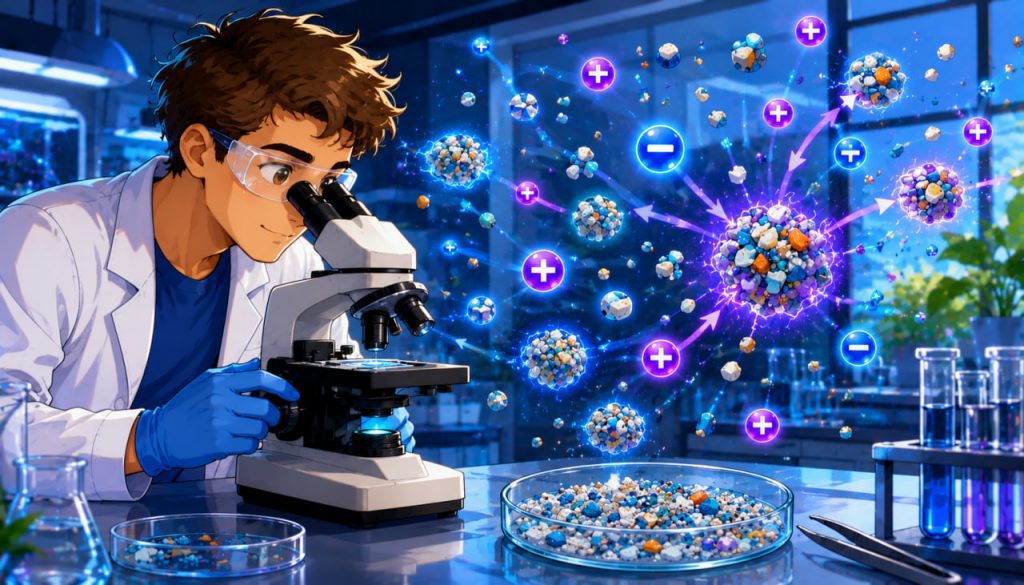
Microplastics and nanoplastics have become some of the most intensively studied environmental pollutants of the 21st century. These tiny plastic particles are found in oceans, rivers, soil, food, drinking water, and even the air we breathe. While much attention has focused on their chemical composition and biological effects, scientists are increasingly interested in another important property: electrostatic charge.
Many airborne plastic particles naturally acquire electrical charges through friction, sunlight exposure, atmospheric interactions, and industrial processes. Air ionization can significantly alter these charges, influencing how microplastics and nanoplastics move, aggregate, settle, and interact with living organisms.
Understanding this relationship is important for environmental science, pollution control, indoor air quality, and future technologies designed to remove plastic particles from the atmosphere.
What Are Microplastics and Nanoplastics?
Microplastics are plastic particles smaller than 5 millimeters.
Nanoplastics are even smaller, typically measured in nanometers.
Common sources include:
- Synthetic textiles
- Tire wear
- Packaging materials
- Plastic waste degradation
- Industrial processes
Because of their small size, these particles can remain suspended in the air for extended periods.
Many are light enough to travel considerable distances through the atmosphere.
Why Plastic Particles Become Electrically Charged
Plastic materials are excellent electrical insulators.
When plastic surfaces rub against other materials, they often accumulate static charge through a process called triboelectric charging.
Examples include:
- Clothing fibers rubbing together
- Airflow through ventilation systems
- Mechanical processing of plastics
- Particle collisions
As a result, many airborne plastic particles carry either positive or negative electrical charges.
What Is Air Ionization?
Air ionization occurs when neutral molecules gain or lose electrons.
This creates:
- Positive ions
- Negative ions
Natural ionization sources include:
- Lightning
- Cosmic radiation
- Waterfalls
- Ocean waves
- Solar radiation
Artificial ionization can be produced by:
- Air ionizers
- Electrostatic filters
- Industrial ionization systems
These ions interact continuously with airborne particles.
How Ions Attach to Plastic Particles
Once ions are present in the air, they collide with airborne particles.
Microplastics and nanoplastics have large surface areas relative to their mass, making them highly effective at collecting ions.
When ions attach to a particle:
- Surface charge changes
- Electrostatic properties change
- Particle behavior changes
This process is especially important for nanoplastics because their tiny size makes electrostatic forces relatively strong compared to gravitational forces.
Neutralization of Static Charges
One of the primary effects of ionization is charge neutralization.
If a positively charged plastic particle encounters sufficient negative ions, its charge may decrease.
Similarly:
- Positive ions can neutralize negatively charged particles.
- Opposite charges can balance each other.
This principle is widely used in electronics manufacturing, where ionization systems eliminate static electricity.
The same mechanism can influence airborne plastic particles.
Changes in Particle Aggregation
Electrostatic charge strongly affects how particles interact.
Particles carrying similar charges tend to repel one another.
Particles with opposite charges tend to attract.
Ionization can therefore influence:
- Clustering
- Aggregation
- Particle growth
When microplastics aggregate into larger clusters, they often become heavier and settle more rapidly from the air.
This may reduce airborne concentrations under certain conditions.
Airborne Transport and Settling
The electrostatic state of a particle affects its movement.
Charged particles may:
- Adhere to surfaces
- Stick to filters
- Attach to walls
- Deposit onto clothing
Ionization can increase the likelihood that particles leave the air and settle onto surrounding surfaces.
This phenomenon is one reason ionization technologies are sometimes used in air-cleaning systems.
Effects on Indoor Air Quality
Researchers are investigating whether ionization can help reduce airborne microplastic exposure indoors.
Potential mechanisms include:
- Enhanced particle deposition
- Increased filtration efficiency
- Aggregation of ultrafine particles
Laboratory studies suggest that electrostatic forces can significantly influence particle behavior.
However, real-world environments are complex, and results vary depending on:
- Airflow
- Humidity
- Particle size
- Surface materials
Nanoplastics and Electrostatic Forces
For nanoplastics, electrostatic effects become especially important.
At extremely small scales:
- Gravitational forces become less dominant.
- Surface interactions become more important.
- Electrostatic attraction and repulsion strongly influence movement.
Nanoplastics may therefore respond more dramatically to ionization than larger particles.
Scientists continue studying these interactions to better understand environmental transport and biological exposure pathways.
Potential Biological Implications
Electrostatic charge may influence how particles interact with living systems.
Researchers are examining whether charge affects:
- Deposition in the respiratory tract
- Interaction with cell membranes
- Transport through biological fluids
- Environmental persistence
Although many questions remain unanswered, charge is increasingly recognized as an important factor in microplastic behavior.
Expert Perspective
Environmental chemist Richard C. Thompson, one of the pioneers of microplastic research, has emphasized that understanding the physical properties of plastic particles—including size, shape, and surface characteristics—is essential for evaluating their environmental impact. Modern studies increasingly extend this concept to electrostatic behavior, which can significantly influence how particles move through air and ecosystems.
Can Ionization Help Remove Airborne Microplastics?
Researchers are exploring whether controlled ionization could become a useful pollution-control technology.
Potential applications include:
- Indoor air purification
- Industrial filtration
- Clean-room environments
- Environmental monitoring
While promising, these approaches are still being actively investigated.
Ionization is unlikely to solve the microplastic problem alone, but it may become one component of broader air-quality management strategies.
The Future of Research
The intersection of air ionization and microplastic science is a rapidly developing field.
Scientists are currently studying:
- Nanoplastic transport mechanisms
- Charge distribution on particles
- Indoor exposure pathways
- Atmospheric behavior
- Advanced filtration technologies
As analytical techniques improve, researchers are gaining a more detailed understanding of how electrical forces influence microscopic plastic pollution.
Conclusion
Air ionization can significantly influence the electrostatic charge of microplastics and nanoplastics. By altering particle charge, ionization affects aggregation, airborne transport, surface deposition, and filtration efficiency. These effects are particularly important for nanoplastics, where electrostatic forces can dominate particle behavior.
Although many questions remain under investigation, current research suggests that ionization may play an important role in understanding and potentially controlling airborne plastic pollution. As concerns about microplastics continue to grow, the interaction between atmospheric ions and plastic particles is likely to become an increasingly important area of environmental science.
Interesting Facts
- Plastic particles often become electrically charged through simple friction.
- Nanoplastics can be thousands of times smaller than the width of a human hair.
- Electrostatic forces become increasingly important as particle size decreases.
- Lightning naturally generates enormous quantities of atmospheric ions.
- Air ionization is already used in semiconductor manufacturing to control static electricity.
- Scientists have detected airborne microplastics in remote mountain regions far from major cities.
Glossary
- Microplastic — A plastic particle smaller than 5 millimeters.
- Nanoplastic — An extremely small plastic particle measured in nanometers.
- Ionization — The creation of electrically charged particles in air.
- Electrostatic Charge — Electrical charge accumulated on an object or particle.
- Triboelectric Charging — Charge generation caused by friction between materials.
- Aggregation — The clustering together of multiple particles.
- Particle Deposition — The settling of airborne particles onto surfaces.
- Atmospheric Ion — A charged molecule or atom present in the atmosphere.