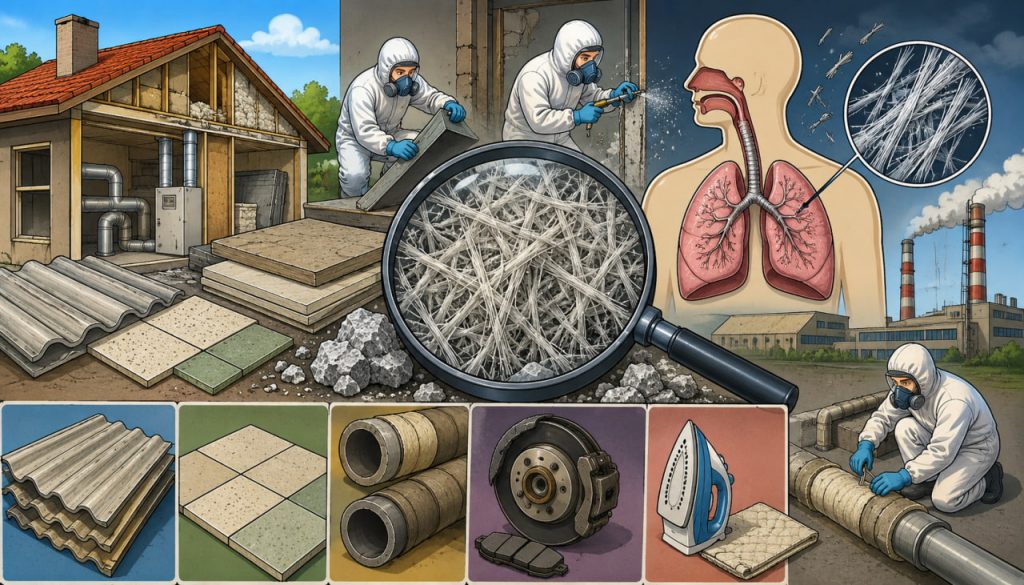
For much of the 20th century, asbestos was celebrated as a wonder material. Its remarkable resistance to heat, fire, and chemicals made it a key ingredient in construction, manufacturing, and insulation. However, decades of scientific research eventually revealed a darker reality: asbestos exposure can cause severe and often fatal diseases. Today, it is considered one of the most dangerous industrial materials ever widely used.
What Is Asbestos?
Asbestos is a group of naturally occurring silicate minerals composed of microscopic fibers. These fibers are extremely durable, resistant to heat, and do not conduct electricity easily.
The term asbestos refers to six different minerals, which are generally divided into two categories:
- Serpentine asbestos
- Chrysotile (white asbestos)
- Amphibole asbestos
- Crocidolite (blue asbestos)
- Amosite (brown asbestos)
- Tremolite
- Actinolite
- Anthophyllite
Among these, chrysotile accounted for the vast majority of commercial asbestos use worldwide.
Why Was Asbestos So Popular?
The widespread use of asbestos was driven by its unique physical properties.
Exceptional Fire Resistance
Asbestos fibers can withstand extremely high temperatures without burning. This made them ideal for:
- Fireproof insulation
- Protective clothing
- Building materials
- Industrial equipment
High Durability
Unlike many natural materials, asbestos does not rot, corrode, or degrade easily.
Chemical Resistance
Many acids and industrial chemicals have little effect on asbestos fibers, making the material useful in harsh industrial environments.
Low Cost
Asbestos deposits are relatively abundant in several regions of the world, making mining and processing economically attractive.
Because of these advantages, asbestos was incorporated into thousands of products during the 20th century.
Common Uses of Asbestos
Before health risks became widely recognized, asbestos appeared in numerous industries.
Construction Materials
Many buildings constructed between the 1940s and 1980s contain asbestos in:
- Roofing materials
- Floor tiles
- Cement products
- Pipe insulation
- Wall panels
- Ceiling coatings
Shipbuilding
Ships often used asbestos extensively because of the need for fire protection in confined spaces.
Automotive Industry
Asbestos was commonly found in:
- Brake pads
- Clutches
- Gaskets
Household Products
Historically, asbestos even appeared in:
- Hair dryers
- Ironing board covers
- Oven mitts
- Some consumer appliances
Millions of people worked with or around these products before the risks were fully understood.
How Does Asbestos Become Dangerous?
The danger arises when asbestos-containing materials are damaged or disturbed.
Microscopic Fibers in the Air
When asbestos products break, wear out, or are cut and drilled, tiny fibers can become airborne.
These fibers are often too small to see with the naked eye.
Inhalation Risk
Once inhaled, asbestos fibers can become trapped deep within the lungs.
The human body has difficulty removing them, and they may remain in tissues for decades.
Long Latency Period
One of the most troubling characteristics of asbestos-related diseases is their delayed appearance.
Symptoms often develop:
- 20 years after exposure
- 30 years after exposure
- Sometimes even 50 years later
This long delay made it difficult for scientists and regulators to recognize the scale of the problem early on.
Diseases Linked to Asbestos Exposure
Research has firmly established a connection between asbestos exposure and several serious diseases.
Asbestosis
Asbestosis is a chronic lung disease caused by inhaling asbestos fibers.
The fibers trigger inflammation and scar tissue formation in the lungs.
Common symptoms include:
- Shortness of breath
- Persistent cough
- Chest tightness
- Reduced lung function
There is currently no cure for asbestosis.
Lung Cancer
People exposed to asbestos have a significantly increased risk of developing lung cancer.
The risk becomes dramatically higher when asbestos exposure is combined with smoking.
Mesothelioma
Mesothelioma is a rare and aggressive cancer affecting the lining of the lungs, abdomen, or heart.
It is considered one of the diseases most strongly associated with asbestos exposure.
Even relatively low exposure levels may increase risk.
Other Cancers
Studies have also linked asbestos exposure to cancers of:
- The larynx
- The ovaries
- The gastrointestinal tract
Expert Opinion
According to the World Health Organization (WHO), all forms of asbestos are carcinogenic to humans, and no safe level of exposure has been established. The organization has repeatedly emphasized that preventing exposure remains the most effective way to eliminate asbestos-related diseases.
This scientific consensus is shared by major public health agencies worldwide, including occupational safety and cancer research organizations.
The Global Response to Asbestos
As evidence accumulated, many countries began restricting asbestos use.
National Bans
More than 60 countries have implemented complete or near-complete bans on asbestos.
Many nations in Europe have prohibited its use in construction and manufacturing.
Ongoing Use
Despite growing restrictions, asbestos has not disappeared entirely.
Some countries continue to mine, export, or use asbestos-containing products, often citing economic considerations and existing industrial infrastructure.
Safe Removal Programs
Governments and property owners increasingly invest in:
- Building inspections
- Asbestos identification
- Professional removal services
- Worker protection programs
Strict procedures are necessary because improper removal can release dangerous fibers into the air.
Asbestos in Older Buildings
Many structures built before modern regulations may still contain asbestos.
However, asbestos is not always an immediate danger.
When It Is Relatively Stable
If asbestos-containing materials remain intact and undisturbed, fiber release may be minimal.
When It Becomes Risky
Risk increases during:
- Renovations
- Demolition
- Drilling
- Sanding
- Structural damage
For this reason, suspected asbestos materials should be evaluated by trained professionals rather than handled independently.
Modern Alternatives to Asbestos
Today, manufacturers use safer substitutes that provide many of the same benefits.
Examples include:
- Fiberglass insulation
- Cellulose fibers
- Mineral wool
- Ceramic fibers
- Advanced fire-resistant composites
These materials generally offer effective performance without the severe health risks associated with asbestos.
Conclusion
Asbestos is one of the most striking examples of how a material once praised for its usefulness can later be recognized as a major public health threat. Its strength, fire resistance, and durability made it indispensable to many industries, but the discovery of its link to cancer and chronic lung disease transformed global attitudes toward its use.
Today, scientists and health authorities agree that preventing exposure is the most important defense against asbestos-related illnesses. While asbestos remains present in many older buildings and industrial products, improved regulations, safer alternatives, and greater public awareness continue to reduce the risks posed by this once-celebrated mineral.
Interesting Facts
- The word “asbestos” comes from a Greek term meaning “inextinguishable.”
- Ancient civilizations used asbestos fibers in cloth and pottery.
- Some historical lamp wicks were made from asbestos because they would not burn.
- During World War II, ships often contained several tons of asbestos insulation.
- Mesothelioma is so strongly linked to asbestos that it is considered a hallmark asbestos-related disease.
- The largest asbestos fibers are visible to the eye, but the most dangerous fibers are often microscopic.
- Researchers estimate that millions of workers worldwide were exposed to asbestos during the 20th century.
- Asbestos fibers are so durable that they can remain in lung tissue for decades.
Glossary
- Amphibole Asbestos — A group of straight, needle-like asbestos minerals that includes crocidolite and amosite.
- Asbestosis — Chronic scarring of lung tissue caused by inhaling asbestos fibers.
- Carcinogen — A substance capable of causing cancer.
- Chrysotile — Also known as white asbestos; the most commonly used asbestos type.
- Fibrosis — Formation of excess scar tissue within an organ.
- Mesothelioma — A rare cancer affecting the lining of internal organs, most often linked to asbestos exposure.
- Serpentine Asbestos — Curly-fiber asbestos minerals, represented mainly by chrysotile.
- Silicate Mineral — A mineral composed primarily of silicon and oxygen, often combined with other elements.
- Latency Period — The time between exposure to a harmful substance and the appearance of disease symptoms.
- Occupational Exposure — Contact with a hazardous substance during work activities.