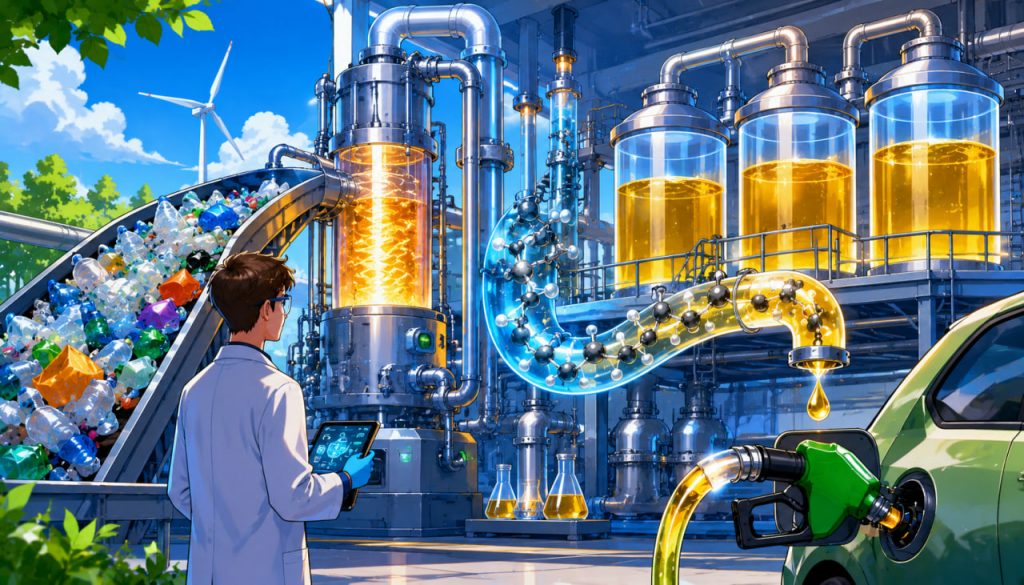
Plastic waste is one of the most pressing environmental challenges of the modern world. Millions of tons of plastic enter landfills, rivers, and oceans every year, creating long-term pollution problems. At the same time, society continues to depend heavily on liquid fuels for transportation. These two issues have inspired scientists and engineers to explore an intriguing solution: converting waste plastic into fuel.
Over the past several decades, researchers have developed technologies capable of transforming certain plastics into liquid hydrocarbons that can be used as fuel or refined into fuel components. Some experimental and commercial processes have produced fuels with properties similar to gasoline, diesel, or jet fuel. In certain cases, the resulting fuel fractions can exhibit very high octane ratings, sometimes exceeding 100, depending on feedstock composition and refining methods.
This article explores the science behind plastic-to-fuel technologies, their advantages, limitations, and their potential role in future energy systems.
Why Plastic Can Be Converted Into Fuel
Most common plastics are made from hydrocarbons originally derived from petroleum or natural gas.
Examples include:
- Polyethylene (PE)
- Polypropylene (PP)
- Polystyrene (PS)
These materials contain large chains of carbon and hydrogen atoms.
Because conventional fuels are also primarily hydrocarbons, scientists realized that plastic molecules could potentially be broken down and converted back into useful fuel products.
In a sense, plastic is already a highly processed petroleum product.
The Principle Behind Plastic-to-Fuel Technology
The most common conversion method is called pyrolysis.
Pyrolysis involves:
- Heating plastic in the absence of oxygen
- Breaking long polymer chains into smaller molecules
- Producing gases, liquids, and waxes
Unlike simple burning, pyrolysis does not rely on combustion.
Instead, it uses heat to rearrange molecular structures.
The resulting liquid products can often be refined into transportation fuels.
What Types of Plastic Work Best?
Not all plastics are equally suitable.
The most useful feedstocks include:
- Polyethylene
- Polypropylene
- Polystyrene
These plastics are widely used in:
- Packaging
- Bottles
- Containers
- Consumer goods
Certain plastics, such as PVC (polyvinyl chloride), require additional processing because they contain chlorine and can produce undesirable byproducts.
Feedstock quality greatly influences final fuel quality.
Can Plastic Fuel Have a High Octane Number?
Octane rating measures a fuel’s resistance to engine knocking.
Higher octane fuels allow engines to operate more efficiently under certain conditions.
Depending on processing methods, some plastic-derived gasoline fractions contain:
- Branched hydrocarbons
- Aromatic hydrocarbons
- High-energy molecules
These compounds may contribute to octane ratings above 100 in laboratory analyses.
However, octane value depends heavily on:
- Plastic type
- Reactor conditions
- Catalysts
- Refining methods
Therefore, there is no single octane number for all plastic-derived fuels.
Some fractions resemble conventional gasoline, while others require additional upgrading before use.
The Role of Catalysts
Modern facilities often employ catalysts to improve fuel quality.
Catalysts help:
- Increase conversion efficiency
- Improve fuel consistency
- Control product composition
- Reduce unwanted byproducts
Catalytic pyrolysis can produce fuel fractions that more closely resemble commercial transportation fuels.
Researchers continue developing advanced catalysts to maximize fuel performance.
Environmental Benefits
Plastic-to-fuel technology offers several potential environmental advantages.
Possible benefits include:
- Reducing landfill waste
- Diverting plastics from oceans
- Recovering energy from discarded materials
- Supporting circular economy strategies
Instead of treating plastic solely as waste, these technologies view it as a resource.
However, environmental outcomes depend heavily on process efficiency and emissions management.
Environmental Challenges
Despite its promise, plastic-to-fuel conversion is not a perfect solution.
Challenges include:
- Energy consumption
- Emissions control
- Feedstock contamination
- Economic viability
Some environmental experts argue that reducing plastic production and increasing recycling should remain priorities.
Plastic-to-fuel systems may be most valuable for plastics that are difficult to recycle mechanically.
Current Commercial Applications
Several companies worldwide operate commercial-scale facilities.
These plants convert waste plastic into:
- Synthetic crude oil
- Naphtha
- Diesel-like fuels
- Chemical feedstocks
Some products are used directly as fuels, while others are further refined in conventional petroleum refineries.
The industry continues to grow as governments and companies seek new approaches to waste management.
The Future of Plastic-Derived Fuels
Researchers are exploring more advanced technologies, including:
- Catalytic cracking
- Hydrothermal liquefaction
- Chemical recycling
- Hydrogen-assisted conversion
Future systems may improve:
- Fuel quality
- Energy efficiency
- Economic performance
- Environmental sustainability
The goal is not merely producing fuel but creating a more circular relationship between materials and energy.
Expert Perspective
Chemical engineer Rakesh Agarwal has emphasized that advanced recycling technologies, including plastic-to-fuel approaches, may play an important role in managing difficult-to-recycle plastics. His research highlights the importance of combining material recovery, energy efficiency, and environmental responsibility when developing future waste-management systems.
Can Plastic Fuel Replace Conventional Gasoline?
At present, plastic-derived fuels are unlikely to completely replace conventional transportation fuels.
However, they may contribute to:
- Waste reduction
- Resource recovery
- Supplementary fuel production
Their greatest value may lie in transforming problematic waste streams into useful products while reducing environmental burdens.
As technology advances, their role could expand significantly.
Conclusion
Plastic-to-fuel technology demonstrates how science can transform a major environmental challenge into a potential resource. Through processes such as pyrolysis and catalytic conversion, waste plastics can be converted into liquid hydrocarbons that resemble conventional transportation fuels. In some cases, refined fractions may even achieve very high octane ratings exceeding 100.
Although significant technical and environmental challenges remain, plastic-derived fuels represent a fascinating intersection of chemistry, energy, and waste management. Rather than viewing plastic solely as pollution, researchers increasingly see it as a valuable carbon resource that may contribute to more sustainable energy systems in the future.
Interesting Facts
- Most common plastics originate from petroleum-based hydrocarbons.
- Pyrolysis can convert plastic into gases, liquids, and waxes.
- Some plastic-derived gasoline fractions have demonstrated octane ratings above 100.
- Plastic-to-fuel technology has been researched since the 1970s.
- Certain facilities process thousands of tons of waste plastic annually.
- Plastic-derived oils can sometimes be refined using existing refinery infrastructure.
Glossary
- Pyrolysis — Thermal decomposition of materials in the absence of oxygen.
- Octane Rating — A measure of a fuel’s resistance to engine knocking.
- Hydrocarbon — A compound composed primarily of hydrogen and carbon.
- Catalyst — A substance that accelerates chemical reactions without being consumed.
- Polyethylene (PE) — One of the most common plastics used in packaging.
- Polypropylene (PP) — A widely used plastic found in containers and consumer products.
- Chemical Recycling — Recycling that breaks materials into molecular components for reuse.