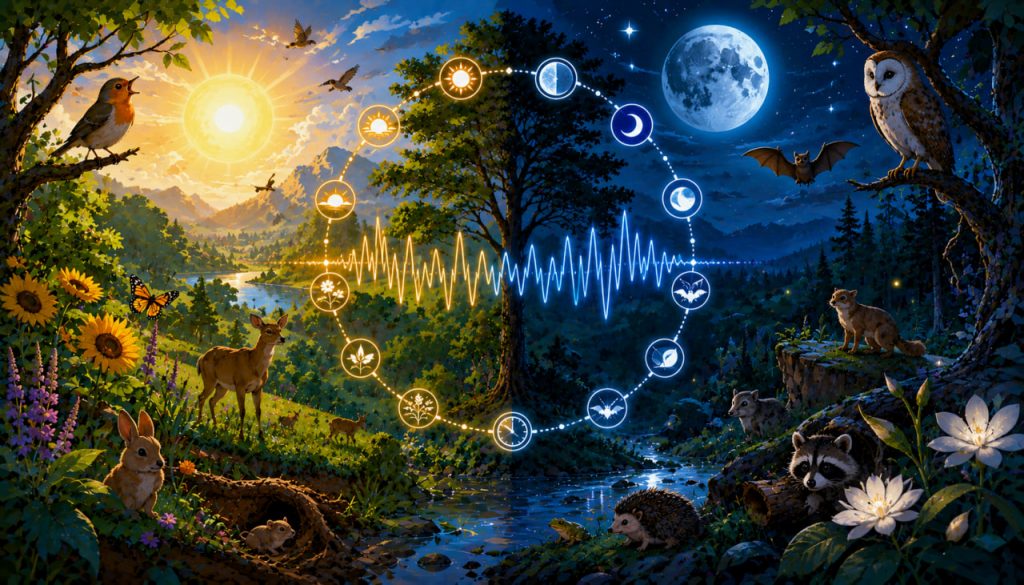
Life on Earth evolved under the constant influence of two dominant celestial bodies: the Sun and the Moon. Long before clocks, calendars, or modern technology existed, living organisms synchronized their behavior with the cycles of daylight, darkness, seasons, and lunar phases. Even today, from microscopic plankton to humans, biological processes continue to follow rhythms shaped by these astronomical influences.
Scientists have discovered that many organisms possess internal biological clocks that help them anticipate environmental changes rather than merely react to them. These rhythms regulate sleep, reproduction, migration, feeding, growth, and countless other functions.
Understanding how the Sun and Moon influence biological rhythms reveals one of the most fascinating connections between life and the cosmos.
What Are Biological Rhythms?
Biological rhythms are recurring physiological or behavioral patterns that occur at predictable intervals.
Examples include:
- Sleep-wake cycles
- Hormone production
- Feeding behavior
- Reproductive timing
- Seasonal migrations
These rhythms help organisms coordinate their activities with environmental conditions.
Rather than responding randomly to changing conditions, living things often anticipate them through internal timing mechanisms.
The Sun: Earth’s Primary Biological Timekeeper
The Sun exerts the strongest influence on biological rhythms.
The daily cycle of:
- Sunrise
- Daylight
- Sunset
- Darkness
creates a predictable pattern that has shaped life for billions of years.
Nearly all organisms have evolved mechanisms that allow them to synchronize with this cycle.
The most well-known example is the circadian rhythm, which operates on an approximately 24-hour schedule.
Circadian Rhythms in Humans
Humans possess an internal biological clock located in a region of the brain called the suprachiasmatic nucleus.
This clock regulates:
- Sleep
- Alertness
- Body temperature
- Hormone release
- Metabolism
Light entering the eyes provides information about the time of day.
Exposure to morning sunlight helps synchronize the body’s clock with the external environment.
Disruptions to circadian rhythms can contribute to:
- Sleep disorders
- Fatigue
- Reduced concentration
- Various health problems
How Sunlight Influences Hormones
Sunlight affects several important hormones.
Two of the most significant are:
- Melatonin
- Cortisol
Melatonin promotes sleep and typically rises after darkness falls.
Cortisol helps maintain alertness and usually peaks during the morning.
Natural light exposure helps regulate these hormonal cycles.
Modern artificial lighting can sometimes interfere with this ancient system.
Seasonal Rhythms and the Sun
The Sun’s annual cycle also influences biological activity.
Changes in day length affect:
- Migration
- Breeding
- Hibernation
- Flowering
- Growth patterns
Many species use changing daylight duration as a reliable signal that seasons are shifting.
Because day length remains predictable, it provides a dependable environmental cue.
The Moon’s Influence on Life
Although less powerful than the Sun, the Moon also affects many biological systems.
Its influence operates through:
- Lunar illumination
- Gravitational effects
- Tidal cycles
The Moon’s phases create regular environmental changes that numerous species have adapted to over millions of years.
Marine Life and Lunar Cycles
The strongest lunar influences are often found in marine ecosystems.
Many marine organisms synchronize activities with lunar cycles.
Examples include:
- Coral spawning
- Fish reproduction
- Crab migrations
- Plankton movements
Some coral species release reproductive cells during specific lunar phases, creating spectacular mass spawning events.
This synchronization increases reproductive success.
Tides and Biological Timing
The Moon’s gravity generates ocean tides.
For coastal organisms, tides create a highly predictable environment.
Many species possess circatidal rhythms, biological clocks synchronized to tidal cycles.
These rhythms influence:
- Feeding
- Burrowing
- Movement
- Reproduction
Animals living in tidal zones often coordinate their behavior with changing water levels.
Nocturnal Animals and Moonlight
Moonlight affects the behavior of many nighttime species.
Predators and prey may respond differently to lunar brightness.
Examples include:
- Owls hunting under moonlit skies
- Rodents reducing activity during bright nights
- Insects altering flight patterns
Moonlight can change visibility, affecting survival strategies throughout ecosystems.
Do Humans Respond to Lunar Cycles?
The relationship between lunar cycles and human behavior remains an active area of research.
Some studies have suggested possible associations between lunar phases and:
- Sleep quality
- Activity levels
- Certain physiological processes
However, scientific evidence remains mixed, and many proposed effects remain controversial.
Unlike marine organisms, humans appear far more strongly influenced by solar rhythms than lunar ones.
Internal Clocks: Nature’s Timekeeping System
Biological clocks allow organisms to anticipate environmental changes.
Advantages include:
- Improved efficiency
- Better reproductive timing
- Enhanced survival
- Reduced energy expenditure
Rather than waiting for conditions to change, organisms can prepare in advance.
This predictive ability provides significant evolutionary benefits.
Expert Perspective
Chronobiologist Franz Halberg helped establish the scientific study of biological rhythms, known as chronobiology. His research demonstrated that many physiological processes follow predictable cycles influenced by environmental timing cues. Halberg emphasized that understanding biological rhythms is essential for understanding health, behavior, and adaptation across living organisms.
Modern Challenges to Natural Rhythms
Human technology has altered natural environmental signals.
Challenges include:
- Artificial lighting
- Shift work
- Screen exposure
- Urban environments
- Light pollution
These factors can disrupt natural synchronization between biological clocks and celestial cycles.
Scientists increasingly study how modern lifestyles affect long-established biological timing systems.
Why Biological Rhythms Matter
Proper synchronization supports:
- Healthy sleep
- Efficient metabolism
- Reproductive success
- Cognitive performance
- Immune function
Understanding biological rhythms helps improve medicine, conservation, agriculture, and environmental management.
The influence of the Sun and Moon extends far beyond astronomy—it reaches into the biology of nearly every living organism.
Conclusion
The Sun and Moon have shaped life on Earth since its earliest beginnings. The Sun governs daily and seasonal rhythms that regulate sleep, hormones, migration, and growth, while the Moon influences tides, marine reproduction, and the behavior of countless nocturnal and coastal species.
These celestial bodies serve as natural timekeepers, helping organisms synchronize their activities with the changing environment. Even in the modern world, biological rhythms remain deeply connected to ancient astronomical cycles, demonstrating that life on Earth is inseparably linked to the movements of the heavens.
Interesting Facts
- Human circadian rhythms continue operating even without clocks or calendars.
- Some coral reefs coordinate mass spawning events using lunar cycles.
- Many migratory birds use seasonal daylight changes as migration cues.
- Tidal organisms often possess biological clocks synchronized to the tides.
- Moonlight can influence predator-prey interactions in many ecosystems.
- Plants also possess biological clocks that regulate flowering and growth.
Glossary
- Biological Rhythm — A recurring physiological or behavioral cycle in a living organism.
- Circadian Rhythm — A biological cycle lasting approximately 24 hours.
- Chronobiology — The scientific study of biological timing systems.
- Melatonin — A hormone involved in regulating sleep.
- Cortisol — A hormone associated with alertness and stress responses.
- Circatidal Rhythm — A biological rhythm synchronized with tidal cycles.
- Light Pollution — Excessive artificial light that alters natural environmental conditions.