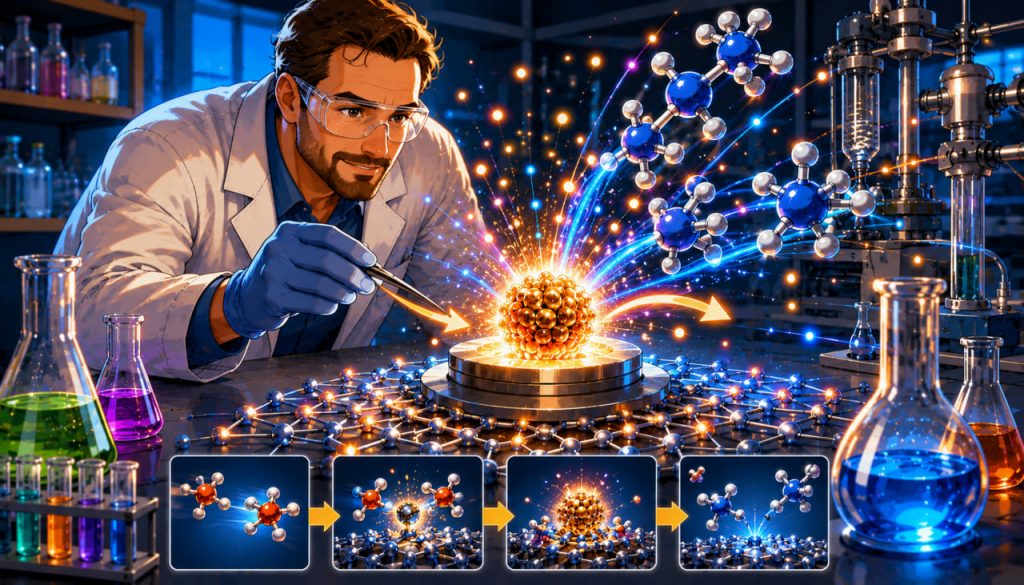
Catalysis is one of the most powerful and important phenomena in chemistry. Without catalysts, many chemical reactions that sustain modern civilization would occur far too slowly to be useful. From producing fuels and fertilizers to manufacturing medicines and cleaning vehicle exhaust, catalysts quietly accelerate countless processes that affect daily life.
Perhaps the most astonishing aspect of catalysis is that an extremely small amount of catalyst can dramatically increase reaction speed. In some cases, reactions proceed millions, billions, or even trillions of times faster than they would otherwise. This remarkable ability has fascinated scientists for more than a century and continues to drive advances in chemistry, biology, energy production, and environmental protection.
Understanding catalysis reveals how nature and technology accomplish seemingly impossible chemical transformations with extraordinary efficiency.
What Is Catalysis?
Catalysis is the process by which a substance called a catalyst increases the rate of a chemical reaction without being permanently consumed.
The catalyst participates in the reaction process but emerges essentially unchanged at the end.
This means that a single catalyst particle may help facilitate enormous numbers of reactions.
Because catalysts are not used up in the same way as reactants, even tiny quantities can have enormous effects.
Why Chemical Reactions Need Help
Not all chemical reactions occur easily.
Many reactions face a barrier known as activation energy.
Before molecules can react, they often need sufficient energy to:
- Break existing bonds
- Rearrange atoms
- Form new bonds
Without enough energy, reactants may collide countless times without producing any reaction.
This is where catalysts become important.
How Catalysts Work
Catalysts provide an alternative reaction pathway.
Instead of forcing molecules to overcome a large energy barrier, the catalyst creates a route requiring less energy.
As a result:
- More molecular collisions become successful
- Reactions occur more frequently
- Reaction rates increase dramatically
The catalyst does not change the final products.
It simply makes the journey faster and more efficient.
A Simple Analogy
Imagine climbing a mountain.
Without a catalyst, molecules must climb over a very high peak.
With a catalyst, a tunnel is provided through the mountain.
The destination remains the same, but reaching it becomes much easier.
This simplified picture captures the essence of catalytic action.
Why Tiny Amounts Can Have Huge Effects
One catalyst molecule can participate repeatedly.
After helping one reaction occur, it becomes available to assist another.
This cycle can repeat:
- Thousands of times
- Millions of times
- Billions of times
In industrial systems, catalyst surfaces may facilitate astronomical numbers of reactions every second.
This repeated use explains why small amounts of catalyst can produce massive effects.
Catalysts in Nature: Enzymes
The most impressive catalysts may be found inside living organisms.
These biological catalysts are called enzymes.
Enzymes control virtually every biochemical process, including:
- Digestion
- Energy production
- DNA replication
- Protein synthesis
Without enzymes, many reactions required for life would proceed far too slowly to sustain living organisms.
Enzymes Can Be Astonishingly Efficient
Some enzymes accelerate reactions by factors exceeding a trillion-fold.
One famous example is carbonic anhydrase, which helps regulate carbon dioxide transport in the body.
Without this enzyme, essential physiological processes would occur far too slowly to support life.
Nature has evolved catalysts that often outperform many human-made systems.
Industrial Catalysts and Modern Civilization
Catalysis is essential to modern industry.
Many products depend on catalytic processes, including:
- Fuels
- Plastics
- Fertilizers
- Pharmaceuticals
- Synthetic fibers
A large proportion of global chemical production involves catalysts at some stage.
Without catalysis, many industrial processes would become economically impractical.
The Haber-Bosch Process
One of the most important examples is the Haber-Bosch process.
This process uses an iron-based catalyst to convert:
- Nitrogen
- Hydrogen
into ammonia.
Ammonia is used to manufacture fertilizers that support modern agriculture.
Many historians consider the Haber-Bosch process one of the most influential technological developments in human history because it dramatically increased food production.
Catalytic Converters in Vehicles
Catalysts also help reduce pollution.
Modern vehicles contain catalytic converters that transform harmful gases into less harmful substances.
These systems convert:
- Carbon monoxide
- Nitrogen oxides
- Unburned hydrocarbons
into products such as:
- Carbon dioxide
- Nitrogen
- Water vapor
This technology has significantly improved urban air quality worldwide.
Surface Catalysis
Many industrial catalysts work through surface catalysis.
Reactant molecules attach temporarily to the catalyst surface.
The surface helps:
- Position molecules correctly
- Weaken existing bonds
- Promote new bond formation
Once the reaction occurs, products leave the surface and new reactants arrive.
This cycle continues continuously.
Nanotechnology and Catalysis
Modern research increasingly focuses on nanoparticles.
Because nanoparticles possess enormous surface area relative to their size, they often make highly effective catalysts.
Scientists are developing catalytic nanoparticles for:
- Clean energy
- Hydrogen production
- Environmental cleanup
- Advanced manufacturing
Nanotechnology may shape the next generation of catalytic innovations.
Catalysis and Green Chemistry
Catalysts contribute significantly to environmental sustainability.
Benefits include:
- Reduced energy consumption
- Lower waste production
- Improved efficiency
- Cleaner manufacturing
Many green chemistry initiatives rely heavily on catalytic technologies.
As industries seek to reduce environmental impact, catalysis becomes increasingly important.
Expert Perspective
Chemist Gerhard Ertl received the Nobel Prize in Chemistry for his groundbreaking studies of surface chemistry and catalytic reactions. His research revealed how molecules interact with catalyst surfaces at the atomic level, helping scientists understand why catalysts can accelerate reactions so dramatically. This work laid foundations for many modern industrial catalytic technologies.
The Future of Catalysis
Researchers continue searching for better catalysts.
Current goals include:
- More efficient hydrogen production
- Carbon dioxide conversion
- Sustainable fuel synthesis
- Improved battery technologies
- Cleaner industrial processes
Future breakthroughs in catalysis could play a major role in addressing global energy and environmental challenges.
Conclusion
Catalysis is one of the hidden forces that make modern life possible. By lowering activation energy and providing alternative reaction pathways, catalysts can accelerate chemical reactions by extraordinary amounts—sometimes by trillions of times. From enzymes inside living cells to industrial catalysts producing fertilizers and reducing pollution, these remarkable substances enable processes that would otherwise be impractically slow.
As science advances, catalysis continues to unlock new possibilities in medicine, energy, manufacturing, and environmental protection. The ability of a tiny catalyst particle to transform entire chemical systems remains one of the most powerful examples of how small changes can produce enormous effects.
Interesting Facts
- Most industrial chemicals are produced using at least one catalytic process.
- Some enzymes can accelerate reactions by more than a trillion times.
- Catalysts are generally not consumed during the reactions they facilitate.
- Vehicle catalytic converters contain precious metals such as platinum, palladium, and rhodium.
- Nanoparticles often make highly effective catalysts because of their large surface area.
- Catalysis is essential for life itself because biological reactions would otherwise occur too slowly.
Glossary
- Catalyst — A substance that increases reaction rate without being permanently consumed.
- Catalysis — The process of accelerating a chemical reaction using a catalyst.
- Activation Energy — The minimum energy required for a reaction to occur.
- Enzyme — A biological catalyst produced by living organisms.
- Surface Catalysis — Catalysis that occurs on the surface of a material.
- Nanoparticle — An extremely small particle measured in nanometers.
- Haber-Bosch Process — An industrial method for producing ammonia using catalysts.