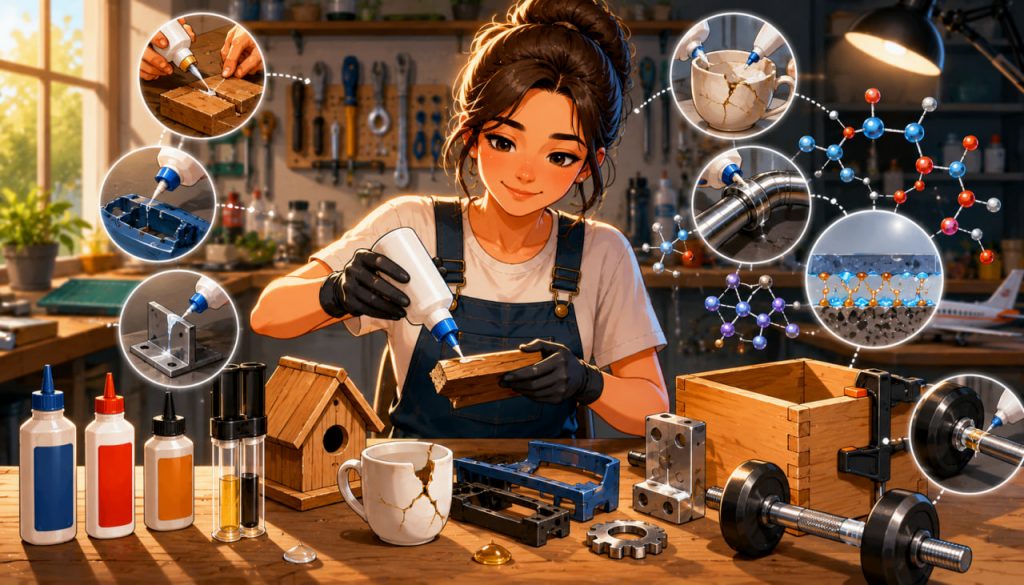
Glue is one of the most useful inventions in human history. From ancient civilizations using natural adhesives made from animal products and plant resins to modern industrial super glues capable of holding aircraft components together, adhesives have become an essential part of everyday life. Whether repairing a broken mug, assembling furniture, building models, or constructing spacecraft, choosing the correct adhesive can make the difference between success and failure.
Many people assume that all glues work in roughly the same way. In reality, adhesives are highly specialized materials designed for specific surfaces, environmental conditions, and mechanical stresses. Understanding how glue works and how to select the appropriate type can save time, money, and frustration.
What Is Glue?
Glue is an adhesive substance used to bond two or more surfaces together.
Adhesives work by creating connections between materials through:
- Mechanical bonding
- Chemical bonding
- Molecular attraction
Once cured or dried, the adhesive helps hold surfaces together against forces that would otherwise separate them.
Modern adhesives are used in:
- Construction
- Manufacturing
- Medicine
- Electronics
- Transportation
- Household repairs
How Does Glue Work?
Although different adhesives use different mechanisms, most rely on close contact with the surfaces being joined.
For a strong bond:
- The adhesive spreads across the surface.
- It penetrates microscopic irregularities.
- Chemical or physical forces develop.
- The adhesive hardens or cures.
The resulting bond may sometimes be stronger than the materials themselves.
Why Surface Preparation Matters
Even the best glue performs poorly on dirty surfaces.
Before applying adhesive, it is often beneficial to remove:
- Dust
- Oil
- Grease
- Rust
- Loose particles
Clean surfaces allow stronger contact between the adhesive and the material.
Many bonding failures occur because of inadequate preparation rather than poor adhesive quality.
White Glue (PVA)
One of the most familiar adhesives is polyvinyl acetate (PVA) glue.
Common uses include:
- Paper
- Cardboard
- Wood crafts
- School projects
Advantages:
- Easy to use
- Non-toxic
- Affordable
Disadvantages:
- Limited water resistance
- Lower strength compared to industrial adhesives
PVA remains an excellent choice for many household tasks.
Wood Glue
Wood glues are specifically formulated for woodworking.
Benefits include:
- Strong wood-to-wood bonds
- Easy application
- Good durability
In properly fitted joints, wood glue often creates bonds stronger than the surrounding wood fibers.
This is why it is widely used by carpenters and furniture makers.
Super Glue (Cyanoacrylate)
Super glue is famous for its rapid bonding ability.
Advantages:
- Fast curing
- High strength
- Easy application
Common uses include:
- Plastic repairs
- Ceramic repairs
- Metal repairs
- Small household fixes
However, super glue may become brittle under heavy stress and is not always ideal for large structural projects.
Epoxy Adhesives
Epoxy consists of two components:
- Resin
- Hardener
When mixed, they undergo a chemical reaction that creates a very strong bond.
Advantages include:
- Exceptional strength
- Chemical resistance
- Gap filling capability
- Durability
Epoxies are frequently used in:
- Construction
- Automotive repair
- Aerospace engineering
- Marine applications
Hot Glue
Hot glue guns are popular for crafts and light-duty projects.
Benefits:
- Quick application
- Fast setting
- Easy removal in some situations
Limitations:
- Reduced strength under high temperatures
- Limited structural performance
Hot glue works best for temporary or lightweight applications.
Construction Adhesives
Construction adhesives are designed for demanding building environments.
They may bond:
- Wood
- Concrete
- Metal
- Drywall
- Stone
These products are formulated to withstand substantial loads and environmental exposure.
Adhesives for Plastic
Plastic bonding can be challenging because different plastics behave differently.
Some plastics bond easily.
Others, such as:
- Polyethylene
- Polypropylene
are notoriously difficult to glue.
Specialized plastic adhesives are often required for reliable results.
Choosing Glue Based on Material
The first step in selecting an adhesive is identifying the materials involved.
Examples include:
| Material | Typical Adhesive |
|---|---|
| Paper | PVA glue |
| Wood | Wood glue |
| Ceramic | Epoxy or super glue |
| Metal | Epoxy |
| Plastic | Plastic-specific adhesive |
| Construction materials | Construction adhesive |
Matching the adhesive to the material is essential.
Environmental Conditions Matter
A bond that works indoors may fail outdoors.
Consider factors such as:
- Moisture
- Temperature
- Sunlight
- Chemicals
- Vibration
Outdoor projects generally require more durable adhesives than indoor applications.
Strength Is Not Everything
Many consumers focus only on advertised strength.
However, flexibility can be equally important.
For example:
- Rigid adhesives work well for stable structures.
- Flexible adhesives perform better where movement occurs.
Selecting the wrong stiffness may lead to premature failure.
Expert Perspective
Materials scientist Anthony J. Kinloch has conducted extensive research on adhesive bonding and fracture mechanics. His work has demonstrated that successful adhesive performance depends not only on bond strength but also on understanding how materials behave under real-world stresses, temperatures, and environmental conditions.
Modern Adhesives in Advanced Technology
Adhesives play critical roles in modern engineering.
They are used in:
- Aircraft
- Satellites
- Wind turbines
- Smartphones
- Medical devices
In many applications, adhesives replace traditional fasteners such as screws and rivets, reducing weight and improving performance.
Common Mistakes When Using Glue
Frequent errors include:
- Using the wrong adhesive
- Applying too much glue
- Failing to clean surfaces
- Ignoring curing times
- Exposing bonds to stress too early
Following manufacturer instructions significantly improves results.
Conclusion
Glue is far more sophisticated than many people realize. Modern adhesives are engineered for specific materials, environments, and performance requirements. Understanding the differences between PVA glue, wood glue, super glue, epoxy, hot glue, and construction adhesives allows users to make better choices and achieve stronger, more reliable bonds.
The best adhesive is not necessarily the strongest one—it is the one designed for the specific materials and conditions involved. By considering surface preparation, environmental exposure, flexibility requirements, and curing characteristics, anyone can dramatically improve the success of repair, construction, and craft projects.
Interesting Facts
- Ancient Egyptians used natural adhesives thousands of years ago.
- Modern aircraft rely extensively on adhesive bonding.
- Some industrial adhesives can withstand temperatures exceeding several hundred degrees Celsius.
- Super glue was accidentally discovered during research into transparent plastics.
- Certain medical adhesives can replace stitches in some situations.
- Geckos inspired scientists to develop advanced adhesive technologies.
Glossary
- Adhesive — A substance used to bond surfaces together.
- Epoxy — A two-component adhesive known for high strength and durability.
- Cyanoacrylate — The chemical family commonly known as super glue.
- Curing — The process by which an adhesive hardens and develops strength.
- Bond Strength — The force required to separate bonded materials.
- PVA (Polyvinyl Acetate) — A common water-based adhesive used for paper and wood.
- Mechanical Bonding — Adhesion created by penetration into surface irregularities.