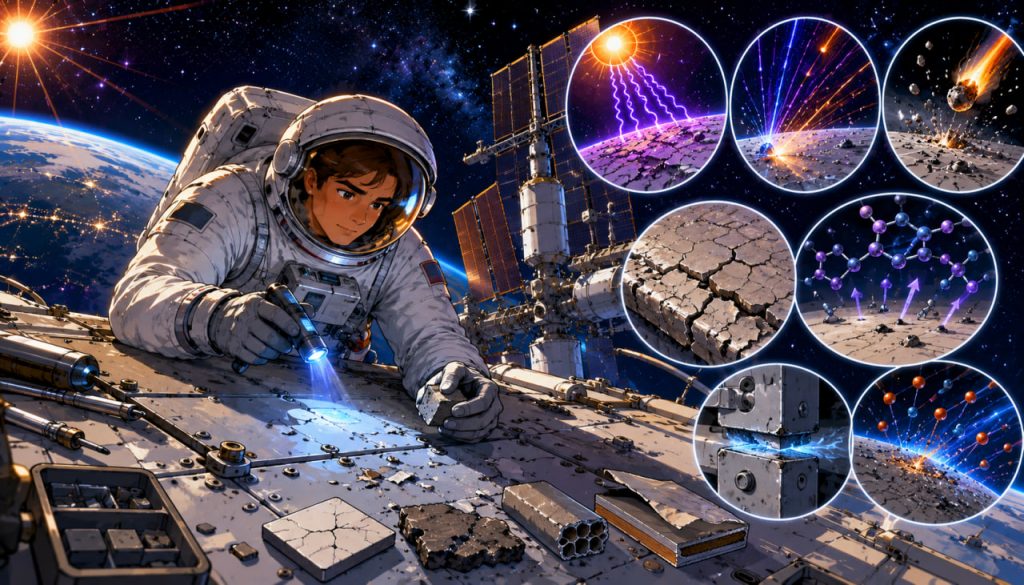
When people think about material aging, they often imagine rust, corrosion, moisture damage, or chemical reactions involving oxygen. On Earth, oxygen plays a major role in the breakdown of metals, plastics, rubber, paints, and countless other materials. But what happens in space, where there is almost no atmosphere and virtually no oxygen?
At first glance, it might seem that materials placed in the vacuum of space would last forever because traditional oxidation cannot occur. Surprisingly, the reality is far more complex. Space presents a unique set of environmental challenges that can degrade materials in ways rarely encountered on Earth.
Scientists and engineers have spent decades studying how spacecraft, satellites, space stations, and scientific instruments age in the harsh environment beyond our planet. Their findings reveal that the vacuum of space creates its own form of aging, often called vacuum degradation or oxygen-free aging.
Why Space Is Not an Empty Environment
Although space is often described as a vacuum, it is not completely empty.
Materials in orbit or deep space are exposed to:
- Extreme temperature changes
- Ultraviolet radiation
- Cosmic rays
- Charged particles
- Micrometeoroids
- Atomic oxygen in low Earth orbit
Together, these factors create one of the harshest environments known.
Even without ordinary atmospheric oxygen, materials can still deteriorate significantly.
The Role of Vacuum
Vacuum itself affects materials.
One major process is called outgassing.
Many materials contain:
- Trapped gases
- Water molecules
- Volatile chemicals
When exposed to vacuum, these substances gradually escape into space.
Outgassing can lead to:
- Shrinkage
- Cracking
- Loss of flexibility
- Changes in mechanical properties
This is particularly important for plastics, adhesives, paints, and composite materials.
Temperature Extremes in Space
Spacecraft experience dramatic temperature swings.
A surface facing the Sun may exceed:
- 120°C (248°F)
Meanwhile, a shaded surface can drop below:
- -150°C (-238°F)
Repeated expansion and contraction place enormous stress on materials.
Over time this may cause:
- Fatigue
- Microcracks
- Delamination
- Structural weakening
Even highly engineered materials gradually accumulate damage.
Ultraviolet Radiation: A Silent Destroyer
Earth’s atmosphere protects us from much of the Sun’s ultraviolet radiation.
In space, materials receive intense UV exposure.
Ultraviolet radiation can:
- Break chemical bonds
- Discolor surfaces
- Reduce flexibility
- Weaken polymers
Many plastics become brittle after prolonged exposure.
Protective coatings are often required to reduce damage.
Cosmic Rays and High-Energy Particles
Space contains energetic particles capable of penetrating materials.
Sources include:
- The Sun
- Galactic cosmic rays
- Solar storms
These particles can alter material structures at the molecular level.
Effects may include:
- Atomic displacement
- Molecular fragmentation
- Electrical property changes
Electronic components are especially vulnerable.
Radiation-Induced Aging
Unlike oxidation on Earth, radiation aging occurs through direct energy deposition.
When radiation strikes a material:
- Chemical bonds may break
- New compounds may form
- Molecular structures may rearrange
The result is gradual degradation even in the complete absence of oxygen.
This process is one reason why spacecraft materials must undergo extensive testing before launch.
Metals in Space
Metals generally perform well in vacuum.
Without moisture and atmospheric oxygen:
- Traditional rusting is greatly reduced
- Corrosion rates often decrease
However, metals still face challenges.
These include:
- Thermal fatigue
- Radiation damage
- Micrometeoroid impacts
Long-term exposure can alter mechanical properties and reduce structural integrity.
Plastics and Polymers
Polymers are among the most vulnerable materials in space.
Potential effects include:
- Embrittlement
- Discoloration
- Cracking
- Outgassing
Engineers often select specialized space-grade polymers designed to withstand extreme conditions.
Even these materials slowly age over time.
The Surprising Problem of Cold Welding
On Earth, microscopic layers of oxidation often separate metal surfaces.
In vacuum, these protective layers may be absent.
When two clean metal surfaces touch in space, they can sometimes bond together spontaneously.
This phenomenon is called cold welding.
Cold welding can cause:
- Mechanical failures
- Stuck components
- Equipment malfunctions
Spacecraft designers carefully account for this risk.
Atomic Oxygen in Low Earth Orbit
Although deep space lacks oxygen, spacecraft in low Earth orbit face a unique challenge.
The upper atmosphere contains highly reactive atomic oxygen.
Atomic oxygen can:
- Erode surfaces
- Damage coatings
- Degrade polymers
NASA has spent decades studying methods to protect spacecraft from this invisible threat.
Micrometeoroid Damage
Tiny particles travel through space at extraordinary speeds.
Even microscopic impacts can:
- Pit surfaces
- Create cracks
- Remove protective coatings
Over many years, these impacts contribute significantly to material aging.
Expert Perspective
Materials scientist Donald J. Kessler has highlighted the importance of understanding the long-term space environment when designing satellites and spacecraft. Research in orbital environments has repeatedly demonstrated that radiation, vacuum effects, and particle impacts can gradually alter materials in ways that are difficult to reproduce on Earth.
How Engineers Fight Space Aging
Modern spacecraft use numerous protective strategies.
Examples include:
- Radiation-resistant materials
- Specialized coatings
- Thermal control systems
- Shielding layers
- Space-qualified polymers
Engineers also conduct accelerated aging tests that simulate years of exposure before a spacecraft is launched.
Future Challenges for Deep-Space Missions
As humanity plans missions to:
- The Moon
- Mars
- Asteroids
- Deep-space destinations
material durability becomes increasingly important.
Future spacecraft may need to survive:
- Decades of radiation exposure
- Extreme temperature cycling
- Long-term vacuum conditions
Developing advanced materials is therefore a major area of modern aerospace research.
Conclusion
Although space lacks the oxygen responsible for many forms of terrestrial aging, materials do not remain unchanged in vacuum. Instead, they face a completely different set of destructive forces, including radiation, ultraviolet light, temperature extremes, outgassing, micrometeoroid impacts, and atomic oxygen.
Understanding oxygen-free aging has become essential for modern space exploration. The lessons learned from studying material degradation in space not only help engineers design more durable spacecraft but also expand our knowledge of how matter behaves under some of the most extreme conditions in the universe.
Interesting Facts
- Some spacecraft materials have survived in orbit for decades while showing measurable aging effects.
- Space vacuum can cause certain plastics to lose trapped gases and shrink.
- Metals can sometimes cold-weld together in vacuum without heat.
- Ultraviolet radiation in space is far more intense than at Earth’s surface.
- Tiny micrometeoroids can strike spacecraft at speeds exceeding tens of thousands of kilometers per hour.
- Engineers often test materials in vacuum chambers that simulate space conditions.
Glossary
- Vacuum — An environment containing extremely little matter.
- Outgassing — The release of trapped gases from a material.
- Polymer — A material composed of long molecular chains.
- Cosmic Ray — A high-energy particle traveling through space.
- Atomic Oxygen — Highly reactive single oxygen atoms found in low Earth orbit.
- Cold Welding — The spontaneous bonding of clean metal surfaces in vacuum.
- Thermal Fatigue — Material weakening caused by repeated temperature changes.