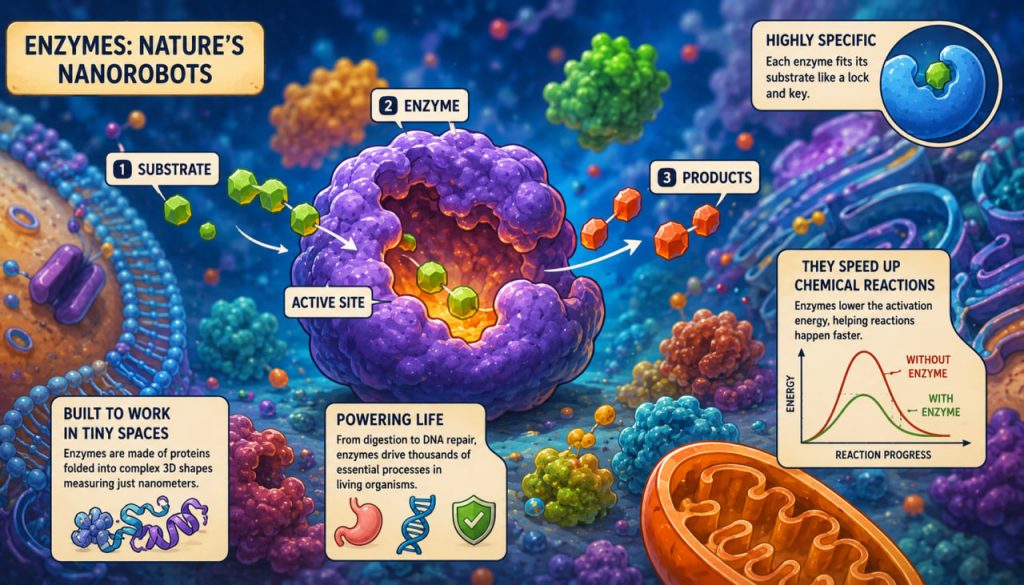
Life as we know it would be impossible without enzymes. Every heartbeat, every breath, every thought, and every movement depends on these remarkable biological molecules. Although invisible to the naked eye, enzymes perform trillions of chemical operations inside living organisms every second.
Scientists often compare enzymes to molecular machines because of their extraordinary precision and efficiency. Some researchers even describe them as biological nanorobots—tiny structures capable of recognizing specific molecules, carrying out complex tasks, and repeating those tasks thousands or even millions of times.
What makes enzymes particularly fascinating is that they often survive long after the molecules they process have disappeared. While the substances they act upon are transformed into entirely new compounds, the enzyme itself frequently remains unchanged and ready for another cycle of work.
What Are Enzymes?
Enzymes are specialized proteins that accelerate chemical reactions inside living organisms.
Without enzymes, many biological reactions would occur so slowly that life could not function. Some processes that take fractions of a second in cells might require years, centuries, or even longer under normal conditions.
An enzyme acts as a catalyst—a substance that speeds up a reaction without being permanently consumed by it.
This is why a single enzyme molecule can participate in an enormous number of reactions throughout its lifetime.
In many ways, enzymes are the workforce that keeps biology running.
Why Scientists Compare Enzymes to Nanorobots
Although enzymes are not machines in the technological sense, their behavior often resembles that of microscopic robots.
Each enzyme possesses a unique three-dimensional structure that allows it to recognize specific target molecules.
This target-binding region is known as the active site.
When the correct molecule arrives, the enzyme:
- Recognizes it.
- Binds to it.
- Modifies it through a chemical reaction.
- Releases the finished product.
- Returns to its original state.
The process can then repeat countless times.
Unlike human-made robots, enzymes require no batteries, programming, or external control. Their structure itself contains the instructions needed to perform their function.
How Enzymes Speed Up Reactions
Chemical reactions often face an energy barrier before they can proceed.
Imagine pushing a rock over a hill. The hill represents the energy needed to start the reaction.
Enzymes effectively lower this barrier, making reactions easier and faster.
They accomplish this by:
- Positioning molecules correctly
- Weakening chemical bonds
- Stabilizing intermediate reaction states
- Providing an optimal microenvironment for reactions
As a result, reactions that would normally occur extremely slowly can happen millions of times faster.
Enzymes Work With Incredible Precision
One of the most impressive features of enzymes is their selectivity.
Many enzymes interact with only a single type of molecule or a small group of closely related molecules.
This precision prevents chaos inside cells.
For example:
- Digestive enzymes break down food.
- DNA polymerases help copy genetic information.
- Metabolic enzymes regulate energy production.
- Repair enzymes fix damaged DNA.
Each performs a highly specific task.
A mistake in enzyme function can sometimes contribute to disease, illustrating just how important their precision is.
The Molecules Change—The Enzyme Remains
One reason enzymes are often described as biological nanorobots is that they repeatedly survive the reactions they catalyze.
Suppose a digestive enzyme breaks apart thousands of protein molecules.
The proteins are destroyed and converted into smaller components, but the enzyme itself remains available to continue working.
This differs from many ordinary chemical reactions where participating substances are consumed.
An enzyme may process thousands, millions, or even billions of molecules during its lifespan.
In this sense, enzymes often outlive the molecules they interact with.
Nature’s Fastest Molecular Machines
Some enzymes operate at astonishing speeds.
One famous example is carbonic anhydrase, an enzyme found in red blood cells.
Its job is to help regulate carbon dioxide transport within the body.
A single molecule of carbonic anhydrase can process hundreds of thousands of reactions every second.
Other enzymes operate more slowly but still perform tasks at rates far beyond what would be possible without biological catalysts.
These incredible speeds are one reason life can sustain complex processes in real time.
Enzymes and the Origin of Life
Many scientists believe enzymes were crucial to the emergence of life on Earth.
Living systems require countless chemical reactions to occur in a coordinated manner.
Without catalysts, these reactions would likely have been too slow to support the first biological systems.
Some researchers even speculate that primitive catalytic molecules may have existed before modern proteins evolved.
Understanding how catalytic systems arose remains one of the central questions in origin-of-life research.
Enzymes in Medicine and Industry
The usefulness of enzymes extends far beyond biology.
Today they are widely used in:
- Medicine
- Biotechnology
- Food production
- Detergent manufacturing
- Biofuel production
- Genetic engineering
For example, many diagnostic tests rely on enzymes to detect specific substances in blood samples.
Modern DNA analysis and gene-editing technologies also depend heavily on specialized enzymes.
Without them, many advances in molecular biology would be impossible.
Expert Perspective on Enzymes
Biochemist Arthur Kornberg, who helped uncover important mechanisms of DNA replication, emphasized the central role enzymes play in living systems.
“Virtually every biological process depends upon enzymes.”
This statement remains true today. Whether researchers study metabolism, genetics, neuroscience, or medicine, enzymes are almost always involved.
Their importance is difficult to overstate.
Could Artificial Enzymes Be the Future?
Scientists are now developing artificial enzymes designed to mimic nature’s catalytic abilities.
These synthetic catalysts could eventually help:
- Manufacture pharmaceuticals more efficiently
- Break down environmental pollutants
- Produce sustainable fuels
- Enable entirely new industrial processes
Researchers are also using artificial intelligence to design enzyme-like molecules with properties not found in nature.
The future may see biological and engineered catalysts working side by side.
Conclusion
Enzymes are among the most remarkable structures in biology. Acting as molecular catalysts, they accelerate the chemical reactions that sustain life while remaining largely unchanged themselves. Their precision, efficiency, and ability to process enormous numbers of molecules have earned them comparisons to biological nanorobots.
From digestion and DNA replication to medicine and biotechnology, enzymes quietly power nearly every aspect of life. As scientists continue to explore and engineer these extraordinary molecular machines, enzymes may help unlock some of the most important technological and medical advances of the future.
Interesting Facts
- A single enzyme molecule can catalyze millions of reactions during its lifetime.
- Carbonic anhydrase is among the fastest known enzymes, processing hundreds of thousands of reactions per second.
- Human cells contain thousands of different enzymes performing specialized tasks.
- Many laundry detergents use enzymes to break down stains.
- Some enzymes remain active in extremely hot environments such as hydrothermal vents.
- Nobel Prizes have been awarded for discoveries involving enzymes, DNA replication, and enzyme-driven biological processes.
Glossary
- Enzyme — A biological catalyst that accelerates chemical reactions without being permanently consumed.
- Catalyst — A substance that increases the rate of a chemical reaction while remaining largely unchanged.
- Active Site — The region of an enzyme where target molecules bind and reactions occur.
- DNA Polymerase — An enzyme responsible for copying DNA during cell division.
- Biotechnology — The use of biological systems and organisms to develop useful technologies and products.