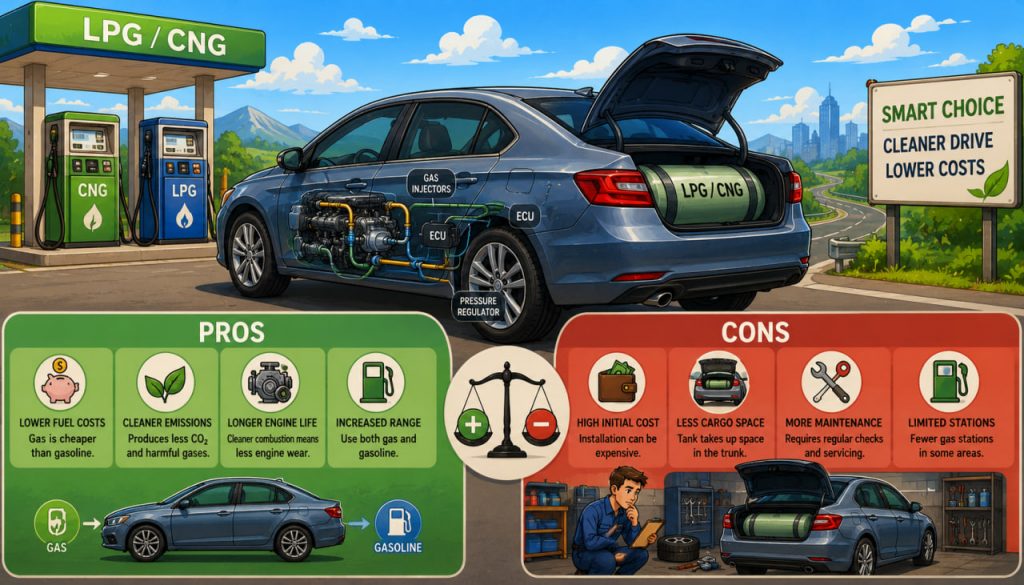
With rising fuel prices and growing concerns about environmental impact, many drivers are looking for alternatives to traditional gasoline and diesel vehicles. One of the most popular options is a gas-powered car that runs on liquefied petroleum gas (LPG) or compressed natural gas (CNG).
Gas-powered vehicles have been used around the world for decades and remain particularly popular in countries where fuel costs are high. Supporters praise them for lower operating expenses and cleaner emissions, while critics point to installation costs, reduced cargo space, and limitations in fueling infrastructure.
Understanding the advantages and disadvantages of gas-powered vehicles can help drivers determine whether this alternative fuel system is right for them.
What Is a Gas-Powered Car?
A gas-powered car is typically a conventional gasoline vehicle equipped with an additional fuel system that allows it to run on gas instead of—or alongside—gasoline.
The two most common types are:
- LPG (Liquefied Petroleum Gas)
- CNG (Compressed Natural Gas)
Most modern conversions allow drivers to switch between gasoline and gas while driving.
This dual-fuel capability provides flexibility and can extend overall driving range.
Why Do Drivers Choose Gas?
The main reason is simple: cost savings.
In many countries, LPG and CNG are significantly cheaper than gasoline. As a result, drivers who travel long distances can reduce fuel expenses considerably.
The greater the annual mileage, the faster the investment in a gas system may pay for itself.
For taxi drivers, delivery services, and frequent commuters, fuel savings can become substantial over time.
Lower Fuel Costs
The most obvious advantage of gas-powered vehicles is reduced fuel expenditure.
Although consumption measured in liters or cubic meters may differ from gasoline, the lower fuel price often compensates for the difference.
For high-mileage drivers, annual savings can reach hundreds or even thousands of dollars depending on fuel prices and driving habits.
This economic benefit is the primary reason most owners choose gas conversion systems.
Reduced Exhaust Emissions
Gas fuels generally burn cleaner than gasoline and diesel.
Compared to traditional fuels, gas-powered vehicles often produce:
- Less carbon monoxide
- Fewer particulate emissions
- Lower levels of certain pollutants
This does not make gas vehicles emission-free, but it can reduce their environmental impact.
Because of cleaner combustion, engine oil may also remain cleaner for longer periods.
Longer Engine Life
Many mechanics note that gas combustion tends to leave fewer carbon deposits inside the engine.
Carbon deposits are accumulations of combustion byproducts that can gradually build up on engine components.
Cleaner combustion may contribute to:
- Reduced engine contamination
- Smoother operation
- Potentially lower maintenance requirements
However, the overall effect depends heavily on engine design, fuel quality, and maintenance practices.
Increased Driving Range
Dual-fuel vehicles benefit from having two fuel sources.
A driver can use:
- Gasoline tank
- Gas cylinder
This effectively increases the total distance that can be traveled before refueling.
For long-distance travelers, this can be a significant advantage.
The Initial Installation Cost
One of the biggest disadvantages is the upfront expense.
Installing a modern gas system requires:
- Fuel tanks
- Fuel lines
- Electronic controls
- Injectors
- Safety equipment
Professional installation can be costly, particularly for advanced systems designed for modern engines.
Drivers with low annual mileage may require several years before fuel savings offset installation costs.
Reduced Cargo Space
Gas cylinders require physical space inside the vehicle.
Depending on the design, the tank may be installed:
- In the trunk
- Under the vehicle
- In the spare wheel compartment
Although modern systems are often compact, some reduction in storage capacity is common.
For families or drivers who frequently transport large loads, this may be an important consideration.
Additional Maintenance Requirements
Gas systems require periodic inspection and maintenance.
Components such as:
- Filters
- Injectors
- Pressure regulators
- Fuel lines
must be monitored to ensure safe operation.
While maintenance costs are generally manageable, they add another layer of responsibility compared to a standard gasoline vehicle.
Performance Differences
Modern gas systems have improved dramatically, but slight performance differences can still occur.
Some drivers report:
- Small reductions in engine power
- Slightly slower acceleration
- Different engine response characteristics
For everyday driving, these differences are often minimal and may go unnoticed.
However, performance-oriented drivers may be more sensitive to such changes.
Fueling Infrastructure Matters
A gas-powered vehicle is only practical if fueling stations are readily available.
Availability varies significantly by country and region.
Before investing in a conversion system, drivers should evaluate:
- Local fuel station availability
- Travel routes
- Regional infrastructure
Limited access to gas stations can reduce the convenience advantages of the system.
Safety Considerations
Some people worry about the safety of gas-powered vehicles.
Modern gas systems incorporate numerous safety features, including:
- Pressure relief valves
- Automatic shutoff mechanisms
- Reinforced fuel tanks
- Leak detection systems
According to automotive safety experts, properly installed and maintained systems are generally very safe.
However, installation should always be performed by qualified professionals.
Expert Opinion
Automotive engineer John Heywood has long emphasized that alternative fuels can play an important role in reducing transportation costs and emissions while existing vehicle technologies continue to evolve.
His research highlights an important reality: no single fuel solution is perfect for every driver. The best choice depends on individual needs, driving patterns, local fuel prices, and infrastructure availability.
Is a Gas-Powered Car Worth It?
The answer depends largely on how much you drive.
Gas systems tend to make the most sense for:
- Taxi drivers
- Delivery vehicles
- Frequent commuters
- Long-distance travelers
For drivers who travel only a few thousand kilometers per year, the economic benefits may be less significant.
The more miles you drive, the more attractive gas conversion becomes.
Conclusion
Gas-powered vehicles offer a practical alternative to traditional gasoline-only cars. Their biggest advantages include lower fuel costs, cleaner combustion, and increased driving range. However, installation expenses, reduced cargo space, and additional maintenance requirements must also be considered.
For high-mileage drivers, gas systems can provide significant long-term savings. For occasional drivers, the financial benefits may be less compelling. Ultimately, the decision depends on balancing upfront investment against future fuel savings and evaluating local fueling infrastructure.
Interesting Facts
- LPG has been used as automotive fuel since the early 20th century.
- Some countries have millions of gas-powered vehicles on their roads.
- Modern LPG tanks are designed to withstand pressures far beyond normal operating conditions.
- Dual-fuel vehicles can often travel significantly farther than gasoline-only cars before requiring refueling.
- Gas combustion generally produces fewer carbon deposits than gasoline combustion.
- Some public transportation fleets operate almost entirely on natural gas.
Glossary
- LPG (Liquefied Petroleum Gas) — A fuel consisting mainly of propane and butane stored in liquid form under pressure.
- CNG (Compressed Natural Gas) — Natural gas stored at high pressure for use as vehicle fuel.
- Carbon Deposits — Residues formed during fuel combustion that accumulate inside engine components.
- Dual-Fuel System — A vehicle setup that allows operation on two different fuels.
- Pressure Regulator — A device that controls and stabilizes fuel pressure within the gas system.