For thousands of years, humanity has dreamed of immortality. Ancient myths spoke of magical elixirs, sacred springs, and divine powers capable of granting eternal life. Today, science has replaced mythology, but the question remains remarkably similar: can humans ever become immortal?
Modern biology, genetics, and medicine have dramatically increased life expectancy compared to previous centuries. Diseases that once killed millions can now be prevented or treated. Researchers are actively studying aging, cellular repair, gene therapy, and regenerative medicine. Yet despite these advances, true biological immortality remains one of the greatest scientific challenges.
The reality is both more hopeful and more complicated than science fiction often suggests.
What Is Immortality?
Before discussing whether immortality is possible, it is important to define the term.
There are several different concepts:
- Biological immortality
- Extreme life extension
- Medical immortality
- Digital immortality
Biological immortality does not necessarily mean an organism cannot die. Instead, it means that aging itself no longer increases the risk of death over time.
Some organisms on Earth already exhibit characteristics approaching biological immortality.
Humans, however, do not.
Why Do Humans Age?
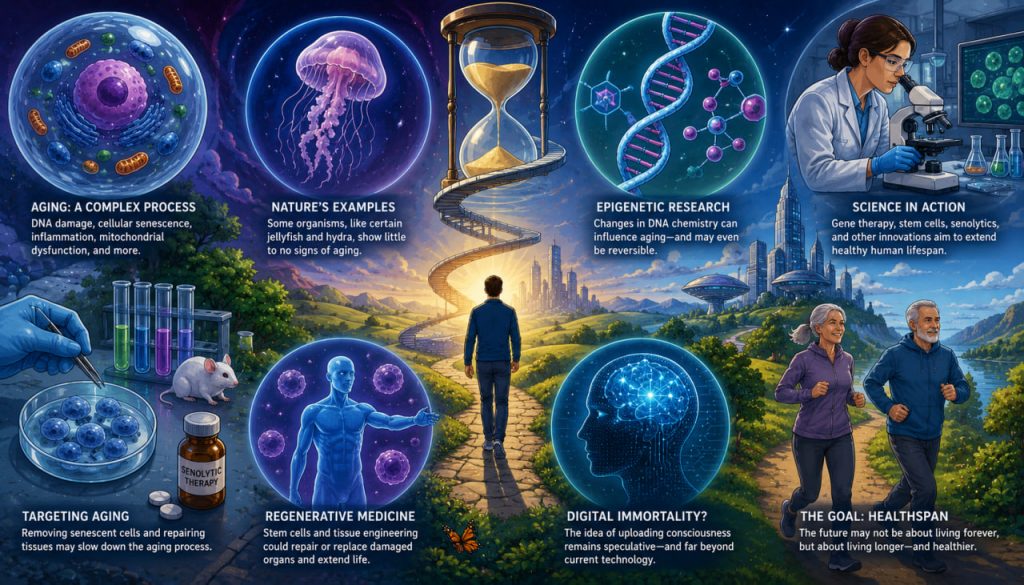
Aging is a complex process involving many interconnected mechanisms.
Scientists have identified several major contributors:
- DNA damage accumulation
- Cellular senescence
- Mitochondrial dysfunction
- Chronic inflammation
- Stem cell exhaustion
- Protein misfolding
Cellular senescence occurs when cells stop dividing but remain alive, often releasing substances that contribute to tissue deterioration.
Over decades, these processes gradually reduce the body’s ability to maintain and repair itself.
Aging is not caused by a single factor but by the interaction of numerous biological mechanisms.
Are There Immortal Organisms?
Surprisingly, nature offers examples of organisms that challenge traditional ideas about aging.
One famous example is the jellyfish Turritopsis dohrnii.
Under certain conditions, this species can revert from its adult stage back to an earlier developmental form, effectively restarting part of its life cycle.
Other organisms show negligible senescence, meaning they exhibit little measurable aging over time.
Examples include:
- Certain jellyfish
- Some hydra species
- A few long-lived marine animals
These organisms demonstrate that aging is not an unavoidable feature of all life.
Can Science Slow Aging?
One of the most active areas of biomedical research focuses on slowing biological aging.
Researchers are investigating:
- Senolytic therapies that remove senescent cells
- Gene-editing technologies
- Stem cell treatments
- Calorie restriction mechanisms
- Epigenetic reprogramming
Animal studies have produced impressive results.
In laboratory experiments, scientists have significantly extended the lifespan of worms, flies, and mice through genetic and pharmaceutical interventions.
While humans are far more complex, these findings suggest that aging may be more flexible than previously believed.
The Role of Epigenetics
One of the most exciting discoveries in longevity science involves epigenetics.
Epigenetics refers to chemical modifications that influence how genes function without changing the DNA sequence itself.
Researchers have developed epigenetic clocks that estimate biological age by analyzing DNA methylation patterns.
These clocks suggest that aging leaves measurable signatures within cells.
Some experimental studies have shown that certain interventions may partially reverse these biological markers.
Although the field remains young, many scientists believe epigenetics may hold important clues to extending healthy lifespan.
Expert Perspective
Harvard geneticist David Sinclair has become one of the most prominent researchers studying aging and longevity.
His work suggests that many aspects of aging may be more reversible than previously assumed.
“Aging is the greatest cause of suffering worldwide, and it is potentially treatable.”
While Sinclair does not claim immortality is near, his research reflects a growing scientific view that aging itself may eventually become a target for medical intervention.
Could Gene Editing Extend Human Life?
Gene-editing technologies such as CRISPR have created new possibilities for treating inherited diseases and modifying biological processes.
Researchers are exploring whether genetic interventions could:
- Improve cellular repair
- Reduce age-related damage
- Enhance longevity pathways
- Prevent certain diseases
However, human aging involves thousands of interacting genes and biological systems.
As a result, extending lifespan significantly through genetic engineering remains a major scientific challenge.
What About Replacing Body Parts?
Another approach focuses on regenerative medicine.
Scientists are developing techniques to repair or replace damaged tissues using:
- Stem cells
- Artificial organs
- Tissue engineering
- Bioprinting technologies
Future advances may allow doctors to replace failing organs more effectively than ever before.
If individual components of the body can be continuously repaired or replaced, lifespan could potentially increase dramatically.
However, many technical and biological obstacles remain.
Digital Immortality: Uploading the Mind
Some futurists propose a very different path toward immortality.
The concept of digital immortality suggests that one day it might be possible to transfer or replicate human consciousness within computers.
This idea remains highly speculative.
Scientists still do not fully understand how consciousness emerges from the brain.
As a result, no existing technology can preserve a person’s mind in digital form.
Whether such a transfer would truly preserve personal identity is also the subject of intense philosophical debate.
The Limits of Human Longevity
Even if aging could be dramatically slowed, immortality would remain difficult to achieve.
Humans would still face risks from:
- Accidents
- Natural disasters
- Infectious diseases
- Environmental hazards
- Cosmic events
For this reason, many scientists prefer discussing life extension rather than immortality.
Extending healthy lifespan by decades may ultimately prove more realistic than achieving eternal life.
What Is Most Likely in the Future?
Most experts do not expect true immortality in the foreseeable future.
However, many researchers believe that substantial increases in healthy lifespan may become possible.
Future medicine may allow people to:
- Remain healthier for longer
- Delay age-related diseases
- Maintain physical function later in life
- Extend average lifespan beyond current expectations
The goal increasingly focuses on improving healthspan—the years spent in good health—rather than simply adding more years.
Conclusion
Science has not discovered a path to human immortality, but it has fundamentally changed how researchers view aging. Once considered an unavoidable consequence of life, aging is now increasingly studied as a biological process that may be influenced, slowed, or partially reversed.
From gene therapy and stem cells to epigenetic research and regenerative medicine, modern science is uncovering mechanisms that could significantly extend healthy lifespan. While true immortality remains beyond our current capabilities, the possibility of living longer and healthier lives is becoming increasingly realistic.
Interesting Facts
- The average human lifespan has more than doubled in many countries over the past two centuries.
- Some jellyfish can revert to earlier life stages and effectively restart part of their life cycle.
- Certain species of hydra show little evidence of biological aging.
- Scientists have extended the lifespan of laboratory animals through genetic modifications.
- Epigenetic clocks can estimate biological age by analyzing DNA chemistry.
- Researchers increasingly study aging itself as a medical condition that may be treatable.
Glossary
- Biological Immortality — A condition in which aging does not increase the risk of death over time.
- Cellular Senescence — A state in which cells stop dividing but remain alive and can contribute to aging.
- Epigenetics — Chemical modifications that regulate gene activity without altering DNA sequences.
- DNA Methylation — The attachment of methyl groups to DNA that can influence gene expression.
- Stem Cells — Cells capable of developing into various specialized cell types.
- Healthspan — The portion of life spent in good health and free from major age-related disease.