Bacteria are among the smallest and oldest living organisms on Earth. Although a single bacterium is only a tiny fraction of a millimeter in size and lacks a brain or nervous system, many species can perform surprisingly sophisticated behaviors. One of the most remarkable is the ability to locate food sources in their environment.
This process is known as chemotaxis—the ability of an organism to move in response to chemical signals. Through chemotaxis, bacteria can detect nutrients, avoid harmful substances, and navigate complex environments with astonishing efficiency.
At first glance, it may seem impossible for a microscopic cell to “search” for food. Yet bacteria have evolved molecular systems that allow them to sense chemical gradients and make movement decisions that increase their chances of survival.
In many ways, chemotaxis represents one of nature’s simplest and most elegant navigation systems.
What Is Chemotaxis?
Chemotaxis is the directed movement of an organism toward or away from a chemical stimulus.
The word comes from:
- “Chemo” — referring to chemicals
- “Taxis” — meaning directed movement
When bacteria move toward beneficial substances such as nutrients, the process is called positive chemotaxis.
When they move away from harmful chemicals or toxins, it is called negative chemotaxis.
This behavior allows bacteria to respond dynamically to changing environmental conditions.
Why Do Bacteria Need Chemotaxis?
Nutrients are rarely distributed evenly in nature.
Instead, food sources often occur in patches.
Examples include:
- Decaying organic matter
- Plant roots
- Animal tissues
- Nutrient-rich water droplets
A bacterium that can move toward richer nutrient sources gains a significant survival advantage over one that simply drifts randomly.
Chemotaxis increases the likelihood of finding:
- Sugars
- Amino acids
- Organic compounds
- Other essential nutrients
For many bacteria, successful chemotaxis can mean the difference between survival and starvation.
How Can a Single Cell Detect Food?
Unlike animals, bacteria cannot see, smell, or hear.
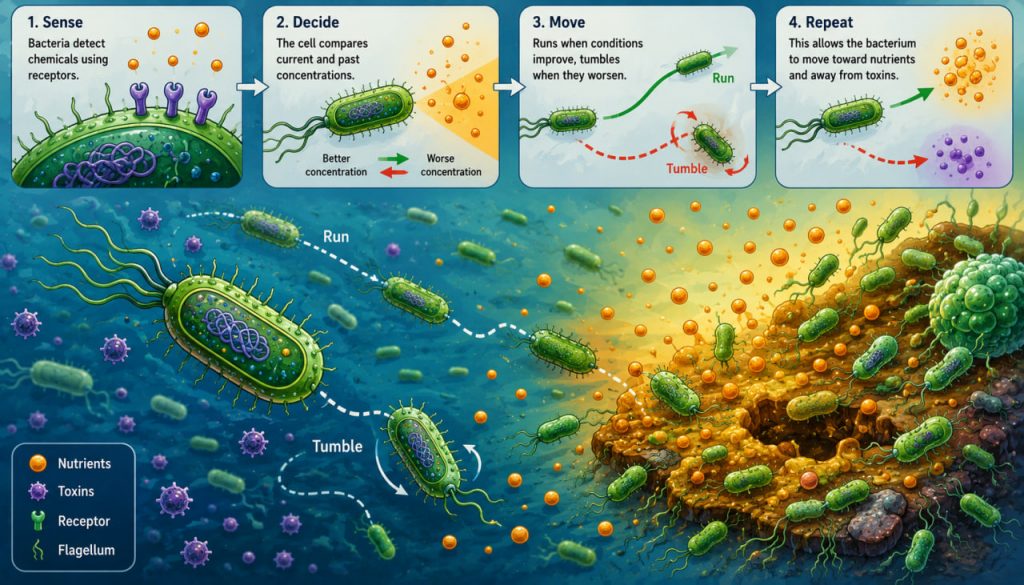
Instead, they rely on specialized receptor proteins embedded in their cell membranes.
These receptors act as microscopic chemical sensors.
When nutrient molecules bind to the receptors, they trigger biochemical signals inside the cell.
The bacterium then adjusts its movement accordingly.
Although the process is entirely molecular, the result resembles a simple form of decision-making.
The Challenge of Measuring a Chemical Gradient
A fascinating problem arises when considering the tiny size of bacteria.
Most bacteria are far too small to measure chemical concentrations at multiple points simultaneously.
Instead, they use a clever strategy.
A bacterium compares chemical concentrations over time.
If nutrient levels increase as it moves, it continues in roughly the same direction.
If nutrient levels decrease, it changes direction more frequently.
By repeatedly sampling its environment, the bacterium gradually moves toward more favorable conditions.
Run-and-Tumble Navigation
Many bacteria, including the famous species Escherichia coli, use a movement pattern called run-and-tumble behavior.
This process consists of two phases:
Run
The bacterium swims forward in a relatively straight line.
Tumble
The bacterium briefly rotates and reorients itself randomly.
After tumbling, a new run begins.
When conditions improve, bacteria extend their runs and reduce tumbling frequency.
When conditions worsen, they tumble more often and explore alternative directions.
This simple strategy allows surprisingly effective navigation.
The Role of Flagella
Many motile bacteria move using structures called flagella.
A flagellum is a long, whip-like appendage powered by a microscopic rotary motor.
This motor is one of the most remarkable biological machines known.
The bacterial flagellar motor can rotate hundreds of times per second and is driven by ion gradients across the cell membrane.
By controlling flagellar rotation, bacteria can switch between running and tumbling.
The coordination of these movements forms the basis of bacterial chemotaxis.
More Than Just Food Detection
Chemotaxis is not limited to locating nutrients.
Bacteria can also respond to:
- Oxygen concentrations
- Light conditions
- Acidity levels
- Toxic chemicals
- Signals produced by other microorganisms
Some species even use chemotaxis during infection.
Pathogenic bacteria may follow chemical cues that guide them toward host tissues where nutrients are abundant.
Understanding these mechanisms is important in medical research.
Chemotaxis and Biofilms
Chemotaxis also plays a role in the formation of biofilms.
A biofilm is a community of microorganisms attached to a surface and surrounded by a protective matrix.
Examples include:
- Dental plaque
- Microbial communities on rocks
- Bacterial layers in pipes
Chemotactic responses help bacteria locate suitable surfaces and aggregate with other cells.
Once established, biofilms can become highly resistant to environmental stresses.
Expert Perspective
Microbiologist Howard Berg was one of the pioneers of bacterial chemotaxis research.
His studies revealed the extraordinary sophistication of bacterial movement systems.
“Bacteria are small, but they are not simple.”
This observation captures an important scientific lesson. Despite their microscopic size, bacteria possess highly refined molecular mechanisms that allow them to interact intelligently with their surroundings.
What Chemotaxis Reveals About Life
Chemotaxis demonstrates that complex behavior does not necessarily require a brain.
Through networks of proteins, receptors, and molecular signals, bacteria can gather information and modify their behavior in response.
Scientists often view chemotaxis as an example of biological information processing at its most fundamental level.
It represents a bridge between chemistry and behavior.
Studying these systems helps researchers understand:
- Evolution
- Cellular communication
- Microbial ecology
- Disease mechanisms
- The origins of biological decision-making
Could Chemotaxis Inspire Technology?
Researchers are increasingly using bacterial navigation as inspiration for engineering.
Scientists are developing microscopic robots and smart materials that mimic chemotactic behavior.
Potential future applications include:
- Targeted drug delivery
- Environmental cleanup
- Medical diagnostics
- Industrial biotechnology
By learning from bacteria, engineers hope to create systems capable of navigating complex environments autonomously.
Conclusion
Chemotaxis is one of the most impressive abilities found in microscopic life. Through specialized receptors, molecular signaling pathways, and flagellar motors, bacteria can locate nutrients, avoid harmful substances, and navigate their environment with remarkable efficiency.
Although bacteria lack brains and nervous systems, their chemotactic behavior demonstrates how sophisticated biological systems can emerge from simple molecular interactions. Far from being passive microorganisms, bacteria are active explorers constantly sensing, evaluating, and responding to the chemical world around them.
Interesting Facts
- Some bacterial flagellar motors can rotate hundreds of times per second.
- Chemotaxis was one of the first complex cellular behaviors studied at the molecular level.
- Bacteria can detect extremely small differences in chemical concentrations.
- A single bacterium can continuously adjust its movement based on environmental changes.
- Chemotaxis helps many pathogenic bacteria locate suitable host tissues.
- Researchers use bacterial movement as inspiration for microscopic robotic systems.
Glossary
- Chemotaxis — Directed movement toward or away from a chemical stimulus.
- Chemical Gradient — A gradual change in chemical concentration across a space.
- Flagellum — A whip-like structure used by many bacteria for movement.
- Receptor Protein — A protein that detects specific molecules and initiates cellular responses.
- Biofilm — A community of microorganisms attached to a surface and protected by a self-produced matrix.
- Motile — Capable of active movement.