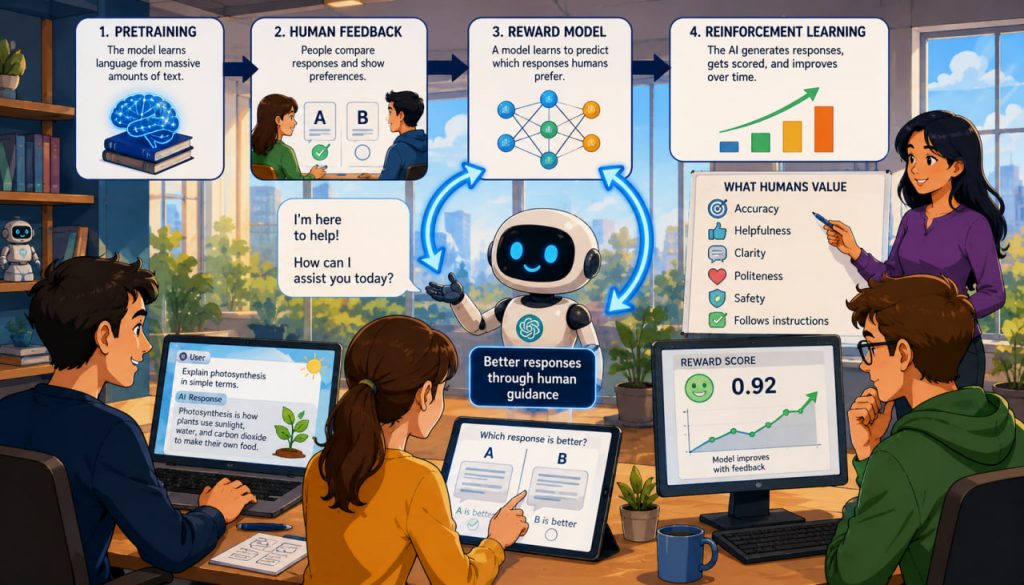
Modern AI chatbots can answer questions, explain complex topics, write code, summarize documents, and carry on surprisingly natural conversations. While large language models learn grammar, facts, and patterns from enormous collections of text, their ability to respond in a helpful, polite, and safe manner comes from additional training beyond simply predicting the next word.
One of the most influential techniques behind today’s conversational AI is Reinforcement Learning from Human Feedback (RLHF). Rather than teaching an AI by providing correct answers alone, RLHF allows human reviewers to evaluate model responses and guide the system toward behaviors that people generally find more useful, accurate, and respectful. This approach has played a major role in transforming powerful language models into practical assistants used by millions of people worldwide.
What Is Reinforcement Learning from Human Feedback?
Reinforcement Learning from Human Feedback, commonly abbreviated as RLHF, is a machine learning technique that combines human judgment with reinforcement learning.
Instead of simply memorizing information, the AI gradually learns which types of responses people prefer.
The process generally involves three stages:
- Pretraining on large text datasets
- Human evaluation of model responses
- Reinforcement learning using those evaluations
The goal is not to make the AI “think like a human,” but to encourage it to produce answers that better match human expectations for clarity, usefulness, and safety.
RLHF teaches preferences rather than facts.
Step One: Learning Language
Every modern large language model begins with pretraining.
During this stage, the model analyzes enormous amounts of publicly available and licensed text to learn:
- Grammar
- Vocabulary
- Writing styles
- Logical relationships
- General world knowledge
- Patterns in language
At this point, the model becomes very good at predicting likely sequences of words.
However, it still does not reliably understand which answers people consider most helpful.
For example, it may generate responses that are technically fluent but overly verbose, confusing, or poorly organized.
Step Two: Humans Compare Responses
The next stage introduces human feedback.
Reviewers are presented with several possible responses to the same question.
Instead of writing new answers themselves, they often compare the model’s outputs and select the better response.
They typically evaluate qualities such as:
- Accuracy
- Clarity
- Helpfulness
- Politeness
- Relevance
- Harmlessness
- Following instructions
Thousands—or even millions—of these comparisons are collected.
This information becomes a valuable dataset describing human preferences.
Step Three: Training a Reward Model
The comparison data is used to train a separate machine learning system known as a reward model.
The reward model learns to estimate which responses humans are likely to prefer.
Instead of assigning rewards based on game scores or physical actions, it predicts human satisfaction.
For example, it may learn that people generally prefer answers that:
- Are well organized.
- Avoid unnecessary repetition.
- Explain reasoning clearly.
- Remain respectful.
- Avoid harmful or misleading content.
This learned reward signal becomes the objective used during reinforcement learning.
Step Four: Reinforcement Learning
Once the reward model has been trained, reinforcement learning begins.
The language model generates responses.
The reward model scores those responses.
The language model then gradually adjusts itself to produce outputs expected to receive higher scores.
This process resembles reinforcement learning used in robotics or game-playing AI, except the “reward” comes from learned human preferences rather than winning a game.
Over many training iterations, the chatbot becomes increasingly aligned with desired conversational behavior.
Why Doesn’t RLHF Just Teach Good Manners?
Politeness is only one small part of RLHF.
Human feedback also encourages the model to:
- Stay on topic.
- Follow instructions carefully.
- Admit uncertainty when appropriate.
- Avoid unnecessary speculation.
- Explain complex ideas clearly.
- Refuse unsafe requests appropriately.
- Maintain consistent conversational behavior.
The objective is to make the model more useful and reliable—not merely more polite.
A concise answer may receive a higher reward than a longer one if it better satisfies the user’s request.
Can Human Feedback Be Biased?
Yes.
Because RLHF depends on human judgments, it inevitably reflects the preferences and guidelines used during training.
Researchers therefore invest considerable effort in:
- Using diverse reviewers.
- Developing detailed evaluation guidelines.
- Measuring consistency between evaluators.
- Continuously improving training methods.
No system can perfectly represent every person’s preferences.
Modern AI development therefore combines RLHF with additional evaluation methods, safety testing, and ongoing research into alignment.
New Approaches Beyond RLHF
Although RLHF remains highly influential, researchers are actively developing complementary methods.
These include:
- AI-assisted feedback
- Constitutional AI
- Reinforcement Learning from AI Feedback (RLAIF)
- Direct Preference Optimization (DPO)
- Improved alignment techniques
Some of these methods reduce dependence on large numbers of human comparisons while still encouraging desirable behavior.
Future AI systems will likely combine several alignment approaches rather than relying on a single training method.
Why RLHF Matters
Without alignment techniques such as RLHF, many language models would still generate fluent text, but their responses would often be less helpful, less consistent, and more difficult to use.
RLHF has improved AI assistants by encouraging behaviors such as:
- Better instruction following.
- More organized explanations.
- More natural conversations.
- Increased transparency about uncertainty.
- Greater focus on user intent.
It represents one of the key advances that transformed research language models into practical conversational assistants.
Expert Perspective
AI researcher Professor John Schulman, one of the pioneers of modern reinforcement learning and a key contributor to the development of RLHF techniques, has emphasized that human feedback provides an effective way to align powerful language models with what users actually want rather than simply optimizing next-word prediction. His work helped establish RLHF as one of the foundational methods for improving conversational AI.
Researchers at organizations including OpenAI, Anthropic, and Google DeepMind continue developing new alignment methods that build upon or complement RLHF. Current research increasingly focuses on improving factual reliability, reducing hallucinations, and making AI systems better at communicating uncertainty while remaining helpful.
The Future of Human-Guided AI
RLHF demonstrates an important principle in artificial intelligence: building increasingly capable models is only part of the challenge.
Equally important is teaching those models how people want them to behave.
As AI systems become more powerful, researchers continue exploring better ways to align them with human values, improve transparency, reduce errors, and encourage trustworthy interactions.
Rather than teaching machines simple politeness, Reinforcement Learning from Human Feedback has become one of the most significant tools for shaping AI into assistants that communicate more clearly, respond more responsibly, and better support the people who use them every day.
Interesting Facts
- RLHF became one of the defining techniques behind modern conversational AI in the early 2020s.
- Human reviewers often compare multiple model responses instead of writing answers from scratch.
- A separate reward model predicts which responses people are likely to prefer.
- Reinforcement learning was originally developed for problems such as robotics and game-playing before being adapted for language models.
- Some newer alignment methods reduce the amount of human feedback required by using AI-assisted evaluation.
- Large language models first learn language patterns before learning conversational preferences through alignment training.
- Researchers continue exploring methods that improve factual accuracy and reduce hallucinations alongside RLHF.
Glossary
- Reinforcement Learning from Human Feedback (RLHF) — A machine learning technique that uses human preference judgments to improve AI behavior.
- Large Language Model (LLM) — An AI system trained on vast amounts of text to understand and generate human language.
- Pretraining — The initial stage in which a language model learns statistical patterns from large text datasets.
- Reward Model — A machine learning model trained to predict which AI responses humans are likely to prefer.
- Alignment — The process of encouraging AI systems to behave in ways that better match human goals, instructions, and safety expectations.
- Reinforcement Learning — A type of machine learning in which a system improves its behavior by maximizing a reward signal.
- Hallucination — An AI-generated statement that is presented confidently but is inaccurate, unsupported, or fabricated.
- Direct Preference Optimization (DPO) — A modern alignment technique that trains language models directly from human preference data without using a separate reinforcement learning stage.