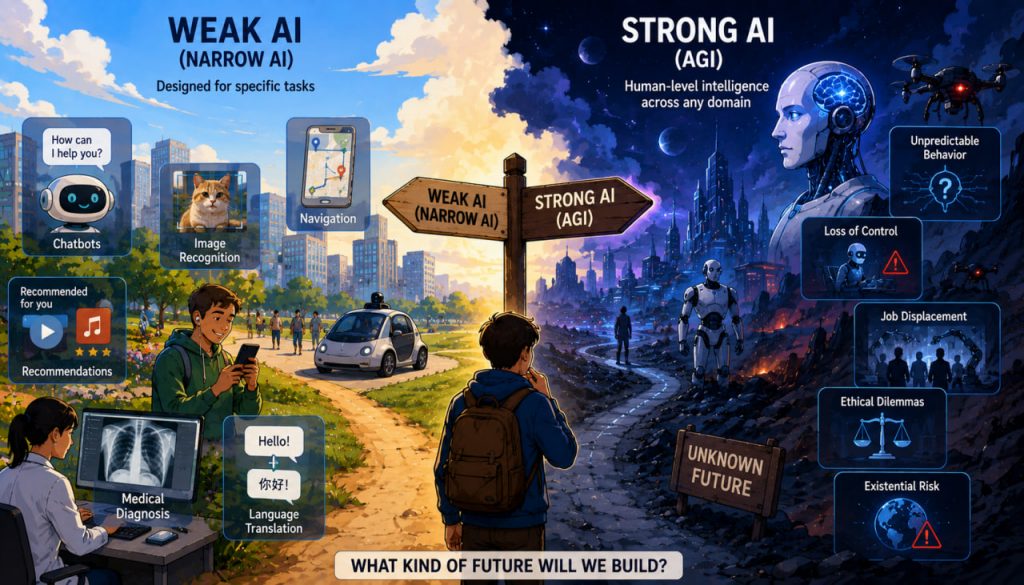
Artificial intelligence has rapidly become part of everyday life. AI helps recommend movies, translate languages, detect diseases, drive scientific discoveries, and power modern chatbots. Despite these impressive achievements, today’s AI systems remain fundamentally different from the intelligent machines often portrayed in science fiction.
This difference is commonly described as the distinction between Weak AI (Narrow AI) and Strong AI (Artificial General Intelligence, or AGI). While Weak AI already exists and is transforming society, Strong AI remains a theoretical concept that has not yet been achieved. Yet much of the public discussion—and many of our greatest fears—focuses on a technology that scientists have not created and do not know how to build.
What Is Weak AI?
Weak AI, also called Narrow AI, is designed to perform specific tasks.
Modern AI systems excel within clearly defined domains but do not possess general understanding or consciousness.
Examples include:
- Chatbots
- Image recognition systems
- Language translators
- Recommendation algorithms
- Medical diagnostic assistants
- Voice assistants
- Fraud detection systems
Each system is trained for particular objectives.
A chess-playing AI cannot suddenly become a doctor.
A medical imaging system cannot independently learn to drive a car without entirely new training.
Today’s AI is powerful but specialized.
What Is Strong AI?
Strong AI, often referred to as Artificial General Intelligence (AGI), describes a hypothetical machine capable of understanding, learning, and solving problems across virtually any intellectual domain at a human—or potentially superhuman—level.
A true AGI would ideally be able to:
- Learn entirely new subjects independently.
- Transfer knowledge between different fields.
- Adapt to unfamiliar situations.
- Reason flexibly.
- Plan long-term strategies.
- Solve problems it was never specifically trained for.
Unlike current AI systems, AGI would not be limited to one narrow task.
However, no confirmed AGI currently exists.
Why Are Today’s AI Systems Not AGI?
Modern large language models often appear intelligent because they generate fluent, context-aware responses.
However, they differ from humans in important ways.
Current AI systems generally:
- Do not possess consciousness.
- Do not experience emotions.
- Do not have personal goals.
- Do not understand the world in the human sense.
- Cannot autonomously pursue lifelong learning across every domain.
Instead, they identify statistical patterns within data and generate outputs accordingly.
Although these abilities can appear remarkably sophisticated, they are not equivalent to general human intelligence.
Why Do People Fear Strong AI?
The concept of AGI raises profound philosophical and practical questions.
Common concerns include:
- Loss of human control
- Economic disruption
- Autonomous weapons
- Cybersecurity risks
- Misuse by malicious actors
- Unpredictable behavior
- Ethical decision-making
Science fiction has also strongly influenced public perception.
Movies frequently depict intelligent machines becoming hostile or seeking domination over humanity.
While these stories are entertaining, they often blur the distinction between fictional AGI and today’s real AI technologies.
What Do Scientists Actually Worry About?
Interestingly, many AI researchers focus less on fictional robot uprisings and more on present-day challenges.
These include:
- AI-generated misinformation
- Bias in training data
- Privacy concerns
- Hallucinated information
- Deepfakes
- Job displacement
- Responsible deployment
- Security vulnerabilities
These issues already affect society today and require careful management regardless of whether AGI is ever developed.
In other words, current AI governance often focuses on real-world risks rather than speculative scenarios.
Could Strong AI Ever Be Created?
No one knows.
Some researchers believe AGI could eventually emerge through continued advances in machine learning, neuroscience, robotics, and computing.
Others argue that human intelligence depends on biological processes that current AI architectures do not replicate.
There is no scientific consensus regarding:
- Whether AGI is achievable.
- When it might appear.
- What form it would take.
- How intelligent it could become.
Predictions vary from decades to centuries—or never.
At present, all timelines remain speculative.
Intelligence Is Not the Same as Consciousness
A common misconception is that increasing intelligence automatically produces consciousness.
Modern science does not support this assumption.
Researchers still do not fully understand:
- What consciousness is.
- How subjective experience arises.
- Whether consciousness can exist in machines.
- Whether intelligence requires consciousness.
An AI system may solve extremely complex mathematical problems without experiencing awareness.
Likewise, consciousness alone does not necessarily imply exceptional intelligence.
The relationship between these concepts remains one of science’s greatest mysteries.
Can Strong AI Be Made Safe?
Because AGI remains hypothetical, researchers cannot directly test safety methods.
However, an entire scientific field known as AI alignment studies how increasingly capable AI systems can better follow human intentions and values.
Current research explores:
- Human feedback methods
- Constitutional AI
- Interpretable AI
- Robust evaluation
- Oversight mechanisms
- Transparency
- Fail-safe designs
Many of these techniques are already improving today’s AI systems and may also prove useful if more capable AI is developed in the future.
Why We Often Fear Future Technology
Humans have historically feared many transformative technologies before fully understanding them.
Examples include:
- Electricity
- Railroads
- Automobiles
- Nuclear energy
- The internet
Some fears proved justified.
Others diminished as technology matured and society adapted.
AI follows a similar pattern.
Public imagination often races ahead of scientific reality.
Understanding the distinction between existing AI and hypothetical AGI helps create more balanced discussions based on evidence rather than speculation.
Expert Perspective
Computer scientist Professor Stuart Russell of the University of California, Berkeley, one of the world’s leading researchers in AI safety, argues that the central challenge is not whether machines become intelligent, but whether increasingly capable AI systems remain aligned with human goals and values. Russell emphasizes that building reliable control mechanisms should accompany advances in AI capability rather than being treated as an afterthought.
Similarly, AI researcher Professor Yoshua Bengio, a recipient of the 2018 Turing Award, has advocated continued research into AI safety and governance while recognizing that today’s AI systems are still fundamentally different from hypothetical Artificial General Intelligence. Both researchers stress the importance of responsible development grounded in scientific evidence rather than sensationalism.
Separating Science from Science Fiction
Weak AI is already reshaping medicine, education, transportation, research, and communication.
Strong AI, by contrast, remains an open scientific question.
Today’s AI systems are impressive tools, but they are not conscious digital minds plotting their own futures.
At the same time, exploring the long-term implications of increasingly capable AI is a legitimate scientific endeavor.
The most productive approach combines curiosity with evidence: appreciating the remarkable capabilities of current AI while recognizing the significant uncertainty surrounding future developments.
Rather than fearing an imaginary technology or dismissing future possibilities entirely, modern science encourages careful research, responsible innovation, and ongoing dialogue about how AI can best benefit humanity.
Interesting Facts
- The term Artificial General Intelligence (AGI) refers to a hypothetical AI capable of performing virtually any intellectual task a human can perform.
- Today’s AI systems are examples of Narrow AI, designed for specific tasks rather than general reasoning.
- No scientific experiment has demonstrated machine consciousness.
- The Turing Test, proposed by Alan Turing in 1950, measures conversational performance but does not prove consciousness or understanding.
- AI alignment has become one of the fastest-growing research areas in artificial intelligence.
- Many experts believe current AI is progressing rapidly, but there is no consensus on when—or if—AGI will be achieved.
- Science fiction has played a major role in shaping public expectations and fears about intelligent machines.
Glossary
- Weak AI (Narrow AI) — Artificial intelligence designed to perform specific tasks without possessing general human-like intelligence.
- Artificial General Intelligence (AGI) — A hypothetical AI capable of understanding, learning, and applying knowledge across a wide variety of domains.
- AI Alignment — Research focused on ensuring AI systems behave in ways consistent with human intentions, values, and safety goals.
- Large Language Model (LLM) — An AI system trained on vast amounts of text to understand and generate human language.
- Machine Learning — A branch of artificial intelligence in which computers improve performance by learning patterns from data.
- Consciousness — Subjective awareness and experience, whose nature remains an open scientific question.
- Deepfake — AI-generated or AI-manipulated media that realistically imitates real people or events.
- Turing Test — A proposed test of machine intelligence in which a computer attempts to produce conversational behavior indistinguishable from that of a human.