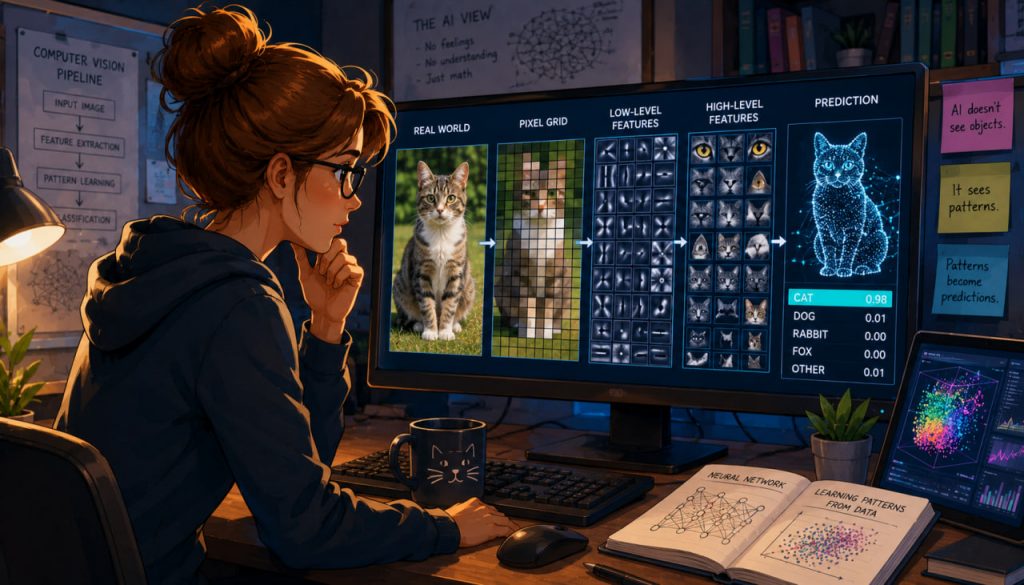
Artificial intelligence can recognize faces, detect tumors in medical scans, identify wildlife in forests, and even help self-driving cars navigate busy streets. To humans, these achievements may seem to suggest that AI “sees” the world much like we do. In reality, modern computer vision works in a fundamentally different way. An AI does not perceive a cat as a furry animal with whiskers, ears, and a tail. Instead, it processes millions of numerical values representing patterns of colored pixels.
This distinction is one of the most fascinating aspects of artificial intelligence. While humans interpret images through experience, context, and common sense, computer vision systems rely on mathematical relationships hidden within digital images. Understanding how AI actually “sees” reveals both the remarkable power and important limitations of modern machine learning.
What Is Computer Vision?
Computer vision is a branch of artificial intelligence that enables computers to extract useful information from images and videos.
Its goals include tasks such as:
- Object recognition
- Face detection
- Medical image analysis
- Autonomous vehicle navigation
- Industrial quality inspection
- Satellite image interpretation
Rather than understanding images like humans, computer vision converts visual information into numerical data that machine learning models can analyze.
To a computer, every image begins as a grid of numbers—not as recognizable objects.
An Image Is Just Numbers
Every digital image consists of tiny squares called pixels.
Each pixel stores numerical values representing color.
For example:
- Red intensity
- Green intensity
- Blue intensity
A typical smartphone photograph may contain over 12 million pixels.
Each pixel carries numerical information, but none individually contains concepts like:
- Cat
- Tree
- Car
- Person
Instead, the AI receives an enormous matrix of numbers.
Its challenge is discovering statistical patterns hidden within those numbers.
AI Does Not “See” a Cat
When humans look at a cat, we instantly recognize:
- Fur
- Eyes
- Tail
- Movement
- Expression
- Context
Our brains combine visual perception with memory, language, and life experience.
AI does something entirely different.
A neural network analyzes relationships among neighboring pixels.
It gradually detects increasingly complex visual features.
Early layers identify:
- Edges
- Lines
- Simple curves
Later layers combine these into:
- Eyes
- Ears
- Fur textures
- Body shapes
Eventually, the model estimates the probability that the image belongs to the category “cat.”
The AI never experiences “catness” in the way humans do—it computes probabilities based on learned patterns.
Learning Through Millions of Examples
Computer vision systems are trained using enormous image datasets.
Each image is typically labeled.
For example:
- Cat
- Dog
- Bicycle
- Apple
- Airplane
During training, the neural network repeatedly compares its predictions with the correct labels.
When mistakes occur, mathematical optimization algorithms adjust millions—or even billions—of internal parameters.
Over time, the system gradually becomes better at recognizing visual patterns.
Importantly, the AI is not memorizing individual cats.
Instead, it learns statistical features shared by many different cats.
Why AI Sometimes Makes Strange Mistakes
Because AI relies on statistical patterns rather than true understanding, unusual images can confuse it.
Examples include:
- Objects viewed from unexpected angles
- Poor lighting
- Partial occlusion
- Visual illusions
- Unusual backgrounds
Researchers have also demonstrated adversarial examples—images altered by tiny, carefully designed changes that humans barely notice but that cause AI systems to make completely incorrect predictions.
For example, a few imperceptible pixel modifications might cause a model to classify a cat as a dog or a stop sign as another object.
These examples highlight that computer vision remains fundamentally different from human perception.
Convolutional Neural Networks Changed Everything
One of the biggest breakthroughs in computer vision came with Convolutional Neural Networks (CNNs).
Unlike earlier image recognition methods that relied heavily on manually designed features, CNNs automatically learn useful visual representations.
They process images layer by layer.
Early layers detect simple structures.
Deeper layers recognize increasingly sophisticated patterns.
This architecture dramatically improved performance in:
- Medical imaging
- Face recognition
- Wildlife monitoring
- Manufacturing inspection
- Autonomous driving
Although newer architectures such as Vision Transformers (ViTs) have become increasingly important, CNNs remain foundational in computer vision.
Does AI Understand Images?
This question is actively debated.
Current AI systems can describe images remarkably well.
They can identify hundreds of objects simultaneously.
Some models even explain relationships between objects.
However, researchers generally distinguish between recognition and understanding.
Today’s computer vision systems excel at pattern recognition.
Whether they possess genuine semantic understanding remains uncertain.
Many experts argue that current AI lacks the common-sense reasoning humans naturally apply when interpreting visual scenes.
How Humans and AI Differ
Human vision depends on far more than the eyes alone.
The brain combines:
- Vision
- Memory
- Language
- Touch
- Experience
- Expectations
- Common sense
For example, humans instantly understand that a toy cat is not a living animal.
An AI may require extensive training examples before making the same distinction reliably.
Humans also recognize objects despite dramatic changes in lighting, orientation, or context with remarkable flexibility.
Modern AI has improved enormously but still struggles in situations that humans find effortless.
Why Computer Vision Matters
Despite its limitations, computer vision has become one of the most valuable technologies in modern science and industry.
Applications include:
- Detecting cancer in medical scans
- Monitoring crops
- Reading handwritten documents
- Guiding robots
- Assisting visually impaired individuals
- Monitoring wildlife populations
- Improving manufacturing quality control
Each year, new algorithms continue narrowing the gap between machine perception and human performance for many specialized tasks.
Expert Perspective
Computer scientist Professor Fei-Fei Li, one of the pioneers of modern computer vision and creator of the influential ImageNet dataset, has emphasized that teaching machines to recognize visual patterns requires exposing them to vast numbers of carefully labeled examples, allowing neural networks to gradually learn increasingly complex visual representations. Her work helped spark the deep learning revolution in image recognition.
Similarly, AI researcher Professor Yann LeCun, recipient of the 2018 Turing Award, has noted that while deep neural networks have transformed computer vision, current AI systems still differ fundamentally from human intelligence because they primarily learn statistical representations rather than possessing human-like common-sense understanding of the physical world.
Seeing Without Understanding
Modern computer vision is one of the greatest achievements in artificial intelligence.
It allows machines to perform visual tasks that once seemed impossible.
Yet AI does not experience the world as humans do.
What appears to us as a familiar cat is, to an AI, a vast mathematical landscape of pixel values, probabilities, and learned statistical patterns.
This difference explains both the extraordinary success and the occasional surprising failures of computer vision systems.
As researchers continue developing more advanced AI architectures that combine vision, language, memory, and reasoning, machines may become increasingly capable of interpreting the world.
For now, however, AI does not truly “see” a cat—it analyzes a cloud of pixels and concludes, with a certain probability, that those numbers most closely resemble one.
Interesting Facts
- A single 12-megapixel smartphone photo contains approximately 12 million individual pixels.
- Early computer vision systems relied on manually engineered image features, while modern deep learning models learn these features automatically.
- ImageNet, introduced in 2009, contains millions of labeled images and played a major role in advancing deep learning.
- Tiny pixel modifications called adversarial perturbations can sometimes fool AI systems while remaining invisible to humans.
- Convolutional Neural Networks revolutionized image recognition after achieving dramatic improvements in the 2012 ImageNet competition.
- Some modern AI systems combine computer vision with large language models to describe images and answer questions about them.
- Human vision processes information using both the eyes and extensive neural networks throughout the brain, integrating memory, context, and prior knowledge.
Glossary
- Computer Vision — A field of artificial intelligence that enables computers to analyze and interpret images and videos.
- Pixel — The smallest unit of a digital image, storing numerical color information.
- Neural Network — A machine learning model inspired by interconnected neurons that learns patterns from data.
- Convolutional Neural Network (CNN) — A specialized neural network architecture designed for image analysis by learning visual features automatically.
- Vision Transformer (ViT) — A newer deep learning architecture that applies transformer models to image recognition tasks.
- ImageNet — A large, labeled image dataset that significantly advanced computer vision research.
- Adversarial Example — An image modified in subtle ways that causes an AI system to make an incorrect prediction.
- Pattern Recognition — The process of identifying meaningful structures or regularities within data, forming the basis of modern computer vision.