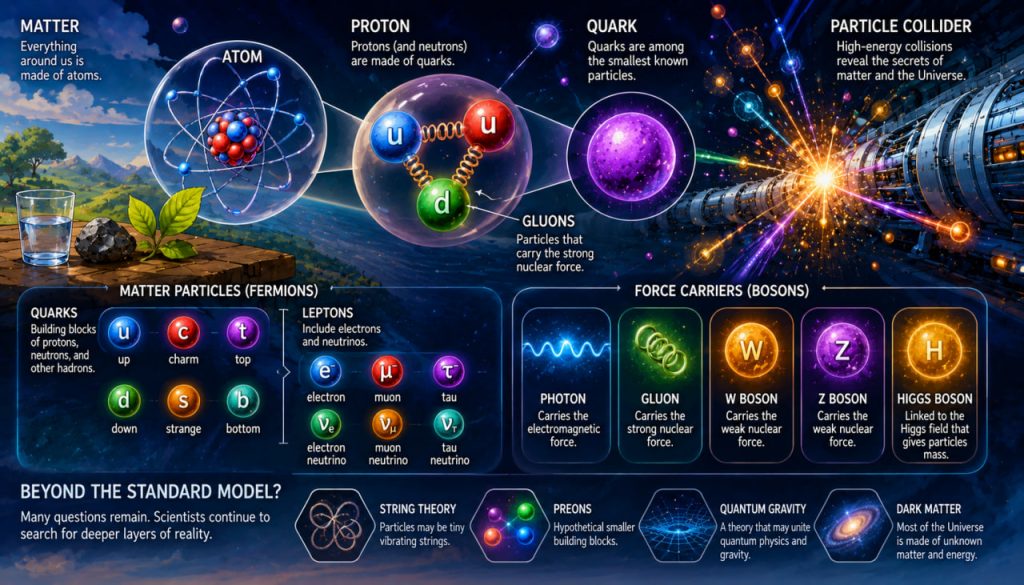
Everything we see in the Universe—from galaxies and stars to living cells and the atoms in our bodies—is built from incredibly tiny particles. For centuries, scientists believed atoms were the smallest indivisible building blocks of matter. Later, atoms were found to contain protons, neutrons, and electrons. Then physicists discovered that even protons and neutrons are composed of even smaller particles called quarks.
This naturally leads to one of the biggest questions in modern physics: Are elementary particles truly fundamental, or are they themselves made of something even smaller? According to today’s best scientific evidence, elementary particles appear to have no internal structure. However, scientists continue searching for deeper layers of reality that could reshape our understanding of the Universe.
What Are Elementary Particles?
Elementary particles are particles that, according to current experiments, cannot be divided into smaller components.
Unlike atoms or protons, they show no measurable internal structure.
The current framework describing these particles is known as the Standard Model of Particle Physics.
It includes two major categories:
- Matter particles (fermions)
- Force-carrying particles (bosons)
Together, these particles explain nearly all known interactions in nature, except gravity at the quantum level.
So far, no experiment has revealed smaller building blocks inside any confirmed elementary particle.
The Building Blocks of Matter
Ordinary matter is made primarily from just a few elementary particles.
These include:
- Up quarks
- Down quarks
- Electrons
- Electron neutrinos
Protons consist of:
- Two up quarks
- One down quark
Neutrons consist of:
- Two down quarks
- One up quark
Electrons, unlike protons and neutrons, are not known to contain smaller components.
They behave experimentally as point-like particles.
Are Quarks Really Fundamental?
Quarks are among the smallest known particles.
Scientists have investigated their structure using powerful particle accelerators such as the Large Hadron Collider (LHC) at CERN.
High-energy collisions probe incredibly small distances.
Current experiments indicate that quarks behave as point-like particles down to distances smaller than approximately 10⁻¹⁹ meters.
If quarks possess internal structure, it must exist at even smaller scales than current technology can observe.
To date, no convincing experimental evidence suggests that quarks contain smaller particles.
What Holds Quarks Together?
Although quarks appear elementary, they rarely exist alone.
They are permanently bound together by one of nature’s strongest interactions: the strong nuclear force.
This force is carried by particles called gluons.
Unlike photons, which transmit the electromagnetic force, gluons also interact with one another.
This unique property creates an extremely strong binding force that prevents quarks from escaping under ordinary conditions.
This phenomenon is called color confinement.
It explains why isolated quarks have never been directly observed.
What About Electrons?
Electrons are even more mysterious.
Unlike protons:
- They contain no quarks.
- They have no measurable size.
- They possess electric charge.
- They have intrinsic angular momentum (spin).
Modern experiments continue testing whether electrons have internal structure.
Thus far, every measurement agrees with the Standard Model prediction that electrons behave as elementary particles.
Their exact origin remains one of the outstanding questions in fundamental physics.
Could There Be Smaller Building Blocks?
Although the Standard Model successfully explains an enormous range of experimental observations, many physicists believe it is probably incomplete.
Several theoretical ideas propose deeper layers of reality.
Among them are:
- String Theory
- Preon models
- Loop Quantum Gravity
- Other speculative quantum gravity theories
Some researchers have suggested that quarks and leptons might themselves consist of hypothetical particles called preons.
However, no experimental evidence currently supports the existence of preons.
These ideas remain speculative and have not been confirmed.
String Theory: Particles as Tiny Vibrating Strings
One of the best-known theoretical proposals is String Theory.
Instead of treating elementary particles as mathematical points, String Theory proposes that they are tiny one-dimensional vibrating strings.
Different vibration patterns would produce different particles.
For example:
- One vibration might appear as an electron.
- Another as a quark.
- Another as a photon.
The predicted strings would be unimaginably small—far smaller than current particle accelerators can directly investigate.
As of today, String Theory remains an elegant mathematical framework rather than an experimentally verified physical theory.
Why Is It So Difficult to Find Smaller Structures?
The smaller scientists attempt to observe, the higher the energy required.
According to quantum physics, resolving extremely tiny distances demands enormous collision energies.
Current accelerators already operate near technological limits.
Investigating significantly smaller scales may require future facilities far larger and more powerful than today’s machines.
Some proposed next-generation colliders could extend these searches, but even they may not reach the energies needed to test certain speculative theories.
What Questions Remain Unanswered?
Despite the success of the Standard Model, important mysteries remain.
Scientists still do not fully understand:
- What dark matter is made of.
- Why particles have the masses they do.
- Why gravity differs so dramatically from the other fundamental forces.
- Why the Universe contains more matter than antimatter.
- Whether elementary particles are truly fundamental.
These unanswered questions motivate ongoing research in particle physics around the world.
Expert Perspective
Physicist Professor Frank Wilczek, recipient of the 2004 Nobel Prize in Physics for his work on the strong nuclear force, has emphasized that the Standard Model is one of the most successful scientific theories ever developed. At the same time, he notes that it almost certainly does not represent the final description of nature, because it leaves major questions—such as dark matter, gravity, and the origin of particle masses—only partially answered.
Similarly, researchers at CERN continue searching for signs of physics beyond the Standard Model through increasingly precise experiments. While no confirmed evidence of smaller constituents of elementary particles has yet been found, future discoveries could fundamentally change our understanding of matter.
The Search Continues
Modern science currently describes elementary particles as the smallest known building blocks of matter.
According to every experiment performed so far:
- Electrons appear fundamental.
- Quarks appear fundamental.
- Neutrinos appear fundamental.
- Force-carrying particles also behave as elementary.
Yet history teaches an important lesson.
Atoms were once believed indivisible.
Later, protons and neutrons were thought to be fundamental before quarks were discovered.
For this reason, physicists remain open to the possibility that even today’s “elementary” particles may one day reveal deeper layers of structure.
Whether the Universe ultimately consists of point particles, vibrating strings, or something entirely unexpected remains one of the greatest unanswered questions in modern science.
Interesting Facts
- Quarks have never been observed in complete isolation because of color confinement.
- The Large Hadron Collider (LHC) accelerates particles to energies of several teraelectronvolts (TeV) before collisions.
- Protons are composed of three valence quarks plus a constantly changing “sea” of virtual quarks and gluons.
- The Standard Model successfully predicts thousands of experimental results with extraordinary precision.
- Neutrinos can pass through enormous amounts of matter with only a tiny probability of interacting.
- String Theory predicts additional spatial dimensions beyond the familiar three, but these have not been experimentally confirmed.
- More than 95% of the Universe’s total mass-energy appears to consist of dark matter and dark energy, which are not explained by the Standard Model.
Glossary
- Elementary Particle — A particle that has no experimentally confirmed internal structure and cannot currently be divided into smaller components.
- Standard Model — The modern theory describing known elementary particles and three of the four fundamental forces.
- Quark — An elementary particle that combines with other quarks to form protons, neutrons, and other hadrons.
- Lepton — A family of elementary particles that includes electrons, muons, tau particles, and neutrinos.
- Gluon — The elementary particle that carries the strong nuclear force between quarks.
- Color Confinement — A property of the strong force that prevents isolated quarks from existing under normal conditions.
- String Theory — A theoretical framework proposing that elementary particles are tiny vibrating strings rather than mathematical points.
- Large Hadron Collider (LHC) — The world’s largest and most powerful particle accelerator, located at CERN near Geneva, used to study the fundamental structure of matter.