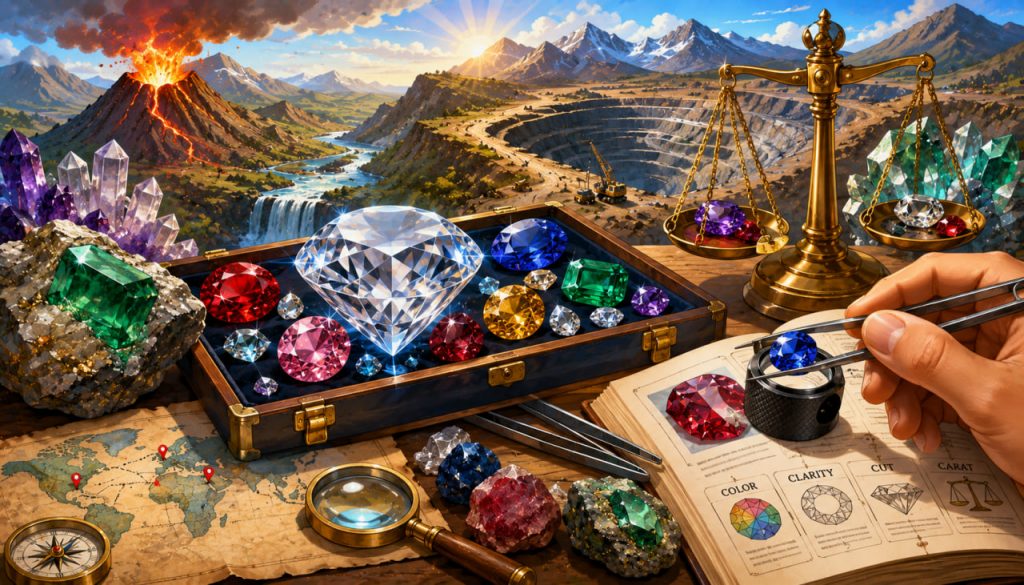
Gemstones have fascinated humanity for thousands of years. Ancient civilizations prized them as symbols of power, wealth, protection, and beauty, while modern society values them for jewelry, investment, and even industrial applications. From the brilliance of diamonds to the deep blue of sapphires and the vibrant green of emeralds, precious stones continue to command extraordinary prices.
But what actually makes a gemstone valuable? Is it simply because it is beautiful, or are there scientific, geological, and economic reasons behind its worth? The answer is a combination of rarity, durability, appearance, cultural significance, and market demand. Understanding these factors reveals why some gemstones are worth only a few dollars while others sell for millions.
What Is a Gemstone?
A gemstone is a naturally occurring mineral—or, in some cases, an organic material—that has been cut and polished for use in jewelry or decorative objects.
To be considered a valuable gemstone, a material generally possesses several important characteristics:
- Beauty
- Durability
- Rarity
- Stability
- Ability to be cut and polished
Common precious gemstones include:
- Diamond
- Ruby
- Sapphire
- Emerald
Many other minerals, such as aquamarine, tourmaline, spinel, and tanzanite, are also highly valued depending on their quality.
Rarity Is One of the Biggest Factors
The law of supply and demand strongly influences gemstone prices.
A gemstone becomes more valuable when it is both difficult to find and highly desired.
However, rarity alone is not enough.
Some minerals are extremely rare but attract little commercial interest because they lack attractive color, durability, or public recognition.
Conversely, diamonds remain highly valuable partly because they combine relative rarity with exceptional physical properties, global marketing, and long-standing cultural importance.
True value arises from the combination of rarity and sustained demand.
The Famous “Four Cs”
When evaluating diamonds, gemologists often use the internationally recognized Four Cs:
- Carat
- Color
- Clarity
- Cut
Carat
Carat measures weight.
Larger diamonds are generally rarer and therefore more valuable, although quality remains equally important.
Color
For white diamonds, stones with less color are usually considered more valuable.
For colored gemstones such as sapphires or emeralds, vivid, evenly distributed color often increases value.
Clarity
Natural gemstones frequently contain tiny internal features called inclusions.
Fewer visible inclusions generally increase value, although some inclusions help confirm a stone’s natural origin.
Cut
The quality of cutting determines how efficiently a gemstone reflects and refracts light.
Even a high-quality rough stone may appear dull if poorly cut.
Beauty Is More Than Just Color
A gemstone’s appearance depends on several optical properties.
Important factors include:
- Color intensity
- Transparency
- Brilliance
- Fire
- Luster
- Optical effects
For example, diamonds are famous for their brilliance and dispersion, which create colorful flashes of light.
Some gemstones display remarkable optical phenomena, including:
- Star sapphires
- Cat’s-eye chrysoberyl
- Color-changing alexandrite
- Opals with shifting rainbow colors
These unusual effects can dramatically increase a gemstone’s value.
Durability Matters
Jewelry is meant to be worn.
A valuable gemstone should resist scratching, breaking, and chemical damage.
Durability depends on three main properties:
- Hardness
- Toughness
- Stability
Diamond ranks 10 on the Mohs hardness scale, making it the hardest naturally occurring mineral.
However, hardness does not necessarily mean a gemstone cannot break.
Emeralds, for example, are relatively hard but often contain natural fractures that make them more susceptible to damage from strong impacts.
The Importance of Origin
For some gemstones, geographic origin significantly influences market value.
Certain regions have earned worldwide reputations for producing exceptional stones.
Examples include:
- Kashmir sapphires
- Colombian emeralds
- Burmese rubies
- Australian opals
Although beautiful gemstones can come from many countries, stones from historically famous deposits often command premium prices because of their rarity and reputation.
Laboratory testing is frequently used to determine a gemstone’s likely geographic origin.
Natural vs. Laboratory-Grown Gemstones
Modern technology can produce laboratory-grown diamonds and other gemstones that are chemically and physically almost identical to their natural counterparts.
Both types possess similar crystal structures and optical properties.
However, natural gemstones formed over millions—or even billions—of years within Earth.
Many buyers value this geological history and rarity, making natural stones generally more expensive than laboratory-grown equivalents.
Both have legitimate places in today’s jewelry market, but their values differ because their rarity differs.
Beyond Jewelry: Scientific and Industrial Value
Not all gemstones are valued solely for decoration.
Several possess important industrial applications.
Diamonds are widely used for:
- Precision cutting tools
- Drilling equipment
- Industrial abrasives
- High-performance scientific instruments
Synthetic diamonds are also being investigated for use in:
- Quantum technologies
- Electronics
- High-pressure research
- Advanced sensors
This demonstrates that gemstones can have value beyond luxury goods.
Why People Have Always Loved Gemstones
Throughout history, gemstones have symbolized:
- Wealth
- Royal authority
- Religious significance
- Love
- Protection
- Status
Many cultures believed gemstones possessed mystical or healing properties.
Although such beliefs are part of cultural history rather than established scientific evidence, they contributed greatly to the enduring popularity of gemstones.
Today, gemstones remain central to engagement rings, family heirlooms, museum collections, and international auctions.
Expert Perspective
Gemologist Dr. James E. Shigley, former Distinguished Research Fellow at the Gemological Institute of America (GIA), has emphasized that a gemstone’s value is determined by a combination of scientific characteristics and market factors. According to Shigley, beauty, rarity, durability, and consumer demand work together to establish value rather than any single property alone.
The Gemological Institute of America (GIA) likewise stresses that objective grading standards—including the Four Cs for diamonds—help create transparency and consistency in the global gemstone market.
Why Gemstones Continue to Fascinate Humanity
Gemstones represent an extraordinary intersection of geology, chemistry, physics, art, and human culture.
Each natural gemstone tells a story that began deep within Earth’s interior millions or even billions of years ago.
Whether admired for their scientific origins, exceptional beauty, historical importance, or craftsmanship, gemstones remain among nature’s most remarkable creations.
Their value is not determined by appearance alone but by a complex combination of rarity, geological history, physical properties, skilled cutting, and the timeless human appreciation for objects of exceptional beauty.
Interesting Facts
- Most natural diamonds formed between 1 and 3.5 billion years ago.
- Diamond is the hardest naturally occurring mineral, ranking 10 on the Mohs hardness scale.
- Alexandrite can appear green in daylight and reddish under incandescent light due to its unique optical properties.
- Emeralds commonly contain natural inclusions known as “jardin,” meaning “garden” in French.
- The largest gem-quality diamonds are extremely rare, making their prices increase disproportionately with size.
- Laboratory-grown diamonds have the same chemical composition as natural diamonds but are produced in weeks rather than billions of years.
- Some opals display a spectacular phenomenon called play-of-color, created by microscopic silica spheres that diffract light.
Glossary
- Gemstone — A mineral or organic material valued for its beauty, rarity, and durability after being cut and polished.
- Carat — A unit of weight used for gemstones, equal to 200 milligrams.
- Clarity — The degree to which a gemstone is free from internal or external imperfections.
- Cut — The quality of a gemstone’s proportions, symmetry, and polish, affecting its brilliance.
- Mohs Hardness Scale — A scale that measures a mineral’s resistance to scratching, ranging from 1 (talc) to 10 (diamond).
- Inclusion — A natural internal feature or imperfection within a gemstone.
- Brilliance — The amount of white light reflected back from a gemstone.
- Dispersion (Fire) — The separation of white light into spectral colors, producing colorful flashes within certain gemstones.