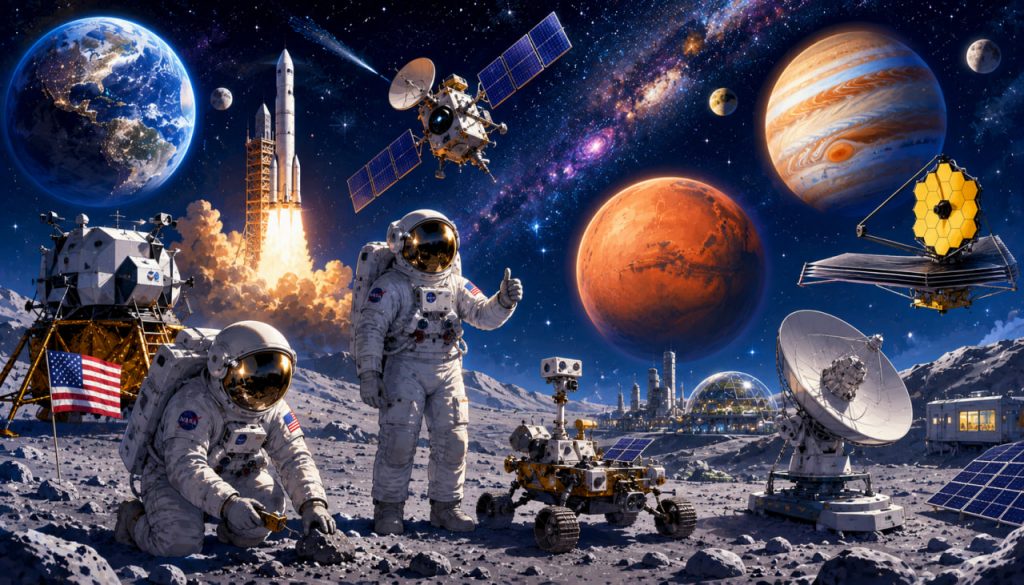
Space exploration entered an exciting new chapter in 2026. Governments, private companies, and international space agencies are launching increasingly ambitious missions that promise to deepen our understanding of the Moon, Mars, asteroids, distant planets, and even the origins of the Universe.
While 2026 has not yet delivered evidence of extraterrestrial life, it is becoming one of the most important years for preparing humanity’s next giant leap into deep space. New telescopes, robotic explorers, planetary defense missions, and lunar programs are laying the foundation for discoveries that could transform astronomy for decades.
A New Era of Lunar Exploration
For the first time since the Apollo era, human missions around the Moon have returned, opening a new phase of exploration.
NASA’s Artemis program aims to establish a long-term human presence on and around the Moon rather than conducting only short visits. The successful Artemis II mission demonstrated critical systems for future lunar exploration and paved the way for later surface missions.
Future lunar exploration focuses on:
- Testing technologies for Mars
- Studying lunar resources
- Building sustainable habitats
- Exploring the Moon’s south pole
- Supporting international scientific cooperation
The Moon is no longer viewed as the final destination—it is becoming a gateway to deeper space.
The Search for Habitable Worlds Continues
One of the biggest scientific questions remains:
Are we alone in the Universe?
Several current and upcoming missions are designed to help answer this question.
NASA’s Europa Clipper, launched in 2024, continues its journey toward Jupiter’s icy moon Europa. During 2026, it performs a crucial Earth gravity assist that helps send the spacecraft toward Jupiter, where it will investigate whether Europa’s subsurface ocean could support conditions suitable for life.
Scientists believe Europa may contain:
- A global underground ocean
- Organic molecules
- Internal heat
- Chemical energy sources
Although no life has been detected, Europa remains one of the Solar System’s most promising places to search for potentially habitable environments.
Powerful Space Telescopes Expand Our View
Modern astronomy is experiencing a revolution thanks to increasingly advanced space telescopes.
The James Webb Space Telescope (JWST) continues to observe the earliest galaxies, distant exoplanets, and stellar nurseries with unprecedented sensitivity.
Meanwhile, preparations continue for the Nancy Grace Roman Space Telescope, expected to begin a new era of wide-field astronomical surveys. Roman will help scientists investigate:
- Dark energy
- Dark matter
- Exoplanets
- Galaxy evolution
- Large-scale cosmic structure
Its enormous field of view will allow astronomers to map huge regions of space much faster than previous observatories.
Planetary Defense Becomes a Reality
Protecting Earth from hazardous asteroids is no longer science fiction.
Following NASA’s successful DART asteroid deflection experiment, the European Space Agency’s Hera mission is approaching the Didymos–Dimorphos asteroid system in 2026 to study the impact in detail and improve future planetary defense strategies.
Researchers hope Hera will answer important questions about:
- Asteroid composition
- Impact physics
- Deflection efficiency
- Internal asteroid structure
Understanding how to alter an asteroid’s path could one day help protect Earth from a real impact threat.
Artificial Intelligence Is Accelerating Astronomy
Artificial intelligence is rapidly becoming one of astronomy’s most valuable research tools.
Modern AI systems help scientists:
- Detect exoplanets
- Analyze telescope images
- Identify unusual galaxies
- Discover gravitational lenses
- Process enormous datasets
- Predict asteroid trajectories
Without AI, analyzing the vast amounts of information collected by today’s telescopes would take far longer.
Rather than replacing astronomers, AI allows researchers to focus on interpreting discoveries instead of manually sorting through billions of observations.
Commercial Spaceflight Continues to Grow
Private companies now play a major role in space exploration.
Commercial launch providers have significantly reduced launch costs, making scientific missions more accessible than ever.
2026 continues to see progress in:
- Reusable rockets
- Commercial lunar landers
- Private space stations
- Cargo transportation
- Space tourism technologies
These developments allow government agencies to concentrate more resources on scientific research while commercial partners provide transportation and infrastructure.
Mars Exploration Never Stops
Although humans have not yet landed on Mars, robotic exploration continues to reveal fascinating clues about the planet’s history.
Current Mars missions continue studying:
- Ancient river systems
- Sedimentary rocks
- Organic chemistry
- Climate history
- Potential biosignatures
Collected rock samples may eventually help scientists determine whether microbial life ever existed on the Red Planet.
Mars also remains the primary long-term destination for future human exploration.
International Cooperation Is Expanding
Space exploration has become increasingly global.
Alongside NASA, organizations including the European Space Agency (ESA), the Japan Aerospace Exploration Agency (JAXA), the China National Space Administration (CNSA), the Indian Space Research Organisation (ISRO), and numerous commercial companies contribute to new discoveries.
Upcoming international missions include:
- Lunar south pole exploration
- Mercury science
- Asteroid sample return
- Exoplanet surveys
- Space debris removal
International collaboration allows scientists to share expertise, reduce costs, and tackle increasingly complex missions.
Expert Perspective
Astrophysicist Martin Rees, the United Kingdom’s Astronomer Royal, has frequently argued that robotic exploration will accomplish much of the most important scientific work in deep space, while human exploration remains valuable for inspiration, innovation, and technological advancement.
His perspective reflects a growing trend in modern space science: robots, artificial intelligence, and astronauts each play complementary roles rather than competing with one another.
As technology advances, future discoveries will likely come from increasingly close cooperation between humans and intelligent machines.
What Could Be the Next Great Discovery?
Astronomers remain optimistic about several major possibilities over the coming years.
Future discoveries could include:
- Stronger evidence of habitable environments beyond Earth
- New Earth-like exoplanets
- Better understanding of dark matter
- Improved measurements of dark energy
- Evidence of ancient microbial life within our Solar System
- New insights into the earliest moments after the Big Bang
While no one can predict exactly what will be discovered first, the pace of exploration is accelerating faster than at any previous point in human history.
Interesting Facts
- The James Webb Space Telescope can observe light that has traveled for more than 13 billion years, allowing astronomers to study some of the earliest galaxies in the Universe.
- Europa likely contains more liquid water beneath its icy crust than all of Earth’s oceans combined.
- NASA’s Europa Clipper carries nine scientific instruments to study Europa’s ice shell, ocean, surface, and atmosphere.
- Hera will provide the first detailed follow-up study of an asteroid that humans intentionally altered in space.
- Modern space telescopes generate enormous datasets, making artificial intelligence increasingly important for scientific analysis.
- More than 5,000 exoplanets have already been confirmed, and future observatories are expected to discover thousands more.
Glossary
- Exoplanet – A planet that orbits a star outside our Solar System.
- Gravity Assist – A maneuver in which a spacecraft uses the gravity of a planet or moon to change its speed and trajectory while conserving fuel.
- Dark Matter – An invisible form of matter believed to make up much of the Universe’s mass, detected through its gravitational effects.
- Dark Energy – A mysterious form of energy thought to drive the accelerating expansion of the Universe.
- Planetary Defense – Scientific efforts to detect, monitor, and potentially deflect asteroids or comets that could threaten Earth.
- Biosignature – Evidence that may indicate the presence of past or present life, such as certain molecules or chemical patterns.
- Space Telescope – A telescope located in space, above Earth’s atmosphere, allowing clearer observations of the Universe.
- Habitable Environment – A location with physical and chemical conditions that could potentially support life as we know it.