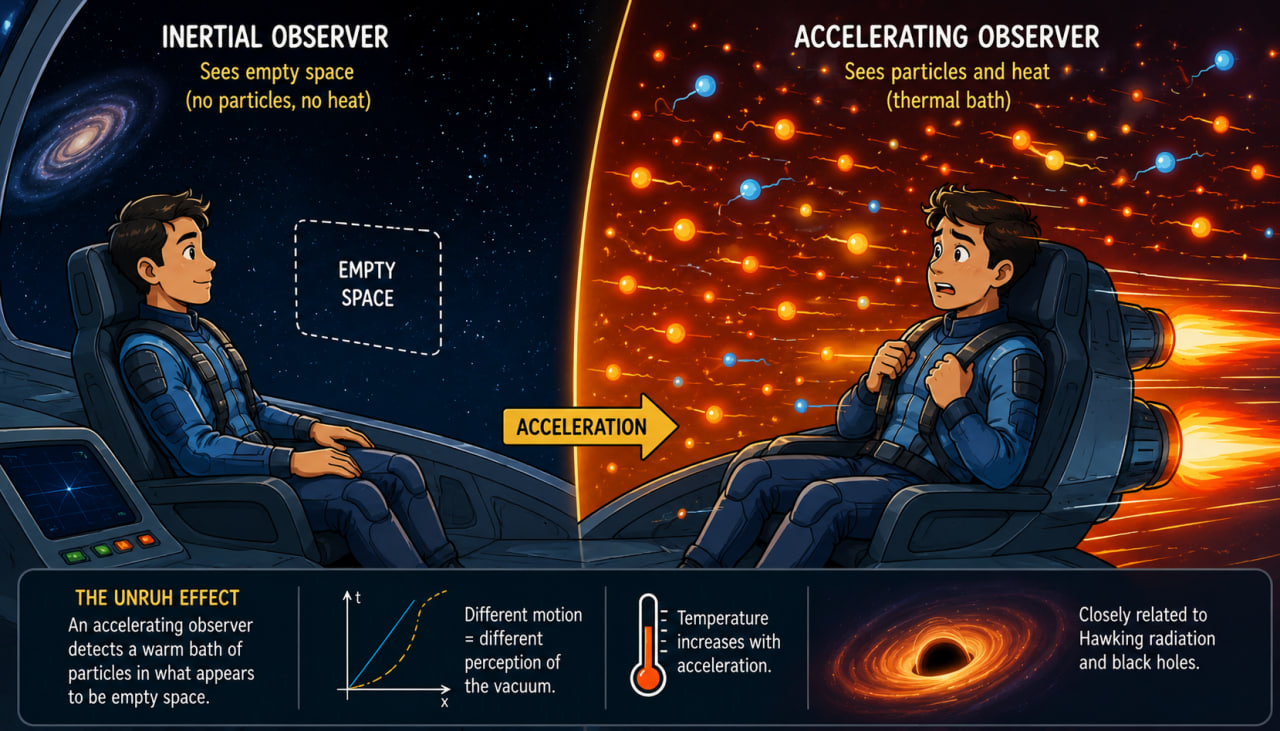
The Unruh Effect: Why an Accelerating Observer Sees Heat Where None Exists
Modern physics often reveals ideas that seem impossible at first glance. One of the most fascinating examples is the Unruh Effect, a theoretical prediction suggesting that an observer undergoing constant acceleration would detect heat in what appears to be empty space. Meanwhile, another observer moving at a constant speed through the same region would see nothing unusual at all. This remarkable concept sits at the intersection of quantum physics, relativity, and thermodynamics. Although the effect has not yet been directly observed in experiments, it is widely accepted by physicists as a consequence of some of the most successful theories in science.