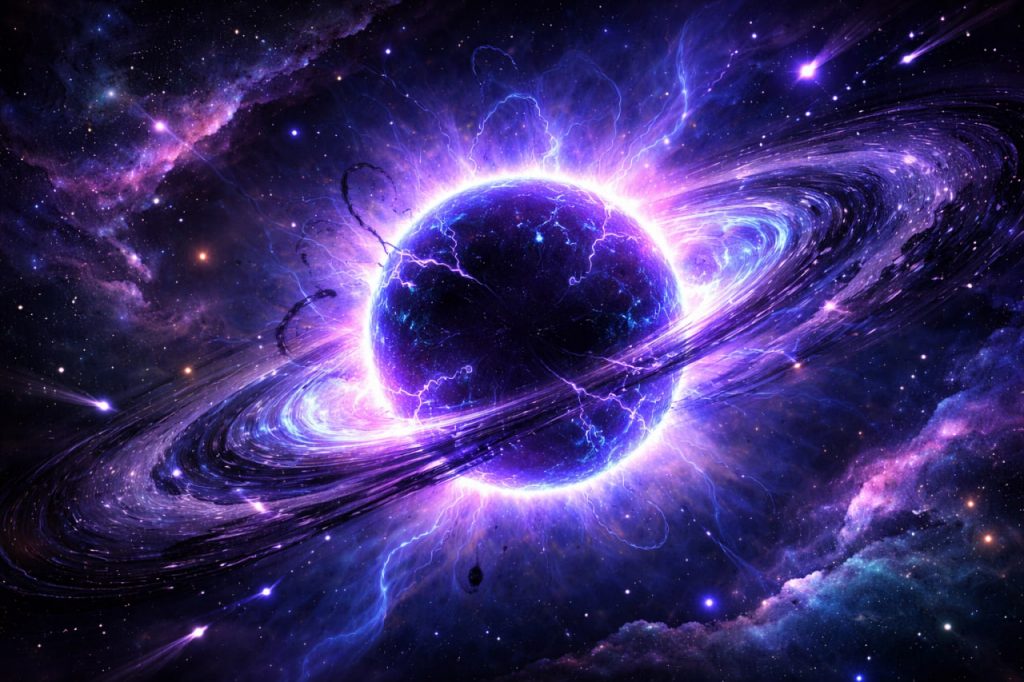
The idea of stars made from dark matter is one of the most intriguing hypotheses in modern astrophysics. Dark matter is a mysterious form of matter that does not emit, absorb, or reflect light, making it invisible to direct observation. Despite this, scientists believe it makes up a significant portion of the universe’s total mass. Because dark matter interacts primarily through gravity, it behaves very differently from ordinary matter. This raises the question of whether it could form structures similar to stars. While no direct evidence of such stars exists, theoretical models suggest that unusual objects related to dark matter may be possible. Exploring this idea helps scientists better understand the nature of the universe.
What Is Dark Matter?
Dark matter is a type of matter that cannot be detected using conventional methods based on light. Its existence is inferred from its gravitational effects on galaxies and cosmic structures. For example, galaxies rotate in ways that cannot be explained by visible matter alone. Astrophysicist Dr. Michael Anders explains:
“Dark matter reveals itself through gravity,
shaping the structure of galaxies and the universe.”
It forms massive halos around galaxies, influencing their motion and evolution. However, its exact composition remains unknown. This makes it one of the biggest mysteries in physics.
Can Dark Matter Form Stars?
Traditional stars form from clouds of gas that collapse under gravity, increasing temperature and pressure until nuclear fusion begins. Dark matter behaves differently because it does not interact strongly with itself or with radiation. This makes it unlikely to collapse and heat up in the same way. However, some theories suggest that under certain conditions, dark matter could form dense objects. These would not shine like normal stars but might still have structure. Such objects would be fundamentally different from stars made of ordinary matter. This idea remains speculative but scientifically interesting.
The Concept of Dark Stars
One of the most discussed ideas is the concept of dark stars, which are not made entirely of dark matter but are influenced by it. In these models, early stars in the universe may have been powered partly by dark matter interactions rather than nuclear fusion. These stars would be larger, cooler, and longer-lived than typical stars. They might have formed in the early universe when dark matter density was higher. Although no such objects have been observed, they remain a topic of active research. These models help scientists explore how dark matter could affect cosmic evolution.
Challenges and Limitations
There are significant challenges in proving the existence of dark matter stars. Because dark matter does not emit light, detecting such objects would be extremely difficult. Scientists would need indirect methods, such as observing gravitational effects or unusual energy signatures. Additionally, current models of dark matter suggest it does not easily form compact structures. This limits the likelihood of star-like objects forming purely from dark matter. Observational evidence is currently lacking, making this idea theoretical. Future discoveries may provide new insights into these possibilities.
Why This Idea Matters
The study of dark matter stars is important because it pushes the boundaries of our understanding of the universe. Even if such objects do not exist, exploring the idea helps refine theories of dark matter and cosmic structure. It also encourages the development of new observational techniques. Understanding dark matter is essential for explaining galaxy formation and large-scale cosmic behavior. Hypotheses like dark stars highlight how much remains unknown in astrophysics. They inspire further research and exploration. The question of whether such stars exist remains open.
Interesting Facts
- Dark matter makes up about 85% of all matter in the universe
- It does not interact with light, making it invisible
- Its presence is detected through gravitational effects
- Dark stars may have existed in the early universe
- The nature of dark matter is still unknown
Glossary
- Dark Matter — invisible matter detected through gravity
- Dark Star — hypothetical star influenced by dark matter
- Gravity — force that attracts objects with mass
- Fusion — process powering normal stars
- Galaxy — large system of stars, gas, and dark matter