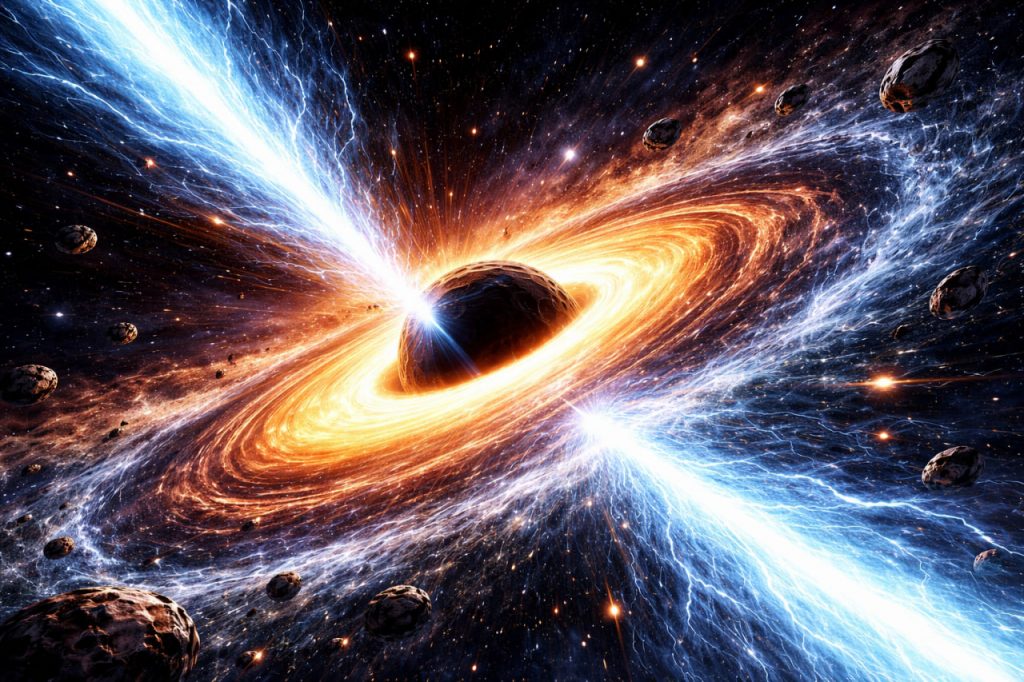
Astrophysical jets are powerful, narrow streams of matter and energy that are ejected from some of the most extreme objects in the universe. They are commonly associated with black holes, neutron stars, and young stars surrounded by accretion disks. These jets can travel enormous distances, sometimes stretching across thousands or even millions of light-years. Despite their immense energy, jets remain highly focused and structured. They move at extremely high speeds, often approaching the speed of light. These phenomena are among the most energetic events known in astrophysics. Studying jets allows scientists to better understand how matter behaves under extreme gravitational and magnetic conditions.
Where Jets Come From
Jets form in systems where a massive central object is surrounded by a rotating accretion disk. As gas and dust spiral inward, they heat up and gain enormous amounts of energy. Astrophysicist Dr. Elena Morozova explains:
“Jets are launched from regions near compact objects,
where gravity, rotation, and magnetic fields interact.”
Not all of the material in the disk falls into the central object. Some of it is redirected outward along the rotational axis of the system. This creates two jets that shoot in opposite directions. The formation of jets requires specific conditions, including rapid rotation and strong magnetic fields. These environments are typically found near black holes and neutron stars.
The Role of Magnetic Fields
Magnetic fields play a central role in shaping and launching jets. As the accretion disk rotates, it twists magnetic field lines into tight, complex structures. These magnetic fields act like channels, guiding charged particles away from the disk. They also accelerate these particles to very high speeds. Without magnetic fields, the material would not be able to form such narrow and focused streams. The interaction between rotation and magnetism creates a powerful mechanism for launching jets. This process is still an active area of research in astrophysics.
Why Jets Are So Fast
Jets reach extremely high speeds because of the intense energy near compact objects. As matter falls inward under gravity, it gains kinetic energy. Some of this energy is redirected outward through magnetic processes. This allows particles to accelerate to speeds close to the speed of light. At such velocities, relativistic effects become important. Time, space, and energy behave differently under these conditions. These high speeds make jets visible across vast cosmic distances. They are often detected through radiation such as radio waves and X-rays.
Types of Jets
There are several types of astrophysical jets, depending on their source. Jets from supermassive black holes in active galaxies are the largest and most powerful. Smaller jets can form around neutron stars and stellar-mass black holes. Young stars also produce jets during their formation process. Although these jets differ in size and energy, they share similar physical mechanisms. Studying different types helps scientists understand how universal these processes are. It also provides insight into different stages of cosmic evolution.
Why Jets Matter
Jets are important because they influence their surroundings on a large scale. They can shape galaxies, redistribute matter, and affect star formation. By studying jets, scientists learn more about how energy moves through the universe. They also provide a way to test theories of gravity and relativity. Jets act as natural laboratories for extreme physics. Understanding them helps answer fundamental questions about the universe. Their study continues to reveal new and unexpected phenomena.
Interesting Facts
- Jets can extend for millions of light-years
- They often travel at near-light speeds
- Found near black holes, neutron stars, and young stars
- Emit radiation across multiple wavelengths
- Help shape galaxies and cosmic structures
Glossary
- Jet — narrow stream of high-speed particles in space
- Accretion Disk — rotating disk of matter around a massive object
- Magnetic Field — force field affecting charged particles
- Relativity — physics of high speeds and strong gravity
- Neutron Star — extremely dense stellar remnant