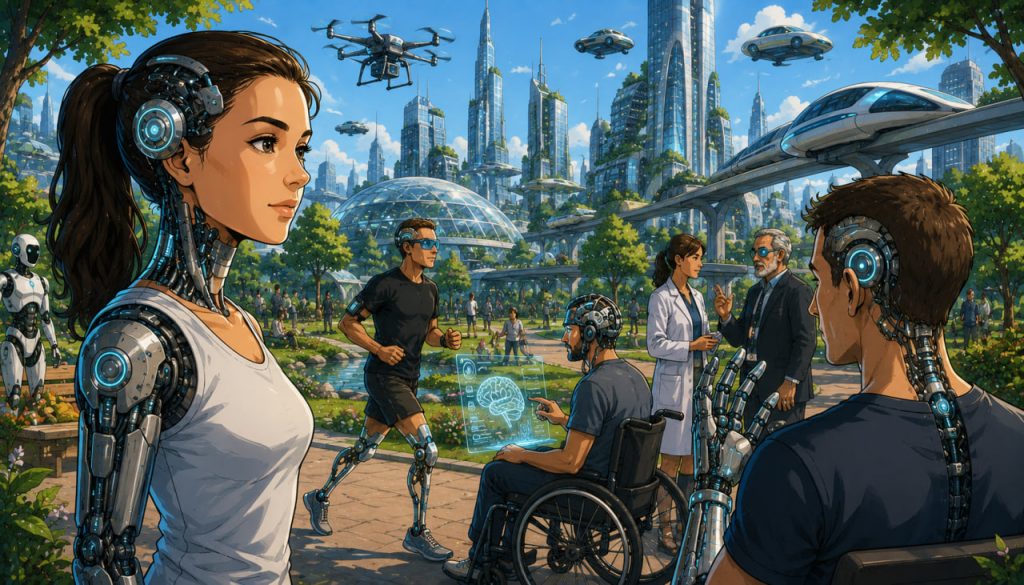
For centuries, humans dreamed about enhancing the body beyond its natural biological limits. Ancient myths described artificial limbs, immortality, and superhuman abilities long before modern science existed. Today, technologies once considered pure science fiction are becoming increasingly real.
Artificial organs, robotic prosthetics, brain-computer interfaces, implanted medical devices, and neural technologies are already blurring the line between biology and machines. This raises one of the most fascinating questions of the modern era:
When does a human officially become a cyborg?
The idea is closely connected to transhumanism — a philosophical and technological movement supporting the use of science and technology to improve human physical and cognitive abilities.
Supporters believe technological enhancement may eventually help humanity overcome:
- Disease
- Aging
- Physical limitations
- Cognitive decline
Critics, however, warn about ethical, social, and philosophical risks.
As biotechnology and artificial intelligence advance rapidly, the debate around transhumanism is becoming increasingly important.
What Is Transhumanism?
Transhumanism is a movement and philosophy advocating the use of advanced technology to enhance human capabilities.
The concept includes technologies such as:
- Neural implants
- Artificial organs
- Genetic engineering
- Brain-computer interfaces
- Robotic prosthetics
- Longevity technologies
The ultimate goal for some transhumanists is to expand human potential beyond natural biological limits.
Futurist Ray Kurzweil described transhumanism as:
“The next stage of human evolution driven by technology.”
Although controversial, transhumanist ideas increasingly influence scientific and technological discussions worldwide.
What Is a Cyborg?
A cyborg, short for “cybernetic organism,” is a being combining:
- Biological systems
- Mechanical or electronic components
Importantly, many people today already technically qualify as partial cyborgs.
Examples include:
- Pacemakers
- Cochlear implants
- Robotic prosthetic limbs
- Artificial joints
- Neural stimulation devices
These technologies directly integrate machines with the human body.
In medicine, cybernetic enhancement is already reality rather than science fiction.
Medical Technology Is Already Creating Cyborg-Like Humans
Modern medicine increasingly merges biology and engineering.
Advanced prosthetics can now:
- Respond to muscle signals
- Restore mobility
- Mimic natural movement
Some experimental prosthetic limbs even provide sensory feedback.
Brain implants are also developing rapidly.
Researchers are studying technologies that may help people with:
- Paralysis
- Blindness
- Neurological disorders
Neuroscientist Miguel Nicolelis once explained:
“The boundary between brain and machine is becoming increasingly flexible.”
This idea lies at the center of modern cybernetic research.
Brain-Computer Interfaces
One of the most revolutionary transhumanist technologies involves brain-computer interfaces (BCIs).
BCIs attempt to allow direct communication between:
- The human brain
- External computers or devices
Scientists are already testing systems capable of:
- Controlling robotic limbs
- Moving computer cursors using thought
- Restoring limited communication abilities
Future developments may eventually allow:
- Memory assistance
- Neural augmentation
- Direct digital interaction
However, these technologies remain highly experimental.
Artificial Organs and Human Enhancement
Artificial organs represent another major step toward cybernetic integration.
Modern medicine already uses:
- Artificial heart valves
- Mechanical heart pumps
- Advanced implants
- Synthetic joints
Researchers continue developing:
- Artificial kidneys
- Lab-grown tissues
- Bioengineered organs
These technologies may dramatically extend lifespan and improve quality of life.
The distinction between therapy and enhancement may eventually become increasingly blurred.
Genetic Engineering and Human Modification
Transhumanism also includes genetic technologies.
Scientists are researching gene-editing systems that may eventually help prevent:
- Inherited diseases
- Certain cancers
- Genetic disorders
Some futurists speculate about possible future enhancement of:
- Intelligence
- Physical performance
- Longevity
However, genetic modification raises major ethical concerns involving:
- Inequality
- Consent
- Human identity
- Unpredictable biological effects
Most countries currently regulate human genetic engineering very carefully.
Will Humans Eventually Enhance Intelligence?
Some transhumanists believe future technologies may increase cognitive abilities.
Potential future enhancements include:
- Memory augmentation
- Faster information access
- AI-assisted thinking
- Neural communication systems
Artificial intelligence may eventually become closely integrated with human cognition.
However, scientists still understand only part of how the human brain functions.
The complexity of consciousness remains one of science’s greatest mysteries.
Ethical Concerns About Transhumanism
Transhumanism generates intense ethical debates.
Critics worry about:
- Social inequality
- Loss of privacy
- Corporate control of human enhancement
- Technological dependence
- Identity changes
Some philosophers question whether radical enhancement might alter fundamental aspects of human nature itself.
Bioethicist Francis Fukuyama once called transhumanism:
“One of the world’s most dangerous ideas.”
Others strongly disagree and view enhancement as a continuation of medicine and human progress.
Economic and Social Impacts
If advanced enhancement technologies become expensive, they may create new forms of inequality.
Enhanced individuals could potentially gain advantages in:
- Intelligence
- Physical ability
- Longevity
- Productivity
This raises questions about:
- Access
- Fairness
- Regulation
Future societies may face difficult decisions regarding which technologies should be available and under what conditions.
Are We Already Becoming Cyborgs?
In some ways, humans already live partially integrated with technology.
Modern people rely heavily on:
- Smartphones
- Wearable devices
- AI systems
- Medical implants
- Digital networks
The difference between external technology and internal technological integration is gradually shrinking.
Some scientists believe cybernetic enhancement will continue expanding slowly rather than arriving suddenly.
When Will Humans Officially Become Cyborgs?
There may never be a single moment when humanity officially “becomes cyborg.”
Instead, gradual integration is already occurring through:
- Medical devices
- Neural technologies
- Artificial organs
- AI assistance
Future generations may simply view technological enhancement as normal healthcare or daily life infrastructure.
The definition of “human” itself may evolve alongside technology.
Why Transhumanism Matters
Transhumanism forces humanity to confront profound questions about:
- Identity
- Mortality
- Technology
- Ethics
- Evolution
The movement reflects both hope and uncertainty about the future relationship between humans and machines.
Whether cybernetic enhancement becomes widespread or remains limited, the technologies being developed today may permanently reshape medicine, society, and the future of civilization itself.
Interesting Facts
- Millions of people already live with implanted medical devices.
- Brain-computer interfaces can allow some patients to control devices using thought.
- Advanced prosthetic limbs may respond to muscle signals.
- The word “cyborg” originated during the 20th century space age.
- Scientists are actively researching artificial organs and neural implants.
Glossary
- Transhumanism — A movement supporting technological enhancement of human abilities.
- Cyborg — A being combining biological and technological components.
- Brain-Computer Interface (BCI) — Technology connecting the brain directly to computers or devices.
- Neural Implant — An electronic device implanted into the nervous system.
- Genetic Engineering — Modification of genetic material using biotechnology.