Artificial intelligence chatbots have rapidly become part of everyday life. They help people write emails, summarize documents, answer questions, learn new skills, generate computer code, and assist with creative projects. Their ability to communicate naturally has made AI one of the fastest-growing technologies in history.
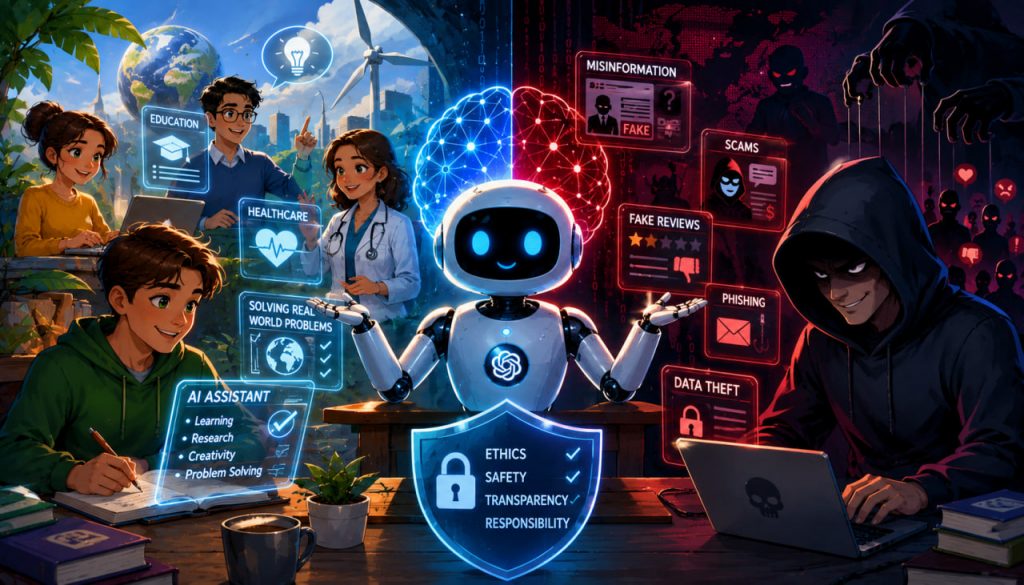
However, like many powerful technologies, AI chatbots are not inherently good or bad. Their impact depends largely on how they are designed and how people choose to use them. While AI offers enormous benefits for education, healthcare, science, and business, experts also recognize that it can be misused in ways that create social, economic, and security challenges.
Understanding both the opportunities and the risks is essential for using conversational AI responsibly.
AI Is a Tool, Not an Independent Decision-Maker
A common misconception is that AI chatbots make independent decisions about how they behave.
In reality, modern chatbots generate responses based on algorithms, training data, and safety rules created by developers.
They do not possess intentions, emotions, beliefs, or personal goals.
Artificial intelligence is a tool whose effects depend primarily on human choices.
This principle is similar to many other technologies. Computers, smartphones, and the internet can improve lives but may also be misused if placed in the wrong hands.
Legitimate Benefits of AI Chatbots
Before discussing risks, it is important to recognize why AI has become so valuable.
Today, chatbots assist millions of people by helping them:
- Learn new subjects
- Improve writing
- Translate languages
- Write computer programs
- Summarize research
- Brainstorm ideas
- Automate repetitive tasks
- Improve accessibility for people with disabilities
Researchers also use AI to accelerate scientific discoveries, analyze medical data, and support environmental research.
These applications demonstrate the technology’s enormous positive potential.
How Could AI Be Misused?
Because AI can generate convincing text quickly, malicious users may attempt to misuse it in harmful ways.
Potential risks include:
- Creating misinformation
- Producing spam content
- Assisting social engineering scams
- Generating fake reviews
- Impersonating individuals
- Supporting phishing campaigns
- Amplifying online disinformation
For example, AI can produce realistic emails or social media posts at a much larger scale than a human could write manually.
However, it is important to note that responsible AI systems include safeguards specifically designed to reduce assistance with harmful or illegal activities.
Misinformation and False Confidence
One of the most widely discussed concerns is misinformation.
AI sometimes generates incorrect information that sounds convincing because language models are designed to produce fluent, natural responses.
This phenomenon is known as an AI hallucination.
Hallucinations may include:
- Incorrect historical facts
- Fabricated references
- Invented quotations
- Outdated statistics
- Incorrect scientific claims
For this reason, important information should always be verified using reliable sources, especially in medicine, law, finance, and science.
Developers continue improving AI systems so they better recognize uncertainty and reduce factual errors.
Privacy and Data Security
Privacy is another important consideration.
Users sometimes share sensitive information with AI systems without realizing that this data may require careful handling.
Responsible use includes avoiding the disclosure of:
- Passwords
- Financial information
- Government identification numbers
- Confidential business data
- Private medical records
Organizations that deploy AI increasingly implement encryption, data protection policies, and strict security standards to reduce privacy risks.
Bias and Fairness
AI systems learn from enormous collections of human-created data.
Because human information can contain historical biases, AI models may occasionally reflect those patterns.
Researchers actively work to reduce unfair outcomes through:
- Better training datasets
- Human review
- Fairness testing
- Independent evaluations
- Continuous model improvements
Developing fair and transparent AI remains one of the most important goals in modern artificial intelligence research.
How Developers Improve AI Safety
Leading AI companies invest heavily in safety research.
Modern systems increasingly include:
- Content moderation
- Human oversight
- Harm prevention mechanisms
- Continuous monitoring
- Security testing
- Reinforcement learning from human feedback
- Independent safety evaluations
These measures help reduce the likelihood that AI will assist with harmful activities while preserving its usefulness for legitimate educational and professional purposes.
No safety system is perfect, but each new generation of AI generally incorporates stronger safeguards than the previous one.
Expert Perspective
Computer scientist Dr. Stuart Russell, one of the world’s leading AI researchers and co-author of the widely used textbook Artificial Intelligence: A Modern Approach, has consistently argued that the greatest challenge is ensuring AI systems remain aligned with human values and objectives.
He emphasizes that AI itself is not inherently dangerous; rather, risks arise when powerful systems are developed or deployed without sufficient safeguards and oversight.
Similarly, many experts—including researchers from leading universities and international organizations—stress that responsible governance, transparency, and continuous safety research are essential for maximizing AI’s benefits while minimizing potential harms.
Their work reflects a growing scientific consensus: the future impact of AI depends more on human decisions than on the technology itself.
Building Responsible AI for the Future
Artificial intelligence is evolving rapidly, and researchers continue developing systems that are more accurate, transparent, and trustworthy.
Future improvements are expected to include:
- Better factual accuracy
- Stronger reasoning capabilities
- Improved source verification
- Enhanced privacy protections
- Reduced bias
- Greater transparency
- More effective safety mechanisms
International cooperation between scientists, governments, technology companies, and educators will play an important role in ensuring AI develops in ways that benefit society.
The goal is not simply to build more powerful AI, but to build AI that is reliable, ethical, and aligned with human interests.
Interesting Facts
- Modern AI chatbots can generate responses in dozens or even hundreds of languages.
- Large language models are trained on enormous datasets containing billions or trillions of words.
- AI safety has become one of the fastest-growing areas of artificial intelligence research.
- Many universities now offer dedicated courses on AI ethics and responsible AI development.
- AI systems are increasingly used to detect online fraud and cybersecurity threats.
- Researchers continue developing methods that allow AI to explain its reasoning more clearly.
- International organizations have proposed principles for trustworthy AI that emphasize transparency, fairness, privacy, and accountability.
Glossary
- Artificial Intelligence (AI) — Computer systems designed to perform tasks that typically require human intelligence.
- Chatbot — A software application that communicates with users through natural language conversations.
- Large Language Model (LLM) — An AI model trained on vast amounts of text to understand and generate human language.
- AI Hallucination — A convincing but factually incorrect or unsupported response generated by an AI system.
- Social Engineering — Psychological manipulation intended to persuade people to reveal information or perform certain actions.
- Bias — A systematic tendency that can produce unfair or unbalanced outcomes in AI systems.
- Transparency — The ability to understand how an AI system reaches its conclusions or generates responses.
- AI Alignment — The field of research focused on ensuring artificial intelligence behaves consistently with human values, safety, and intended objectives.