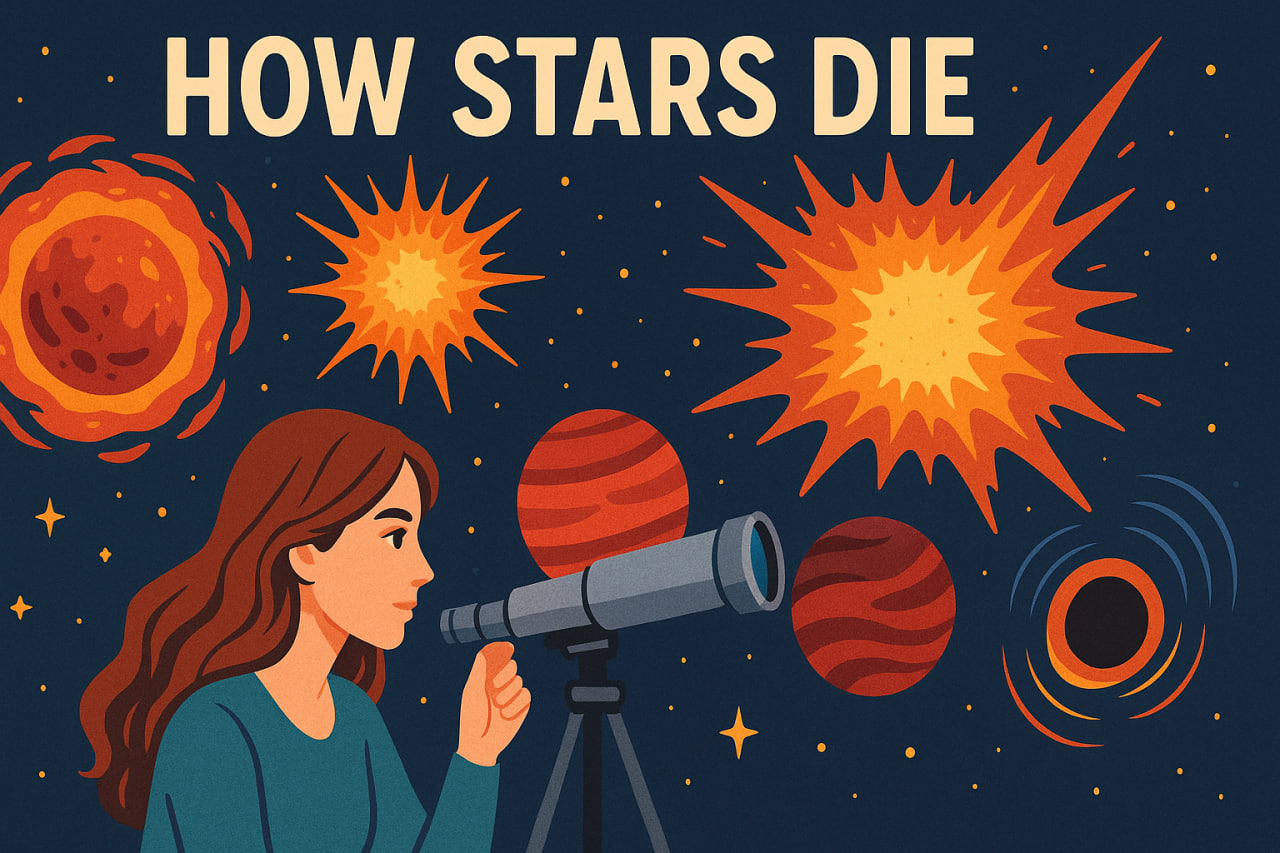
How Stars Die: The Final Stages of Stellar Evolution
The death of a star is one of the most dramatic and influential processes in the universe, shaping galaxies and creating many of the elements essential for life. Every star, regardless of its size, eventually exhausts the nuclear fuel that keeps it shining, causing fundamental changes that lead to its collapse, explosion, or gradual fading. The fate of a star depends largely on its mass, with small, medium, and massive stars following very different evolutionary endings. Scientists study stellar death to understand how heavy elements form, how supernovae enrich the cosmos, and how compact objects such as white dwarfs, neutron stars, and black holes originate. Observations of dying stars also reveal how galaxies evolve over billions of years, offering insights into cosmic cycles of birth, destruction, and renewal. This knowledge helps astronomers trace the universe’s history and predict its long-term future.