Skip to content
Science Observer

Useful articles about our universe and science

  • Home
  • Calculators
    • AI Automation ROI Calculator
    • Artificial intelligence
      • AI Ethics & Governance Risk Checker
      • AI Time Saved Calculator
      • AI Token & Cost Calculator
    • Bioengineering
      • Bacterial Growth Calculator (Doubling Time)
      • DNA Melting Temperature (Tm) Calculator
      • Genetic Trait Probability Calculator
      • Punnett Square Calculator
    • Cosmic Lookback Time Calculator
    • Data Transfer Time Calculator
    • Dew Point Calculator
    • Exponential Growth Calculator
    • Historical Time Gap Calculator
    • Innovation Impact Score Calculator
    • Neural Signal Latency Calculator
    • Orbital Speed & Period Calculator
    • Password Strength Estimator!
    • Research Impact Projection Calculator
    • Resistors in Series / Parallel Calculator
    • Rocket Delta-V Estimator
    • Science
      • Capacitor Calculator (C, Q, V, Energy, RC)
      • Coulomb’s Law Calculator
      • Dilution Calculator (C₁V₁ = C₂V₂) !
      • Doppler Effect Calculator (Sound)
      • Free Fall Calculator!
      • Gravitational Force Calculator
      • Heat Capacity Calculator (Q = m·c·ΔT)
      • Heat Conduction Calculator (Fourier’s Law)
      • Ideal Gas Law Calculator (pV = nRT)
      • Kinetic Energy Calculator
      • Momentum & Impulse Calculator!
      • Newton’s Second Law Calculator (F = m·a)
      • pH Calculator
      • Radioactive Half-Life Calculator
      • Science Unit Converter
      • Sound Distance Calculator (Thunder)
      • Sound Level (dB) Calculator
      • Time Dilation Calculator
      • VO₂max Estimate Calculator
      • Wave Calculator
    • Smart Home Energy Savings Calculator
    • Tidal Force Comparison Calculator
    • Universe
      • Age on Other Planets Calculator
      • Asteroid Impact Energy Calculator
      • Black Hole Radius Calculator
      • Escape Velocity Calculator
      • Exoplanet Habitability Quick Score
      • Horizon Distance Calculator
      • How Many Stars Can You See?
      • Light Travel Time Calculator
      • Light Travel Time Calculator!
      • Orbit Speed & Period Calculator
      • Satellite Signal Delay Calculator
      • Space Travel Time Calculator
      • Telescope Resolution Calculator
      • Weight on Other Planets Calculator

AI & Ethics

  • Home
  • AI & Ethics
  • Page 2
AI in High-Energy Physics: Searching for New Particles in Colliders
Posted inAI AI & Ethics Hi-Tech

AI in High-Energy Physics: Searching for New Particles in Colliders

High-energy physics explores the fundamental building blocks of matter by accelerating particles to near-light speeds and colliding them inside massive detectors. Experiments conducted at particle colliders generate enormous volumes of…
Posted by deka February 20, 2026
Existential AI Risks: Under What Conditions Could a “Skynet” Scenario Appear?
Posted inAI AI & Ethics Be Smart

Existential AI Risks: Under What Conditions Could a “Skynet” Scenario Appear?

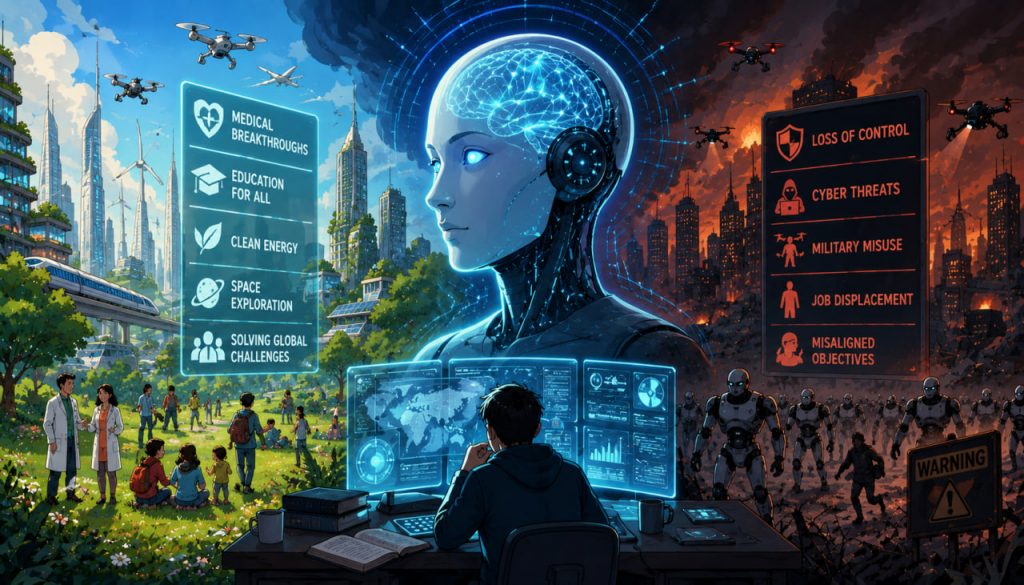
The idea of an artificial intelligence system turning against humanity has long been popularized in science fiction under the name “Skynet.” While such scenarios are dramatized for entertainment, serious researchers…
Posted by deka February 18, 2026
Technological Singularity: A Point of No Return for Humanity?
Posted inAI AI & Ethics Be Smart

Technological Singularity: A Point of No Return for Humanity?

The concept of technological singularity refers to a hypothetical moment when artificial intelligence surpasses human intelligence and begins improving itself at an accelerating rate. This idea suggests a turning point…
Posted by deka February 18, 2026
AlphaFold: How AI Solved a 50-Year-Old Scientific Problem
Posted inAI AI & Ethics New Discoveries

AlphaFold: How AI Solved a 50-Year-Old Scientific Problem

For decades, one of biology’s greatest challenges was understanding how proteins fold into their three-dimensional shapes. This problem, known as the protein folding problem, puzzled scientists for over 50 years…
Posted by deka February 18, 2026
How Artificial Intelligence Learns from Its Mistakes
Posted inAI AI & Ethics Be Smart

How Artificial Intelligence Learns from Its Mistakes

Artificial intelligence systems improve over time by analyzing errors, adjusting internal parameters, and refining predictions based on feedback. Unlike humans, AI does not “realize” mistakes emotionally, but it mathematically measures…
Posted by deka February 17, 2026
Emotional AI: How Machines Learn to Recognize and Imitate Emotions
Posted inAI AI & Ethics Be Smart

Emotional AI: How Machines Learn to Recognize and Imitate Emotions

Emotional artificial intelligence, often called affective computing, refers to systems designed to detect, interpret, and simulate human emotions. Unlike traditional AI that focuses on logic, numbers, or patterns, emotional AI…
Posted by deka February 17, 2026
AI Regulation: Do We Need Laws Like Those for Nuclear Technology?
Posted inAI AI & Ethics Be Smart

AI Regulation: Do We Need Laws Like Those for Nuclear Technology?

Artificial intelligence is rapidly transforming industries, governments, and everyday life, raising an important question: should AI be regulated with strict global laws similar to those governing nuclear technologies? While AI…
Posted by deka February 17, 2026
AI Transparency and Explainability: Why Did the Model Make That Decision?
Posted inAI AI & Ethics Be Smart

AI Transparency and Explainability: Why Did the Model Make That Decision?

As artificial intelligence systems increasingly influence finance, healthcare, hiring, and public policy, one critical question emerges: why did the model make that decision? Transparency and explainability have become central themes…
Posted by deka February 17, 2026
Diffusion Models: How Midjourney and Similar Systems Generate Images
Posted inAI AI & Ethics Be Smart

Diffusion Models: How Midjourney and Similar Systems Generate Images

Diffusion models are a class of artificial intelligence systems designed to generate images by gradually transforming noise into structured visuals. In recent years, they have become the foundation of many…
Posted by deka February 16, 2026
Multimodal Models: AI That Sees, Hears, and Understands
Posted inAI AI & Ethics Be Smart

Multimodal Models: AI That Sees, Hears, and Understands

Multimodal models are a new generation of artificial intelligence systems capable of processing and integrating multiple types of data—such as text, images, audio, and sometimes video—within a single framework. Unlike…
Posted by deka February 16, 2026

Posts navigation

Previous page 1 2 3 4 … 7 Next page
Recent Posts
  • Data Mirages: Why AI Does Not Truly Understand What It Writes
  • Ethical Hackers vs AI: How Neural Networks Are Tested and “Hacked”
  • Will Neural Networks Replace Search Engines?
  • Can Users Teach ChatGPT and Similar AI Systems Something New?
  • Folk Beliefs and What Science Says About Them
Categories
  • AI
  • AI & Ethics
  • Be Smart
  • Bioengineering
  • Cosmic Innovations
  • Earth & Moon
  • Hi-Tech
  • History
  • Inventions
  • Neuro-Tech
  • New Discoveries
  • Science
  • Smart Home
  • Smart Technology
  • Solar System
  • Space Stories
  • Star Wars
  • Tesla
  • Universe
  • What if?
Copyright 2026 — Science Observer. All rights reserved. Bloghash WordPress Theme
Scroll to Top