At first glance, the Moon appears to be a barren and lifeless world, covered in dust, craters, and silent plains. However, beneath its seemingly inactive surface lies a complex history and hidden structures that continue to intrigue scientists. The Moon preserves a record of billions of years of solar system evolution, acting as a time capsule untouched by weather, water, or tectonic activity. Modern missions and advanced instruments have revealed that its interior is far more dynamic than once believed. From subsurface ice to geological layers and ancient lava tubes, the Moon holds secrets that could reshape our understanding of planetary formation and even support future human exploration. Exploring what lies beneath the lunar surface is key to unlocking its past—and its potential future.
Layers Beneath the Surface
The Moon is not just a solid rock; it has a structured interior composed of crust, mantle, and a small core. The crust is covered by a thick layer of regolith, a fine dust created by billions of years of meteorite impacts. Beneath this lies the mantle, which was once partially molten and shaped the Moon’s volcanic activity. The core, though relatively small, may still be partially molten and contributes to weak seismic activity known as “moonquakes.” According to planetary scientist Dr. Laura Chen:
“The Moon may look quiet, but its interior still carries the echoes
of a once-active and evolving world.”
This reveals that the Moon is more than just a static celestial body.
Hidden Water Ice
One of the most important discoveries in recent decades is the presence of water ice beneath the lunar surface, particularly in permanently shadowed craters near the poles. These regions never receive direct sunlight, allowing ice to remain stable for billions of years. This finding has major implications for future space missions, as water can be used for drinking, oxygen production, and even fuel. The existence of ice transforms the Moon from a barren landscape into a potential resource hub for long-term exploration.
Lava Tubes and Underground Structures
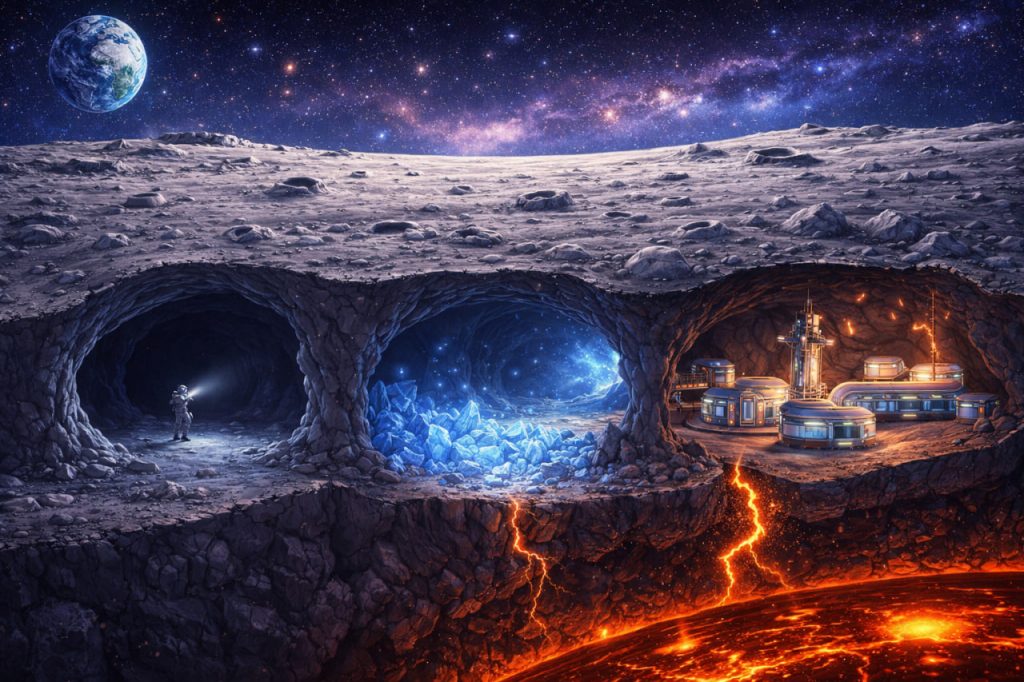
Scientists have identified large lava tubes beneath the Moon’s surface—tunnels formed by ancient volcanic activity. These structures could provide natural shelter for future human bases, protecting against radiation, extreme temperatures, and micrometeorites. Some of these tubes are believed to be enormous, potentially large enough to house entire habitats. Their stability and accessibility make them one of the most promising features for future lunar colonization.
Seismic Activity and Moonquakes
Although the Moon lacks active plate tectonics, it is not entirely geologically inactive. It experiences moonquakes, which can be caused by tidal forces from Earth, temperature changes, or internal processes. Some of these quakes are surprisingly strong and can last much longer than earthquakes on Earth. Studying this activity helps scientists understand the Moon’s internal structure and how it continues to evolve over time.
A Record of Cosmic History
Because the Moon has no atmosphere or weather, its surface and subsurface preserve a nearly untouched record of cosmic events. Impact craters, geological layers, and buried materials provide valuable information about the early solar system. By studying these features, scientists can learn about the formation of planets, the history of asteroid impacts, and the conditions that shaped Earth itself. The Moon serves as a natural archive, offering insights that are impossible to obtain elsewhere.
Interesting Facts
- The Moon’s surface is covered by a dust layer called regolith, formed over billions of years.
- Some lunar craters have remained in permanent shadow for over 2 billion years.
- Lava tubes on the Moon could be hundreds of meters wide.
- Moonquakes can last up to 10 times longer than earthquakes on Earth.
- The Moon has no atmosphere, which helps preserve its geological history.
Glossary
- Regolith — a layer of loose dust and rock covering the Moon’s surface.
- Lava Tube — a tunnel formed by flowing lava beneath the surface.
- Moonquake — a seismic event occurring on the Moon.
- Mantle — the layer beneath the crust of a planetary body.
- Water Ice — frozen water found in shadowed regions of the Moon.