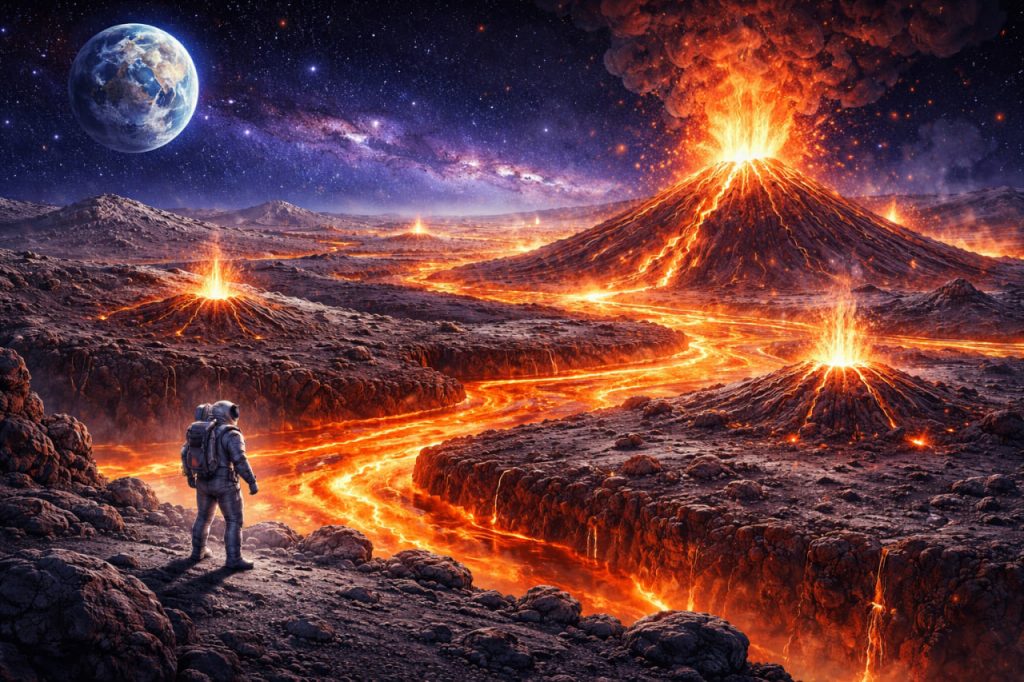
Today, the Moon appears cold, silent, and geologically inactive, but billions of years ago it was shaped by intense volcanic activity. Vast dark plains known as lunar maria were created by enormous lava flows that spread across the surface after powerful eruptions from the Moon’s interior. These features, visible even from Earth with the naked eye, show that the Moon was once a far more dynamic world than it appears today. Although its volcanism ended long ago, the traces of these ancient eruptions remain preserved because the Moon has no atmosphere, rain, or strong erosion to erase them. This makes the lunar surface an extraordinary geological archive of early planetary history. Studying volcanic activity on the Moon helps scientists understand not only the Moon itself, but also how rocky bodies cool, evolve, and transform over time throughout the solar system.
Lunar Maria and Ancient Lava Seas
The clearest evidence of lunar volcanism is found in the lunar maria, the large dark plains that cover significant portions of the Moon’s near side. These maria formed when magma rose from deep beneath the crust and flooded enormous impact basins with liquid rock. Unlike many volcanic eruptions on Earth, which can be explosive because of water and atmospheric gases, lunar eruptions were mostly effusive, meaning lava flowed steadily across the surface. Over time, these flows cooled into wide, relatively flat basaltic plains. Planetary geologist Dr. Megan Foster explains:
“The lunar maria are the frozen remains of vast lava floods
that transformed the Moon’s landscape on an extraordinary scale.”
These plains are some of the strongest proof that the Moon once possessed enough internal heat to drive long-lasting volcanic processes.
Volcanic Domes, Rilles, and Surface Features
Beyond the maria, the Moon also contains many smaller volcanic structures that reveal the diversity of its ancient eruptions. Scientists have identified lava domes, low rounded hills formed by thicker and slower-moving magma, as well as rilles, long narrow channels carved by flowing lava or collapsing lava tubes. Some of these rilles stretch for hundreds of kilometers and resemble dried river valleys, although they were created entirely by molten rock. These features show that lunar volcanism was not limited to one single style or region. Different types of magma, eruption intensity, and crustal conditions likely produced a wide variety of volcanic landscapes. By mapping these formations, researchers can reconstruct how the Moon’s interior once behaved and how its surface changed over time.
Where the Moon’s Heat Came From
The Moon’s volcanic past was powered by internal heat generated during its early formation and evolution. After the Moon formed, it contained large amounts of residual heat, and radioactive elements within its interior continued to release energy over long periods. This heat kept parts of the mantle partially molten, allowing magma to rise toward the surface through fractures in the crust. Over hundreds of millions of years, however, the Moon gradually cooled because of its relatively small size compared with Earth. As the heat diminished, volcanic activity weakened and eventually came to an end. Understanding this thermal history is essential because it helps scientists compare the Moon with other rocky worlds such as Mars, Mercury, and even Earth in its earliest stages.
Could Volcanism Have Lasted Longer Than Expected?
For a long time, scientists believed that nearly all volcanic activity on the Moon ended more than 3 billion years ago. However, more recent observations suggest that some volcanic features may be significantly younger than previously thought. Certain small basaltic deposits and irregular formations appear to have formed perhaps as recently as 1 billion years ago, which is surprisingly late in lunar history. If confirmed, this would mean the Moon remained volcanically active far longer than old models predicted. Such findings challenge traditional ideas about how quickly small rocky bodies lose internal heat. They also raise new questions about whether isolated pockets of magma persisted deep beneath the surface long after major eruptions had ended.
Why Lunar Volcanism Matters Today
The study of lunar volcanism is not only about the Moon’s past — it also has major implications for future exploration. Ancient volcanic regions may contain valuable resources, including specific minerals and structures such as lava tubes, which could one day shelter human habitats from radiation and extreme temperature changes. Volcanic rocks also preserve chemical information about the Moon’s interior, helping scientists understand how planetary bodies differentiate into crust, mantle, and core. By analyzing these ancient lava plains and volcanic deposits, researchers gain a clearer picture of the Moon’s history and of planetary evolution more broadly. The Moon may look lifeless today, but its surface still tells the story of a world once shaped by fire.
Interesting Facts
- The dark patches visible from Earth are mostly ancient lava plains called maria.
- Most lunar volcanic activity occurred between 3 and 4 billion years ago.
- Some lunar rilles extend for hundreds of kilometers across the surface.
- Lunar lava was mainly basaltic, similar in some ways to volcanic rock found on Earth.
- Scientists believe some volcanic features on the Moon may be much younger than once expected.
Glossary
- Volcanism — geological activity involving the movement and eruption of magma onto a planetary surface.
- Lunar Maria — large dark basaltic plains formed by ancient lava flows on the Moon.
- Basalt — a dark volcanic rock formed from cooled lava.
- Rille — a long narrow channel on the Moon, often formed by lava flow or structural collapse.
- Lava Dome — a rounded volcanic feature created by slow-moving, viscous magma.