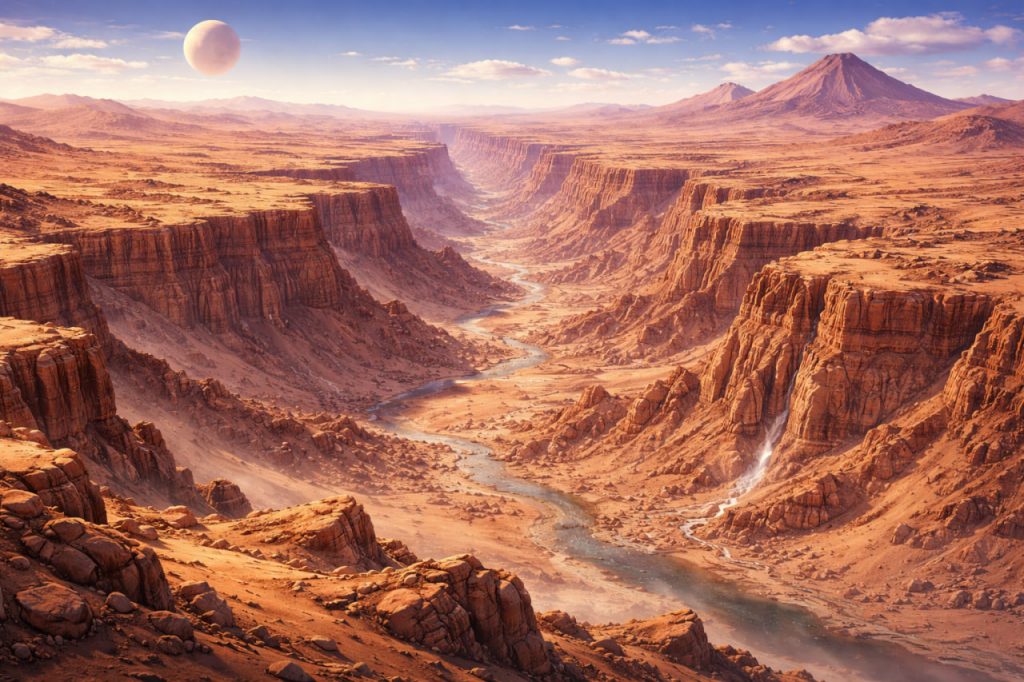
Valles Marineris is one of the most impressive geological structures in the solar system, stretching across the surface of Mars like a massive scar. This enormous canyon system extends for over 4,000 kilometers, making it far larger than any canyon on Earth, including the Grand Canyon. Its vast scale, depth, and complexity reveal a dramatic history of tectonic activity, erosion, and possible water flow. Unlike typical river-formed canyons on Earth, Valles Marineris is believed to have formed primarily through crustal stretching and collapse. Studying this region provides valuable insights into the geological evolution of Mars and the processes that have shaped its surface. It also raises intriguing questions about the planet’s past, including the possible presence of water and habitable conditions.
Scale and Structure of the Canyon
Valles Marineris is not a single canyon but a vast network of interconnected valleys and chasms. In some places, it reaches depths of up to 7 kilometers and widths exceeding 200 kilometers. The canyon system runs along the Martian equator and is so large that it would stretch across an entire continent on Earth. Planetary geologist Dr. Kevin Ramirez notes:
“Valles Marineris is a reminder that Mars experienced
forces capable of reshaping an entire planet’s crust.”
Its immense size makes it one of the most striking features visible from orbit.
Formation Through Tectonic Forces
The primary cause of Valles Marineris is believed to be tectonic stretching of the Martian crust. As the nearby Tharsis volcanic region grew, it placed enormous stress on the surrounding surface. This stress caused the crust to crack, sink, and collapse, forming deep valleys and cliffs. Unlike Earth, Mars does not have active plate tectonics today, so these features remain largely unchanged for billions of years. The canyon system represents a frozen record of ancient geological activity.
Signs of Water and Erosion
Although tectonic forces played the main role in shaping Valles Marineris, there is evidence that water may have contributed to its evolution. Certain channels, layered deposits, and mineral compositions suggest that liquid water or ice once interacted with the canyon walls. Landslides and erosion features also indicate that material has moved and reshaped parts of the canyon over time. These findings support the idea that Mars may have had a wetter and more dynamic past.
Extreme Environment and Conditions
Conditions within Valles Marineris are extreme, even by Martian standards. The canyon’s depth creates significant variations in temperature, pressure, and atmospheric density. These differences could influence weather patterns, including localized winds and dust activity. Some scientists believe that the canyon environment may have once provided relatively more stable conditions compared to the open surface, making it an interesting target for future exploration.
Why Valles Marineris Matters
Studying Valles Marineris helps scientists better understand the geological history of Mars and the forces that shaped it. The canyon’s layers act like a natural archive, preserving information about past volcanic activity, climate conditions, and potential water presence. It is also a key location for future missions, as it may contain clues about past habitability. As one of the largest canyons in the solar system, Valles Marineris continues to be a focal point for planetary research and exploration.
P.S. I listened to one volunteer’s work where this valley was compared to the Mariana Trench on Earth, and they suggested that a recent hydrodynamic impact in this area may have ended Mars as a living and Earth-like planet. The same film warned that a similar event could occur on Earth in the near future.
Interesting Facts
- Valles Marineris is about 10 times longer than the Grand Canyon.
- It can reach depths of up to 7 kilometers in some regions.
- The canyon system spans nearly one-fifth of Mars’ circumference.
- It was named after the Mariner 9 spacecraft, which first mapped it in detail.
- Some areas show evidence of ancient landslides and possible water activity.
Glossary
- Valles Marineris — a canyon system on Mars stretching thousands of kilometers.
- Tectonic Activity — movement and deformation of a planet’s crust.
- Erosion — the process of wearing away surface material over time.
- Tharsis Region — a volcanic plateau on Mars linked to the formation of the canyon.
- Landslide — the movement of rock and soil down slopes due to gravity.