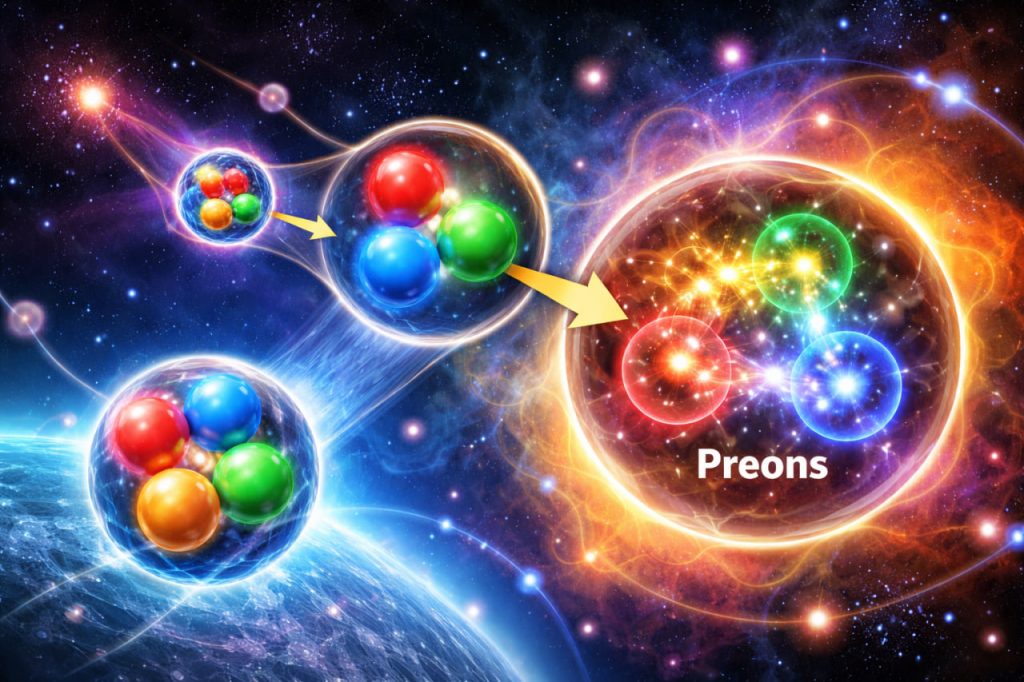
Modern physics describes the fundamental building blocks of matter using particles such as quarks and leptons, which are considered elementary particles—meaning they are not known to be made of anything smaller. However, the idea of preons challenges this assumption, suggesting that even quarks might have an internal structure. This concept arises from the desire to simplify and unify the growing number of particles observed in high-energy physics experiments. If preons exist, they could represent a deeper level of reality, revealing that what we consider “fundamental” is actually composed of even smaller entities. Despite decades of theoretical exploration, no direct experimental evidence for preons has been found. Understanding this idea helps scientists explore the limits of particle physics and the nature of matter itself.
What Are Preons?
Preons are hypothetical particles proposed as subcomponents of quarks and leptons, meaning they would exist at a level smaller than anything currently confirmed in the Standard Model of particle physics. The idea first emerged in the 1970s as physicists searched for a simpler explanation of the growing “zoo” of particles. Instead of dozens of fundamental particles, preon models suggest that a smaller set of building blocks could combine in different ways to form known particles. According to theoretical physicist Dr. Alan Richter:
“Preons are an attempt to restore simplicity in a universe that appears increasingly complex at smaller scales.”
If true, this would fundamentally change our understanding of what “elementary” means in physics.
Why Scientists Consider Preons
The motivation behind preon theories lies in the search for unification and simplicity. The Standard Model successfully explains many phenomena, but it includes numerous particles and parameters that seem arbitrary. Preons could reduce this complexity by acting as a smaller set of building blocks underlying all known matter. Additionally, they might help explain patterns observed in particle masses and charges. However, introducing preons also raises new questions about the forces that would bind them together and how such structures could remain stable at extremely small scales.
Experimental Challenges and Limitations
Detecting preons is extremely difficult because it would require probing distances far smaller than those accessible with current technology. Particle accelerators like the Large Hadron Collider can explore incredibly high energies, but even these may not be sufficient to reveal substructure within quarks. So far, all experimental evidence suggests that quarks behave as point-like particles, with no detectable internal structure. This does not necessarily prove that preons do not exist, but it places strong limits on their possible size and behavior. As a result, preon theories remain speculative and are not part of mainstream physics.
Alternatives and Competing Theories
While preons are one possible extension beyond the Standard Model, other theories attempt to answer similar questions in different ways. For example, string theory proposes that fundamental particles are not point-like at all, but rather tiny vibrating strings. Other approaches, such as quantum field theories and higher-dimensional models, also aim to unify forces and particles without introducing smaller constituents. These competing ideas reflect the broader challenge of understanding physics at the smallest scales, where experimental data is limited and mathematical models become increasingly complex.
Could There Be a Limit to Smallness?
A fundamental question in physics is whether there is an ultimate limit to how small matter can be divided. Some theories suggest the existence of a minimum length scale, such as the Planck length, beyond which the concept of space itself may lose meaning. If such a limit exists, it could imply that quarks are truly fundamental—or that preons exist but cannot be observed directly. The answer remains unknown, and ongoing research continues to push the boundaries of what we can measure and understand. Whether or not preons exist, the search itself drives deeper insights into the nature of reality.
Interesting Facts
- The Standard Model includes over 17 fundamental particles, all currently considered indivisible.
- Preon theories were most actively developed in the 1970s and 1980s, but are still studied today.
- Experiments show that quarks behave as point-like particles down to extremely small scales.
- The Planck length (~1.6 × 10⁻³⁵ meters) is often considered the smallest meaningful unit of space.
- Some preon models suggest that all matter could be built from just two or three fundamental components.
Glossary
- Quark — a fundamental particle that combines to form protons and neutrons.
- Preon — a hypothetical particle proposed as a building block of quarks and leptons.
- Standard Model — the current theoretical framework describing fundamental particles and forces.
- Planck Length — the smallest meaningful scale in physics, where classical concepts of space break down.
- Lepton — a class of fundamental particles that includes electrons and neutrinos.