The Planck length represents one of the most fundamental limits in modern physics, marking a scale at which our current understanding of reality begins to break down. At approximately 1.6 × 10⁻³⁵ meters, it is considered the smallest meaningful unit of length, beyond which classical concepts of space and time may no longer apply. While the Standard Model of particle physics successfully describes fundamental particles and forces at accessible scales, it does not incorporate gravity in a fully consistent way. As scientists probe deeper into smaller distances, they encounter theoretical limits where known physics becomes incomplete. The Planck length emerges from combining constants of quantum mechanics, relativity, and gravity, suggesting a boundary where a new theory is required. Understanding this scale is crucial for exploring the unification of physics and the true nature of space-time.
What Is the Planck Length?
The Planck length is derived from fundamental constants, including the speed of light, Planck’s constant, and the gravitational constant. It defines a scale where quantum effects of gravity become significant and cannot be ignored. At distances close to the Planck length, space may no longer behave as a smooth continuum but instead could exhibit a discrete or “quantized” structure. According to theoretical physicist Dr. Andrew Collins:
“The Planck length is not just small—it marks the boundary
where our current theories lose their predictive power.”
This makes it a central concept in attempts to unify quantum mechanics with general relativity.
Limits of the Standard Model
The Standard Model describes electromagnetic, weak, and strong interactions with remarkable accuracy, but it does not include gravity as a quantum force. At extremely small scales, especially near the Planck length, gravitational effects are expected to become as strong as other fundamental forces. This creates a conflict between quantum mechanics and general relativity, two pillars of modern physics that are currently incompatible at these extremes. As a result, predictions become unreliable, and new theoretical frameworks are required to describe reality at this scale.
Quantum Gravity and New Theories
To address these limitations, physicists explore theories of quantum gravity, which aim to unify all fundamental forces into a single framework. Approaches such as string theory and loop quantum gravity propose radically different views of space-time at the Planck scale. In some models, space is made of tiny vibrating strings, while in others it is composed of discrete loops or networks. These ideas suggest that the fabric of reality may be far more complex than previously imagined, with the Planck length acting as a natural boundary between known and unknown physics.
Why We Cannot Measure It Directly
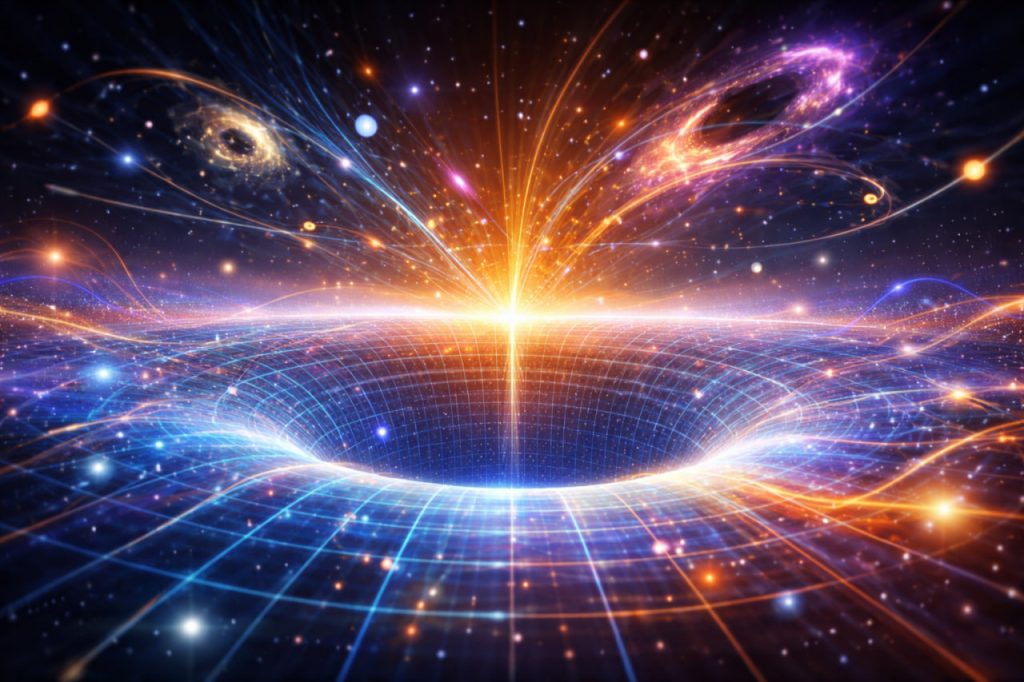
Measuring the Planck length directly is beyond current technological capabilities. To probe such small distances, scientists would need energies far greater than those achievable in modern particle accelerators. At these energies, the concentration of energy could theoretically create microscopic black holes, further complicating observation. This makes the Planck scale largely theoretical, studied through mathematical models rather than direct experimentation. Despite this limitation, indirect evidence and theoretical consistency continue to guide research in this area.
Implications for the Nature of Reality
The existence of a fundamental length scale raises profound questions about the nature of space and time. If space is not infinitely divisible, then reality may have a granular structure, similar to pixels in a digital image. This idea challenges long-held assumptions about continuity and opens new possibilities for understanding the universe. The Planck length also plays a role in black hole physics, early universe cosmology, and the search for a unified theory of everything.
Interesting Facts
- The Planck length is about 10²⁰ times smaller than a proton.
- At this scale, quantum fluctuations of space-time may become extremely significant.
- Combining relativity and quantum mechanics naturally leads to the concept of a minimum length.
- Some theories suggest space-time behaves like a quantum “foam” at the Planck scale.
- No current experiment can directly probe distances anywhere near the Planck length.
Glossary
- Planck Length — the smallest meaningful unit of length where quantum gravity effects become significant.
- Standard Model — the theory describing fundamental particles and three of the four fundamental forces.
- Quantum Gravity — a theoretical framework aiming to unify quantum mechanics with gravity.
- Space-Time — the four-dimensional structure combining space and time in physics.
- General Relativity — Einstein’s theory describing gravity as the curvature of space-time.