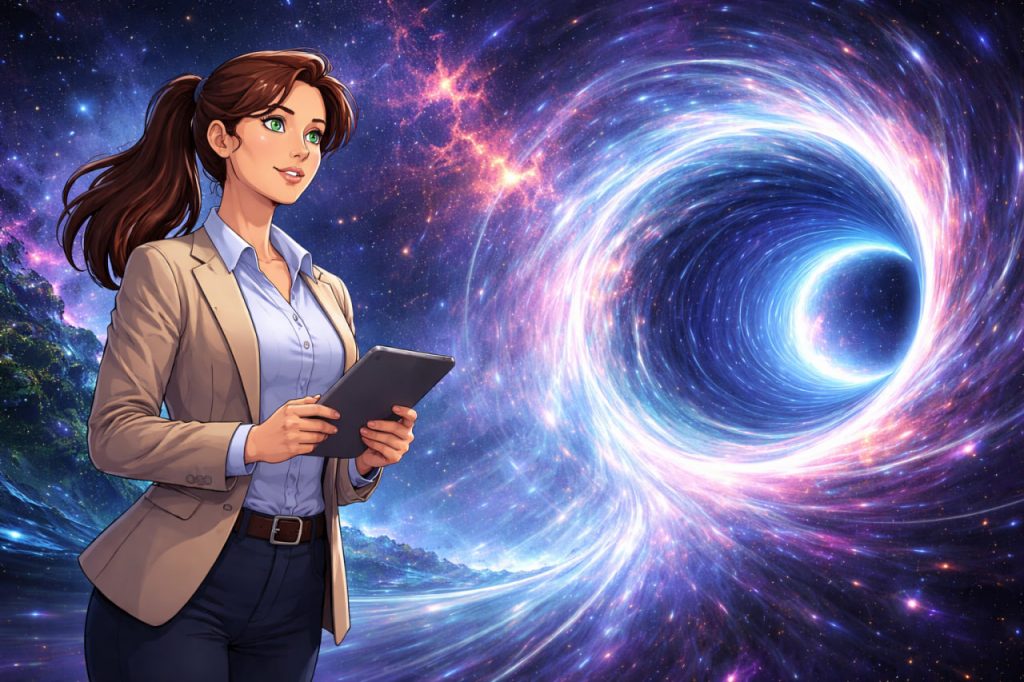
Wormholes are one of the most intriguing concepts in theoretical physics, often described as shortcuts connecting distant points in space and time. Unlike conventional travel, which requires moving through space step by step, a wormhole would allow instant passage between two regions of the universe. The idea originates from solutions to Einstein’s equations of general relativity, suggesting that space-time can be curved in ways that create hidden connections. Although wormholes remain hypothetical, they have become a powerful tool for exploring the limits of physics, cosmology, and even the nature of time itself. Understanding wormholes helps scientists investigate whether faster-than-light travel or time travel could ever be possible within the laws of physics.
What Is a Wormhole?
A wormhole can be imagined as a tunnel in the fabric of space-time, linking two separate points that may be extremely far apart. Instead of traveling across vast distances, an object entering a wormhole could emerge almost instantly at another location. In theory, wormholes consist of two “mouths” connected by a throat-like structure. According to theoretical physicist Dr. James Carter:
“Wormholes are not just science fiction—they are mathematical solutions
that reveal how flexible space-time could be under extreme conditions.”
This demonstrates that wormholes are grounded in real physics, even if they have not been observed.
Einstein–Rosen Bridges and General Relativity
The earliest concept of a wormhole is known as an Einstein–Rosen bridge, proposed as a connection between two black holes. These structures arise naturally from the equations of general relativity, showing that space-time can fold in on itself. However, these early models are unstable and would collapse too quickly for anything to pass through. This limitation has led scientists to explore more advanced models that could remain open long enough for travel.
The Role of Exotic Matter
To keep a wormhole stable and traversable, theories suggest the need for exotic matter, a form of matter with negative energy density. This type of matter would counteract gravitational collapse and hold the wormhole open. While quantum physics allows for small amounts of negative energy under certain conditions, it is unclear whether sufficient quantities could exist in reality. The requirement for exotic matter is one of the biggest challenges in turning wormholes from theory into practice.
Wormholes and Time Travel
One of the most fascinating implications of wormholes is their potential connection to time travel. If one end of a wormhole experiences time differently than the other, it could theoretically allow movement between different points in time. This raises complex questions about causality, paradoxes, and the fundamental nature of time. While mathematically possible, these scenarios remain highly speculative and are not supported by experimental evidence.
Do Wormholes Exist?
Currently, there is no direct evidence that wormholes exist in the universe. They remain a theoretical concept supported by mathematical models rather than observation. Scientists continue to study them as part of broader efforts to understand quantum gravity and the structure of space-time. Even if wormholes never become practical, the ideas behind them push the boundaries of human knowledge and inspire new approaches to understanding the universe.
Interesting Facts
- Wormholes are sometimes called “Einstein–Rosen bridges” in physics.
- They could theoretically connect not only distant places but also different times.
- Stable wormholes would require exotic matter with negative energy.
- No experimental evidence of wormholes has been found so far.
- Wormholes are widely used in science fiction, but are based on real equations.
Glossary
- Wormhole — a hypothetical tunnel connecting two points in space-time.
- General Relativity — Einstein’s theory describing gravity as the curvature of space-time.
- Einstein–Rosen Bridge — an early theoretical model of a wormhole connecting two regions.
- Exotic Matter — theoretical matter with negative energy density.
- Space-Time — the four-dimensional structure combining space and time.