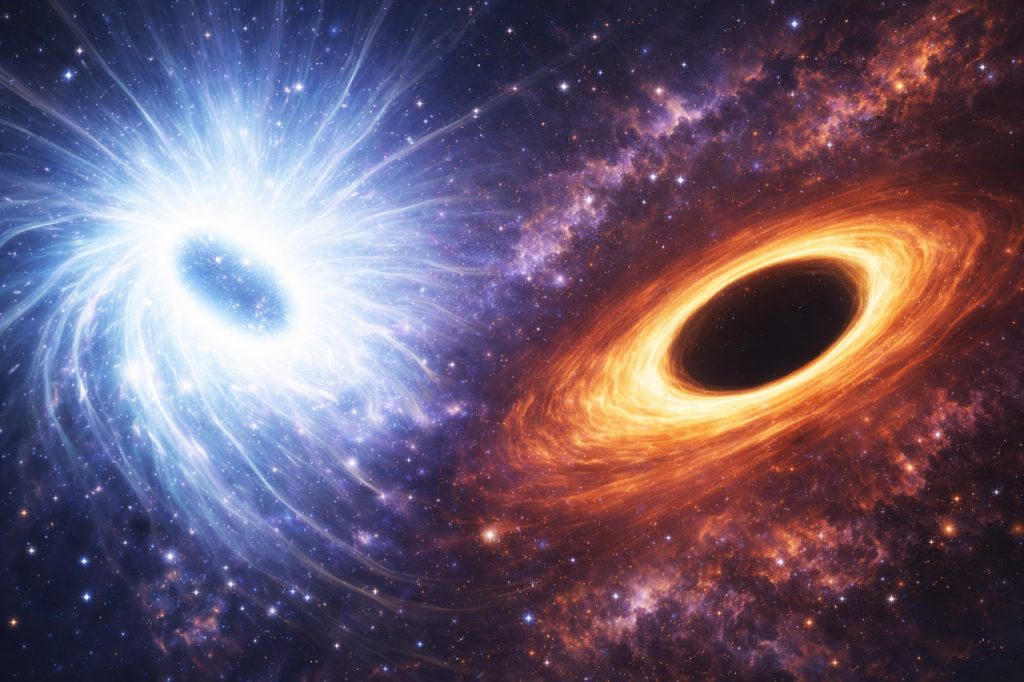
White holes are one of the most fascinating and speculative concepts in modern physics, often described as the theoretical opposites of black holes. While black holes absorb matter and light, white holes are predicted to do the reverse—expelling matter and preventing anything from entering. This idea emerges naturally from certain solutions of Einstein’s equations of general relativity, suggesting that space-time could allow such objects to exist. However, unlike black holes, which have strong observational evidence, white holes remain purely theoretical. Their existence raises deep questions about time, causality, and the fundamental structure of the universe. Exploring white holes helps scientists test the limits of physics and understand whether our current theories describe reality completely.
What Is a White Hole?
A white hole can be thought of as a region of space-time that cannot be entered from the outside, but from which matter and energy can emerge. In theory, it is a time-reversed version of a black hole. If a black hole traps everything beyond its event horizon, a white hole would act as a source, continuously emitting matter. According to theoretical physicist Dr. Elena Vasquez:
“White holes are mathematically valid solutions,
but whether nature actually allows them is still an open question.”
This highlights the distinction between mathematical possibility and physical reality.
Connection to General Relativity
White holes appear in the mathematical framework of general relativity, particularly in solutions related to black holes. When equations are extended symmetrically in time, they naturally produce white hole counterparts. These solutions suggest that space-time may allow regions where time behaves differently, leading to objects that operate in reverse compared to black holes. However, these solutions rely on idealized conditions and may not represent stable or realistic structures in the universe.
Stability and Physical Challenges
One of the main problems with white holes is their instability. Even a tiny amount of incoming matter would theoretically disrupt a white hole, causing it to collapse or transform into something else. This makes it difficult to imagine how such an object could persist in a real, dynamic universe filled with particles and radiation. Additionally, the concept of a white hole challenges our understanding of causality, as it would involve matter appearing without a clear origin in time.
Links to Wormholes and the Early Universe
Some theories connect white holes to wormholes, hypothetical tunnels linking different regions of space-time. In certain models, a black hole could be connected to a white hole at another point in the universe, allowing matter to pass through. Other speculative ideas suggest that the Big Bang itself might resemble a white hole, representing a massive release of energy and matter at the beginning of the universe. While these ideas are intriguing, they remain unproven and highly theoretical.
Do White Holes Exist?
Currently, there is no observational evidence that white holes exist. Astronomers have not detected any phenomena that clearly match their predicted behavior. Most scientists consider them an interesting mathematical concept rather than a physical reality. However, ongoing research in quantum gravity and cosmology may provide new insights in the future. Whether or not white holes exist, studying them helps deepen our understanding of space, time, and the universe.
Interesting Facts
- White holes are predicted by the same equations that describe black holes.
- No confirmed observation of a white hole has ever been recorded.
- Some theories suggest the Big Bang could resemble a white hole event.
- White holes would theoretically repel all incoming matter and light.
- They are closely linked to ideas about time symmetry in physics.
Glossary
- White Hole — a hypothetical region of space-time that emits matter and cannot be entered.
- Black Hole — a region of space with gravity so strong that nothing can escape it.
- General Relativity — Einstein’s theory describing gravity as the curvature of space-time.
- Event Horizon — the boundary beyond which nothing can escape a black hole.
- Wormhole — a theoretical tunnel connecting distant points in space-time.