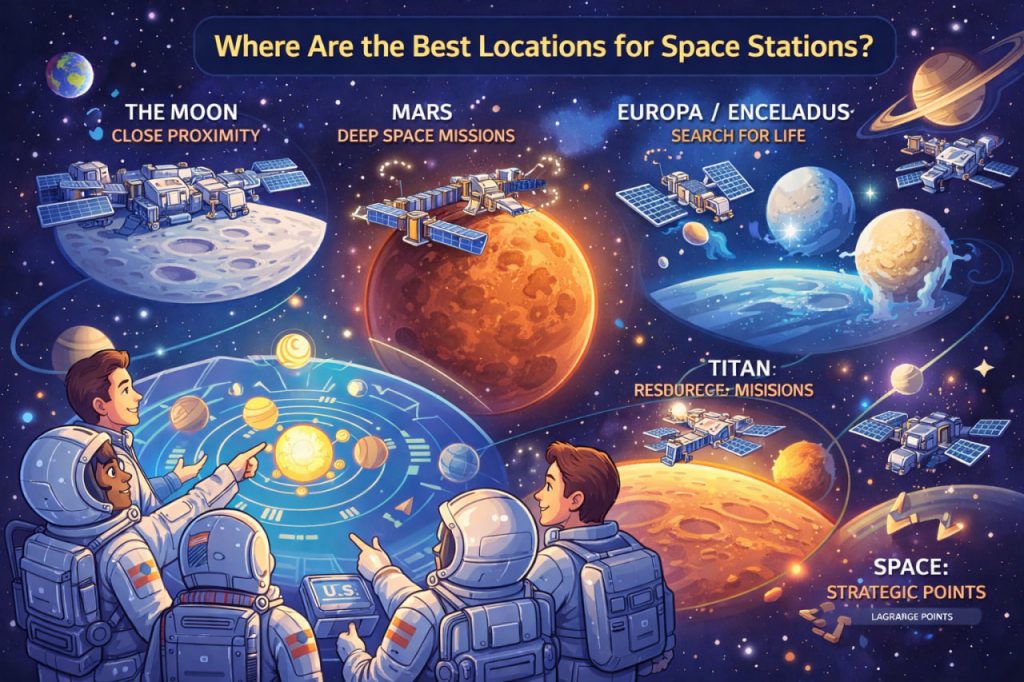
As humanity looks beyond Earth, the idea of placing space stations near other planets and moons becomes increasingly important. These stations could serve as scientific hubs, logistics centers, refueling points, and stepping stones for deep-space exploration. However, not every celestial body is equally suitable for such projects. Factors such as gravity, radiation, access to water ice, orbital stability, and distance from Earth all influence whether a location is practical. Scientists and engineers study these conditions carefully to identify the most promising destinations for long-term infrastructure in space. Understanding where future stations could be built helps define the next stages of human exploration and makes the concept of a multi-planetary civilization more realistic.
What Makes a Location Promising for a Space Station?
Choosing a location for a space station is not simply a matter of picking the nearest planet or moon. Engineers must consider orbital mechanics, environmental safety, communication delays, and access to useful resources. A good location should support transportation, offer scientific value, and reduce risks for astronauts and equipment. Aerospace researcher Dr. Alan Brooks explains:
“The most valuable station sites are those that combine strategic position,
resource potential, and long-term operational stability.”
This means that the best place for a station is often not on a planetary surface itself, but in orbit around a planet or moon, or near a location where future missions can be supported efficiently.
The Moon: The Most Practical First Step
The Moon remains the most realistic and strategically important location for humanity’s next major space station. Its close distance to Earth makes transport, communication, and emergency planning far easier than for more distant destinations. A station in lunar orbit or near the Moon could support scientific research, surface missions, technology testing, and preparation for missions deeper into the solar system. The Moon is also valuable because it may contain water ice in permanently shadowed regions, which could potentially be used for drinking water, oxygen, and rocket fuel. A lunar station would therefore not only be a laboratory but also a testing ground for long-term human survival beyond Earth.
Mars: A Future Hub for Deep-Space Expansion
Mars is one of the most discussed targets for future human exploration, and a station connected to Mars missions would be highly valuable. Because the planet is far more distant than the Moon, building stations in Martian orbit may be more practical at first than building permanent settlements directly on the surface. Such stations could serve as command centers, cargo hubs, and support platforms for robotic and human expeditions. Mars is attractive because it has water ice, a day length similar to Earth’s, and major scientific importance related to planetary evolution and the search for past life. At the same time, radiation exposure, long travel times, and difficult landing conditions make Mars a far more demanding destination than the Moon.
Moons of the Outer Solar System
Several moons in the outer solar system are scientifically fascinating enough to justify future orbital stations, even if such missions remain far in the future. Moons such as Europa, Ganymede, Titan, and Enceladus are especially important because they may contain subsurface oceans or complex chemistry relevant to the search for life. A station near these worlds would most likely be robotic or semi-automated for a long time, because the distances involved create enormous technical and logistical challenges. Still, these moons are attractive because they offer unique research opportunities that cannot be matched by most planets. In the long term, orbital stations near such moons could become centers for astrobiology, resource studies, and advanced robotic operations.
Gas Giant Systems and Strategic Orbits
Although gas giants themselves are not suitable for surface stations, their systems may offer useful locations for orbital infrastructure. Jupiter and Saturn have many moons and strong gravitational influence, making them scientifically rich but also technically difficult environments. Stations in these systems would need to account for radiation belts, extreme cold, and long communication delays. Even so, placing a station in a carefully selected orbit around a major moon could allow long-term exploration of entire planetary systems. In that sense, gas giant regions may eventually function like space harbors for robotic exploration, resource mapping, and interplanetary science.
Free-Space Stations Versus Planetary Locations
In some cases, the best place for a station may not be near a planetary surface at all. Engineers often study locations such as Lagrange points, where gravitational forces create relatively stable orbital regions. These points can be useful for observation, transport staging, and long-term space operations. A station located there could support missions to the Moon, Mars, or even deeper destinations without the complications of landing and launching from a surface. This idea shows that the future of space stations may involve not just planets and moons, but also strategically valuable regions of open space.
Why These Locations Matter
Identifying promising locations for future space stations is about much more than exploration alone. These choices affect how humans will travel, where they will conduct research, and how they might one day live beyond Earth. A well-placed station can reduce mission costs, improve safety, and make long-distance travel more realistic. It can also act as a bridge between short missions and permanent off-world presence. As technology develops, the most promising sites will likely be those that combine science, logistics, and resource potential in the most sustainable way.
Interesting Facts
- The Moon is currently considered the most realistic next step for major off-Earth station development
- Mars missions may rely on orbital stations before permanent surface bases
- Europa and Enceladus are especially important because they may hide subsurface oceans
- Lagrange points are regions where gravity can create relatively stable orbital positions
- Future stations may serve as fuel depots, laboratories, and transport hubs at the same time
Glossary
- Orbital Station — a space station placed in orbit around a planet, moon, or other body
- Lagrange Point — a location in space where gravitational forces can create a stable position for spacecraft
- Radiation — high-energy particles or waves that can be dangerous to living organisms and electronics
- Astrobiology — the scientific study of life in the universe and the conditions that may support it
- Resource Potential — the possibility of obtaining useful materials such as water ice or fuel components from a location