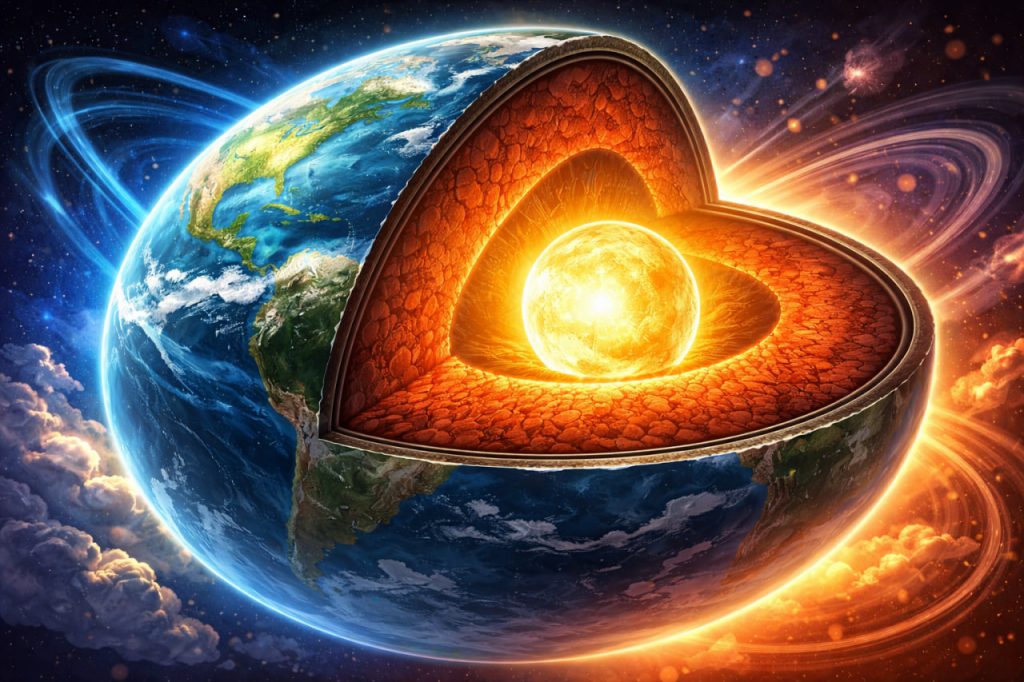
The interior of Earth is one of the most mysterious and fascinating parts of our planet. Although we cannot directly observe it, scientists have developed detailed models of its structure using seismic data and advanced research methods. The Earth is divided into several layers, including the crust, mantle, outer core, and inner core. At the very center lies the core, which plays a crucial role in shaping the planet’s magnetic field and geological activity. Temperatures and pressures in this region are extreme, reaching levels far beyond anything found on the surface. Despite these conditions, the core is essential for maintaining life on Earth. Understanding its structure helps scientists explain many natural processes, from earthquakes to magnetic phenomena.
The Structure of Earth’s Core
Earth’s core is divided into two main parts: the outer core and the inner core. The outer core is a liquid layer composed mainly of iron and nickel, located beneath the mantle. It extends thousands of kilometers and surrounds the inner core. The inner core, in contrast, is a solid sphere, even though temperatures there are extremely high. Geophysicist Dr. Robert Hayes explains:
“The inner core remains solid due to immense pressure,
even at temperatures comparable to the surface of the Sun.”
This combination of liquid and solid layers creates dynamic processes deep within the planet. The interaction between these layers is responsible for generating Earth’s magnetic field. Without this structure, many essential planetary functions would not exist.
Extreme Conditions Inside the Core
Conditions inside the Earth’s core are unlike anything on the surface. Temperatures can reach over 5,000–6,000 degrees Celsius, and pressure is millions of times greater than atmospheric pressure. These extreme conditions affect the behavior of materials, making them behave differently than under normal circumstances. Metals such as iron remain stable in unusual states due to compression. The core’s environment cannot be replicated easily in laboratories, making it a challenging area of study. Scientists rely on indirect observations, such as seismic waves, to understand these conditions. These waves change speed and direction depending on the materials they pass through, revealing details about the core’s structure.
How Scientists Study the Core
Since direct exploration of the core is impossible with current technology, scientists use indirect methods to study it. One of the most important tools is the analysis of seismic waves generated by earthquakes. These waves travel through the Earth and provide information about different layers based on how they move. By studying wave patterns, scientists can determine whether a layer is solid or liquid. Additional data comes from magnetic field observations and laboratory simulations. Advances in technology continue to improve our understanding of the planet’s interior. Each discovery helps refine existing models and reveals new insights into Earth’s formation.
The Core and Earth’s Magnetic Field
One of the most important functions of the core is the creation of Earth’s magnetic field. The movement of liquid metal in the outer core generates electric currents, which in turn produce the magnetic field. This field protects the planet from harmful solar radiation and cosmic particles. Without it, life on Earth would be much more difficult to sustain. The magnetic field also helps guide navigation systems and affects many natural processes. Changes in the core can influence the strength and behavior of this field over time. This makes the study of the core essential not only for geology but also for understanding planetary protection.
Why the Core Matters
The Earth’s core is fundamental to the planet’s stability and long-term evolution. It influences everything from tectonic activity to the magnetic field that shields life. Understanding the core helps scientists predict geological events and better understand Earth’s history. It also provides insight into how other planets are structured. By studying Earth, researchers can compare it with other celestial bodies and expand knowledge of planetary science. The core remains one of the least accessible yet most important parts of our planet. Continued research will help uncover more of its secrets in the future.
Interesting Facts
- The inner core is about the size of the Moon
- Temperatures in the core are similar to the surface of the Sun
- The outer core is completely liquid metal
- Earth’s magnetic field is generated deep inside the core
- Scientists study the core using seismic waves
Glossary
- Core — the central part of the Earth
- Seismic Waves — waves generated by earthquakes used to study Earth’s interior
- Magnetic Field — invisible field protecting Earth from radiation
- Mantle — layer between the crust and the core
- Pressure — force applied to materials at great depth