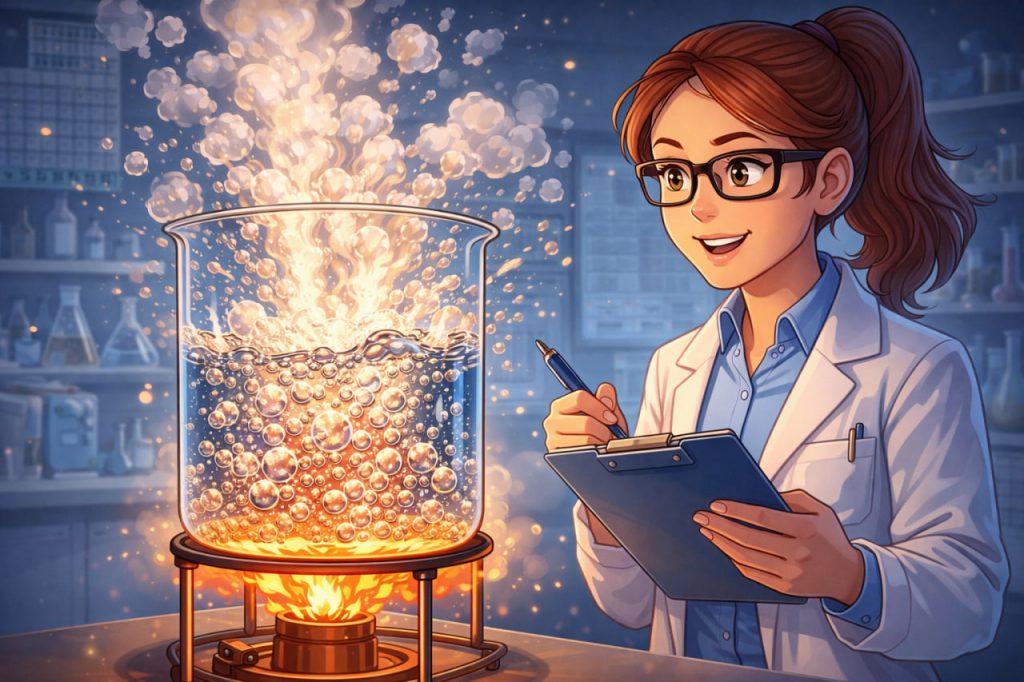
Boiling is a fundamental physical process that occurs when a liquid transforms into vapor throughout its entire volume. Unlike evaporation, which happens only at the surface, boiling involves the formation of vapor bubbles within the liquid. This process begins when the liquid reaches a specific temperature known as the boiling point. At this temperature, the pressure of the vapor inside the bubbles equals the external pressure acting on the liquid. As a result, bubbles can form and rise freely to the surface. Boiling is influenced by factors such as pressure, temperature, and the properties of the liquid. Understanding boiling helps explain many natural and technological processes, from cooking to industrial systems.
What Happens During Boiling
When a liquid is heated, its molecules gain kinetic energy and move more rapidly. As the temperature increases, some molecules begin to escape from the liquid phase into the gas phase. At the boiling point, vapor bubbles form within the liquid rather than only at the surface. These bubbles consist of gas that expands as it rises due to lower pressure near the surface. Physicist Dr. James Carter explains:
“Boiling occurs when internal vapor pressure matches external pressure,
allowing bubbles to grow and move through the liquid.”
This marks a transition from localized evaporation to full-phase change. The process continues as long as heat is supplied, maintaining the energy required for vaporization. This dynamic interaction between heat and pressure defines the boiling process.
Boiling Point and Pressure
The boiling point of a liquid is not a fixed value—it depends on the surrounding pressure. At higher altitudes, where atmospheric pressure is lower, liquids boil at lower temperatures. This is why water boils below 100°C in mountainous regions. Conversely, increasing pressure raises the boiling point, which is used in pressure cookers to cook food faster. The relationship between pressure and boiling is a key principle in thermodynamics. It shows how environmental conditions influence phase transitions. Understanding this relationship is important in both everyday life and scientific applications.
Bubble Formation and Growth
Bubble formation begins at small imperfections or nucleation sites within the liquid or on container surfaces. These sites allow vapor to accumulate and form stable bubbles. As heat continues to be supplied, bubbles grow and detach, rising to the surface. The movement of bubbles creates turbulence and enhances heat transfer within the liquid. This process makes boiling an efficient way to transfer energy. The behavior of bubbles can vary depending on temperature and liquid properties. In some cases, rapid bubble formation can lead to violent boiling, known as boiling instability.
Heat Transfer and Energy
Boiling is an energy-intensive process because it requires heat not only to raise temperature but also to change the phase of the liquid. This energy is known as latent heat of vaporization. During boiling, temperature remains constant even though heat continues to be added. This is because the energy is used to break intermolecular bonds rather than increase temperature. Boiling is widely used in engineering systems for efficient heat transfer. It plays a critical role in power generation, cooling systems, and chemical processes. Understanding energy exchange during boiling is essential for designing efficient systems.
Why Boiling Matters
Boiling is not only important in physics but also in everyday life and industry. It is used in cooking, sterilization, and many manufacturing processes. In nature, boiling-related processes occur in geothermal systems and volcanic environments. The principles of boiling also apply to advanced technologies such as steam turbines and refrigeration systems. Studying boiling helps scientists and engineers improve efficiency and safety in many applications. It is a simple phenomenon with complex underlying physics. Understanding it provides insight into how energy and matter interact.
Interesting Facts
- Water boils at 100°C at standard pressure
- Boiling point decreases at higher altitudes
- Latent heat is required to change liquid into vapor
- Boiling improves heat transfer efficiency
- Bubble formation depends on surface conditions
Glossary
- Boiling Point — temperature at which a liquid becomes vapor
- Vapor Pressure — pressure exerted by a vapor in equilibrium with its liquid
- Latent Heat — energy required for phase change without temperature increase
- Nucleation Site — point where bubbles begin to form
- Thermodynamics — study of heat and energy transfer