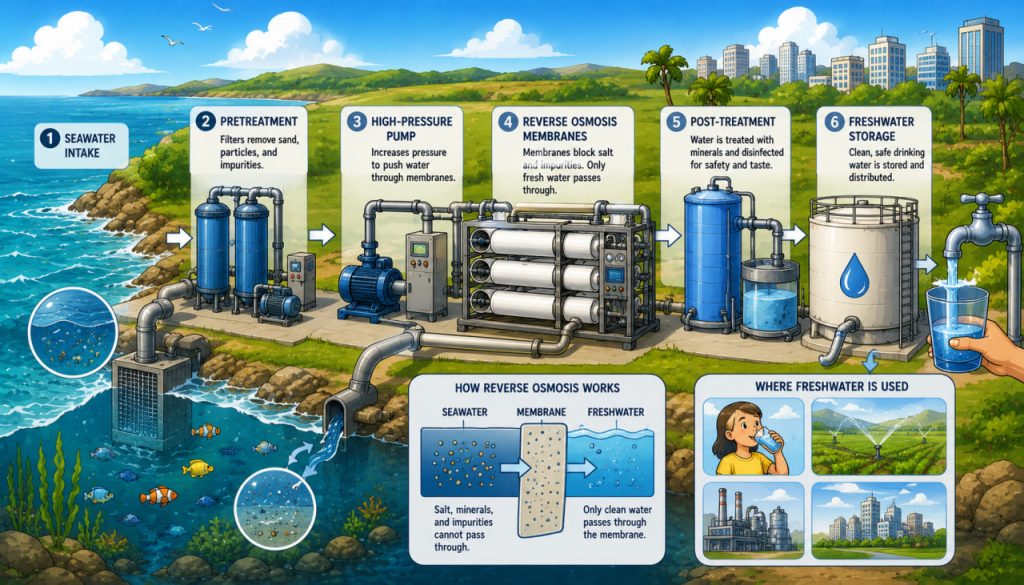
Freshwater shortages are becoming one of the biggest global challenges of the modern era. As populations grow and climate change affects natural water supplies, many countries are turning to desalination technology to produce clean drinking water from the ocean. Desalination plants already provide water for millions of people worldwide. Understanding how desalination works reveals how science and engineering can help solve critical environmental problems.
What Is Desalination?
Desalination is the process of removing salt and impurities from seawater or brackish water to make it safe for human use.
The goal is to produce:
- Drinking water
- Water for agriculture
- Industrial water supplies
It transforms unusable saltwater into freshwater.
Why Desalination Is Important
Earth is covered mostly by water, but:
- About 97% is saltwater
- Only a small portion is accessible freshwater
Many regions face:
- Droughts
- Water shortages
- Population pressure
Desalination offers a potential solution where natural freshwater is limited.
Main Types of Desalination
There are two primary methods used today.
Reverse Osmosis (RO)
Reverse osmosis is the most common modern desalination method.
How it works:
- Seawater is pushed through special membranes
- The membranes block salt and impurities
- Freshwater passes through
This process requires:
- High pressure
- Advanced filtration systems
RO is energy-efficient compared to older methods.
Thermal Desalination
This method uses heat to separate water from salt.
Process:
- Seawater is heated
- Water evaporates into steam
- Steam condenses into freshwater
Salt remains behind.
This method is common in:
- Oil-rich countries with abundant energy resources
The Science Behind Reverse Osmosis
Normally, water naturally moves through membranes from low-salt to high-salt concentration. This is called osmosis.
Reverse osmosis applies pressure to reverse the process.
P>ΠP > \PiP>Π
Where:
- PPP = applied pressure
- Π\PiΠ = osmotic pressure
The applied pressure forces freshwater through the membrane while salt stays behind.
Components of a Desalination Plant
Modern desalination facilities include:
- Intake systems
- Filtration units
- High-pressure pumps
- Membrane systems
- Water treatment stages
These systems work together to ensure water safety and efficiency.
Advantages of Desalination
Desalination provides several important benefits.
Reliable Water Source
Oceans provide nearly unlimited saltwater supplies.
Drought Resistance
Unlike rainfall-dependent systems, desalination can operate continuously.
Urban Support
Large coastal cities can secure stable water supplies.
It increases water security in dry regions.
Challenges and Limitations
Despite its advantages, desalination has challenges.
High Energy Consumption
Producing freshwater requires significant energy.
Environmental Concerns
Salt waste (brine) can affect marine ecosystems if poorly managed.
High Cost
Construction and operation of plants are expensive.
Balancing efficiency and environmental protection remains important.
Expert Insight
Water expert John Anthony Allan, known for his work on global water systems, explained:
“Desalination can help solve water shortages, but it must be combined with conservation and sustainable management.”
This highlights that technology alone is not enough.
Countries Using Desalination
Several nations rely heavily on desalination.
Major users include:
- Saudi Arabia
- United Arab Emirates
- Israel
- Australia
Some countries obtain large portions of drinking water from desalination plants.
Future of Desalination
Scientists are developing better technologies to:
- Reduce energy use
- Improve membrane efficiency
- Lower environmental impact
Renewable energy sources like solar power may make desalination more sustainable.
Why Desalination Matters
Water is essential for civilization.
Desalination:
- Expands freshwater access
- Supports growing populations
- Helps regions adapt to climate change
It may become increasingly important in the future.
Interesting Facts
- The world’s largest desalination plants are located in the Middle East.
- Reverse osmosis membranes contain microscopic pores.
- Desalination can produce millions of liters of water daily.
- Some desalination plants use solar energy.
- Oceans contain enough water to supply humanity indefinitely if efficiently processed.
Glossary
- Desalination — Process of removing salt from water.
- Reverse Osmosis — Filtration method using pressure and membranes.
- Membrane — Thin material that filters substances.
- Brine — Highly concentrated saltwater left after desalination.
- Osmosis — Natural movement of water through a membrane.