Diamonds have long been associated with rarity, beauty, and immense value. Traditionally formed deep within the Earth over billions of years, diamonds are now being produced in laboratories using advanced technology. These lab-grown diamonds are chemically and physically identical to natural ones. Understanding how they are created reveals how science can replicate one of nature’s most extraordinary processes in a controlled environment.
What Is a Diamond?
A diamond is a crystal made of carbon atoms arranged in a specific structure.
This structure:
- Makes diamonds extremely hard
- Gives them high thermal conductivity
- Allows them to reflect light brilliantly
It is one of the hardest known natural materials.
Natural vs. Lab-Grown Diamonds
Natural diamonds form deep underground under extreme conditions.
Lab-grown diamonds:
- Are created in weeks instead of billions of years
- Have the same physical and chemical properties
- Are often more environmentally controlled
The key difference lies in their origin, not their structure.
How Diamonds Form in Nature
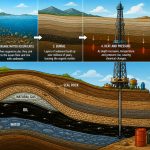
In nature, diamonds form about 150–200 kilometers below the Earth’s surface.
Conditions include:
- Extremely high pressure
- Temperatures over 1,000°C
Over millions of years:
- Carbon atoms bond into a crystal lattice
- Diamonds are brought to the surface through volcanic activity
Methods of Growing Diamonds
Scientists use two main methods to grow diamonds in laboratories.
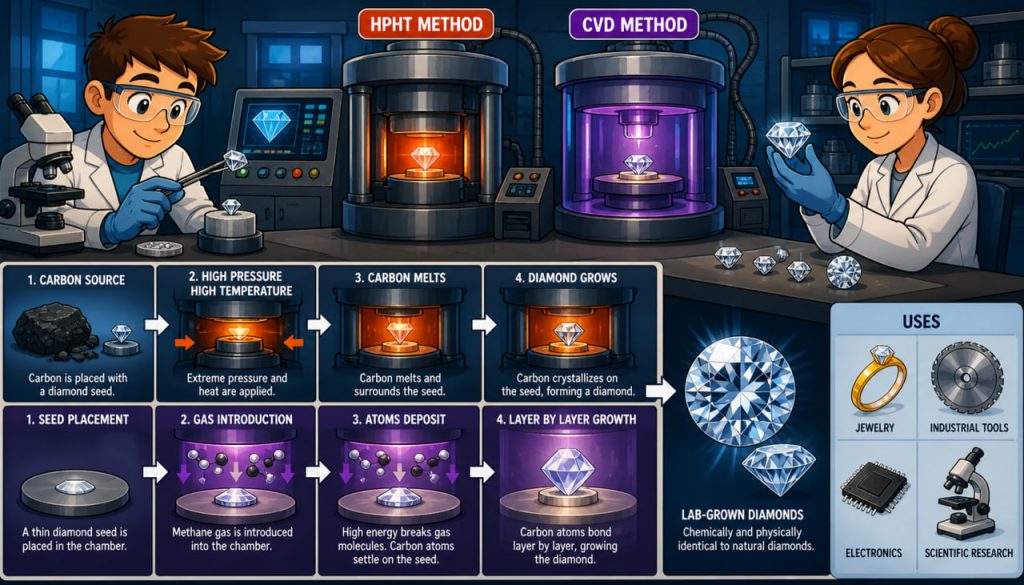
High Pressure High Temperature (HPHT)
This method mimics natural conditions.
Process:
- Carbon is placed in a press
- Extreme pressure and heat are applied
- A small diamond “seed” is used to start growth
The carbon:
- Melts and bonds to the seed
- Forms a diamond crystal over time
This method closely replicates Earth’s natural process.
Chemical Vapor Deposition (CVD)
CVD is a more modern and precise method.
Process:
- A thin diamond seed is placed in a chamber
- Gas (usually methane) is introduced
- High energy breaks gas molecules apart
- Carbon atoms settle on the seed
Layer by layer:
- The diamond grows upward
This method allows precise control over diamond quality.
Expert Insight
Materials scientist Russell Hemley has explained:
“Lab-grown diamonds demonstrate how controlled environments can reproduce natural processes with remarkable accuracy.”
This highlights the power of modern technology in materials science.
How Long Does It Take?
Unlike natural diamonds:
- HPHT diamonds can form in days to weeks
- CVD diamonds may take several weeks
The timeline is dramatically shorter than geological formation.
Uses of Lab-Grown Diamonds
Diamonds are not only used in jewelry.
They are important in:
- Industrial cutting tools
- Electronics
- Medical equipment
- Scientific research
Their hardness and thermal properties make them highly valuable.
Advantages of Lab-Grown Diamonds
Lab-grown diamonds offer several benefits:
- Lower environmental impact
- More controlled production
- Often lower cost
- Ethical sourcing
They provide a sustainable alternative to mining.
Challenges and Limitations
Despite advantages, challenges exist:
- High energy consumption
- Expensive equipment
- Market perception differences
Some consumers still prefer natural diamonds for their rarity.
Why This Technology Matters
Growing diamonds in laboratories represents a major advancement in science and industry.
It shows that:
- Complex natural processes can be replicated
- Materials can be engineered for specific uses
- Sustainability can be improved
It is a powerful example of human innovation.
Interesting Facts
- Diamonds are made entirely of carbon.
- Lab-grown diamonds are real diamonds, not imitations.
- They can be created in weeks instead of billions of years.
- Diamonds are used in high-tech industries.
- Some lab diamonds are purer than natural ones.
Glossary
- HPHT — High Pressure High Temperature method of diamond growth.
- CVD — Chemical Vapor Deposition process.
- Crystal Lattice — Arrangement of atoms in a solid.
- Seed Crystal — A small crystal used to grow a larger one.
- Methane — A gas used in diamond production.