Oil, also known as petroleum, is one of the most important natural resources in modern civilization. It fuels transportation, powers industries, and serves as the foundation for countless everyday products. But where does oil actually come from? The answer lies deep in Earth’s history. Scientists have discovered that oil is formed from ancient organic matter that transformed over millions of years under extreme conditions.
Understanding oil helps explain both its value and its environmental impact.
What Is Oil?
Oil is a naturally occurring liquid found beneath the Earth’s surface. It is composed mainly of hydrocarbons—molecules made of hydrogen and carbon.
Oil can be:
- Thick or light
- Dark or nearly clear
- Found in liquid or semi-solid form
It is extracted from underground reservoirs and refined into usable products.
The Origins of Oil
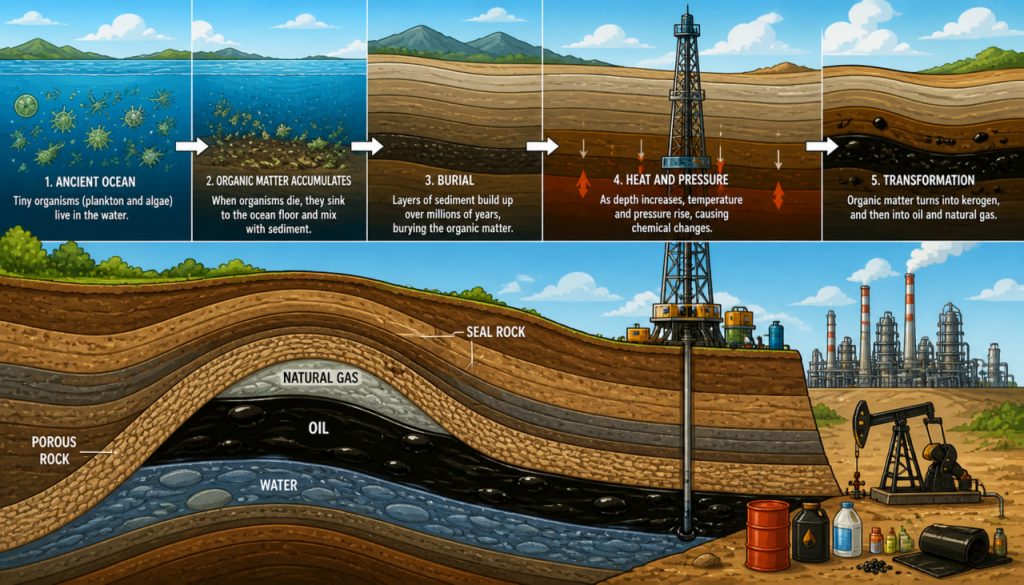
Oil begins its journey in ancient oceans.
Millions of years ago:
- Tiny organisms like plankton and algae lived in water
- When they died, they sank to the ocean floor
- Their remains mixed with sediment
Over time, these layers built up and were buried.
Formation Process
The transformation from organic material to oil takes millions of years.
Step 1: Accumulation
Organic matter accumulates at the bottom of seas and lakes.
Step 2: Burial
Sediment layers cover the material, increasing pressure.
Step 3: Heat and Pressure
As depth increases:
- Temperature rises
- Pressure increases
- Chemical changes occur
Step 4: Transformation
Organic material becomes:
- Kerogen (a waxy substance)
- Then oil and natural gas
This process is known as the “petroleum formation process.”
Where Oil Is Found
Oil is stored in underground rock formations called reservoirs.
These are typically:
- Porous rocks (like sandstone)
- Covered by impermeable layers that trap oil
Oil deposits are found worldwide, especially in:
- The Middle East
- Russia
- North America
Types of Oil
Oil varies in composition and quality.
Main types include:
- Light crude oil (easier to refine)
- Heavy crude oil (thicker and more complex)
- Sweet oil (low sulfur content)
- Sour oil (higher sulfur content)
Different types require different refining processes.
How Oil Is Extracted
Oil is extracted using drilling techniques.
Methods include:
- Onshore drilling (land-based)
- Offshore drilling (under the sea)
Advanced technologies allow:
- Deep drilling
- Horizontal drilling
- Hydraulic fracturing (fracking)
Uses of Oil
Oil is incredibly versatile.
It is used to produce:
- Fuel (gasoline, diesel, jet fuel)
- Plastics
- Chemicals
- Asphalt
- Synthetic materials
Modern life depends heavily on petroleum products.
Expert Insight
Geologist M. King Hubbert, known for his work on oil production, stated:
“Oil is a finite resource formed over geological time, and its extraction inevitably leads to depletion.”
This highlights the importance of managing oil resources responsibly.
Environmental Impact
While oil is valuable, it also has environmental consequences.
These include:
- Greenhouse gas emissions
- Oil spills
- Air and water pollution
Burning oil contributes significantly to climate change.
Is Oil Renewable?
Oil is considered a non-renewable resource.
Although it forms naturally:
- The process takes millions of years
- It cannot be replaced quickly
This means that oil supplies are limited.
The Future of Oil
As the world moves toward renewable energy:
- Demand for oil may decrease
- Alternative energy sources are growing
- Sustainability is becoming a priority
However, oil will likely remain important for decades.
Why Oil Matters
Oil has shaped global economies, politics, and technology.
It:
- Powers transportation
- Drives industrial development
- Influences global markets
Understanding oil helps us understand the modern world.
Interesting Facts
- Oil can take millions of years to form.
- It was once used for lighting before electricity.
- Crude oil must be refined before use.
- The deepest oil wells reach several kilometers underground.
- Oil is used in thousands of everyday products.
Glossary
- Petroleum — Another name for oil.
- Hydrocarbons — Molecules made of hydrogen and carbon.
- Reservoir — Underground rock formation holding oil.
- Refining — Process of converting crude oil into usable products.
- Non-renewable Resource — A resource that cannot be quickly replaced.