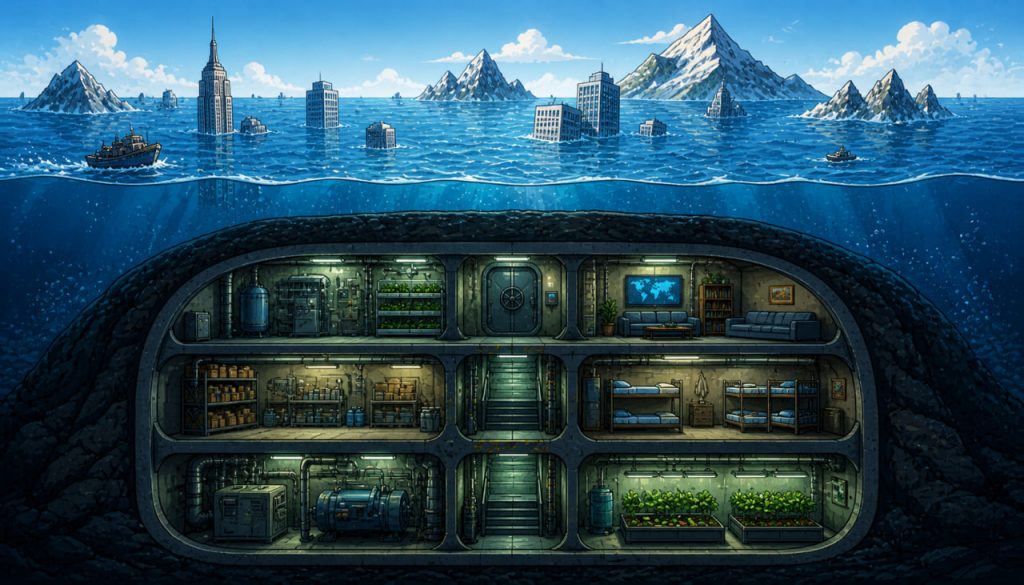
The idea of global water levels rising by 5 kilometers is an extreme and hypothetical scenario far beyond any known natural process. However, exploring this concept allows us to understand the limits of human survival systems, including underground bunkers. While bunkers are often seen as ultimate survival shelters, their effectiveness depends on environmental conditions, engineering limits, and long-term sustainability.
Is a 5-Kilometer Sea Level Rise Possible?
First, it is important to clarify the scale.
A 5-kilometer (3.1 miles) rise in water level would:
- Submerge all continents
- Cover even the highest mountains like Everest
- Require more water than exists on Earth’s surface
Scientifically, this scenario is not physically realistic under current planetary conditions.
However, as a thought experiment, it helps evaluate survival strategies.
What Are Survival Bunkers?
Bunkers are fortified underground or enclosed structures designed to protect people from extreme conditions.
They are built to withstand:
- Nuclear explosions
- Radiation
- Natural disasters
Typical features include:
- Reinforced walls
- Air filtration systems
- Independent power sources
They are designed for isolation and protection, but not unlimited survival.
What Happens to Bunkers Under Extreme Water Pressure?
If Earth were submerged under kilometers of water, pressure becomes the main problem.
At great depths:
- Water pressure increases dramatically
- Structures must withstand crushing forces
- Even submarines have depth limits
For example:
- At 1 km depth: pressure is about 100 times atmospheric pressure
- At 5 km: pressure becomes extreme
Most bunkers are not designed to survive such conditions.
Structural Limits of Underground Shelters
Standard bunkers are built for:
- Surface threats
- Limited underground depth
They are not engineered to:
- Resist deep ocean pressure
- Remain stable under massive water loads
Even reinforced structures would likely:
- Collapse
- Flood
- Lose structural integrity
Deep-sea engineering is fundamentally different from bunker construction.
Oxygen and Air Supply
Survival requires breathable air.
Bunkers rely on:
- Stored oxygen
- Air filtration systems
In a fully submerged world:
- External air cannot be accessed
- Systems must operate indefinitely
Long-term oxygen supply would be a critical limitation.
Food and Water Sustainability
Bunkers can store supplies, but only for limited periods.
Challenges include:
- Finite food storage
- Need for water purification
- Lack of agriculture
Without external resources:
- Supplies would eventually run out
Sustainable life requires renewable systems, not just storage.
Energy Requirements
Modern bunkers depend on energy systems.
These may include:
- Generators
- Batteries
- Renewable energy (rare underground)
In a submerged environment:
- Fuel would be limited
- Solar energy would be unavailable
- Maintenance would be difficult
Energy sustainability would be a major challenge.
Expert Insight
Engineer and disaster resilience expert Joseph Tainter has noted:
“Complex survival systems require continuous energy and maintenance—without them, collapse is inevitable.”
This highlights that survival is not just about protection, but long-term system stability.
Psychological and Social Factors
Even if physical survival were possible, human factors matter.
Long-term isolation can cause:
- Stress and anxiety
- Social breakdown
- Cognitive decline
Survival is both physical and psychological.
Could Advanced Technology Help?
In theory, future technologies might improve survival chances.
Possible solutions:
- Deep-sea habitats
- Closed-loop ecosystems
- Advanced pressure-resistant structures
However, these systems:
- Are complex and expensive
- Require constant maintenance
- Are not widely available
Realistic Conclusion
In such an extreme scenario:
- Standard bunkers would not survive
- Pressure would destroy most structures
- Long-term life support would fail
Bunkers are not designed for global ocean submersion at extreme depths.
Why This Question Matters
Exploring extreme scenarios helps us understand:
- Limits of human engineering
- Importance of sustainable systems
- Vulnerability of civilization
It shows that true survival depends on adaptability, not just shelter.
Interesting Facts
- The deepest ocean trenches reach about 11 km.
- Submarines have strict depth limits due to pressure.
- Most bunkers are designed for surface-level threats.
- Closed ecosystems are difficult to maintain long-term.
- Human survival requires continuous resource cycles.
Glossary
- Bunker — A fortified shelter designed for protection.
- Water Pressure — Force exerted by water at depth.
- Closed-Loop System — A system that recycles resources internally.
- Structural Integrity — Ability of a structure to withstand stress.
- Sustainability — Ability to maintain systems over time.