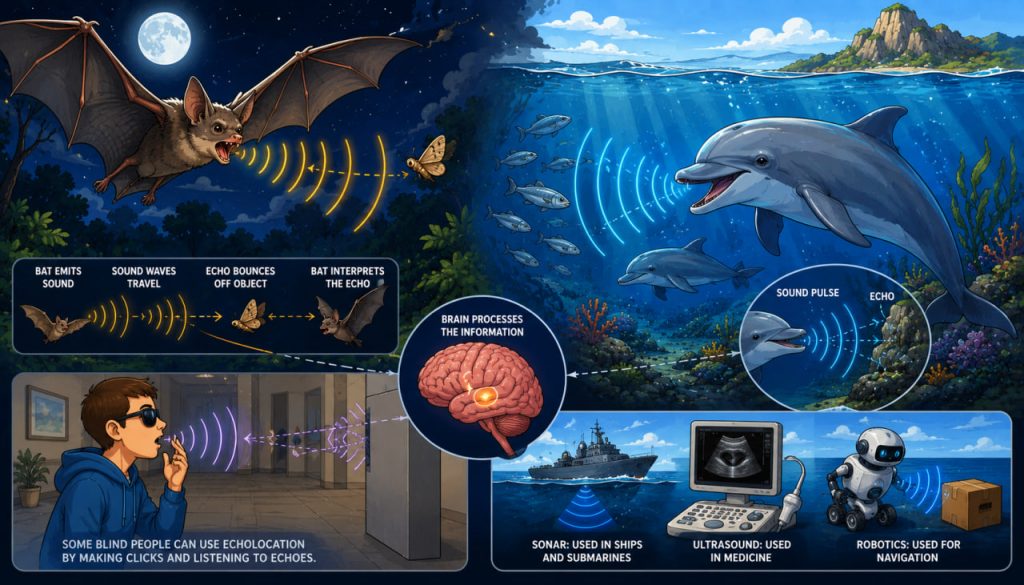
Echolocation is one of the most fascinating biological abilities in nature. It allows animals to navigate, hunt, and understand their surroundings using sound instead of vision. Bats flying in complete darkness and dolphins swimming through deep ocean waters rely on echolocation to survive. This remarkable system demonstrates how evolution created alternative ways to perceive the world beyond ordinary sight.
Scientists also use the principles of echolocation in technologies such as sonar, medicine, and robotics.
What Is Echolocation?
Echolocation is a method of detecting objects by producing sound waves and analyzing the returning echoes.
The process works like this:
- An animal emits a sound
- The sound travels through the environment
- It bounces off objects
- The echo returns
- The brain interprets the information
This allows animals to determine distance, size, shape, and movement.
Which Animals Use Echolocation?
Several species evolved this ability independently.
The best-known examples include:
- Bats
- Dolphins
- Toothed whales
Some birds and small mammals also use simpler forms of echolocation.
Echolocation in Bats
Bats are famous for navigating at night using sound.
They emit:
- High-frequency ultrasonic calls
These sounds are:
- Too high for humans to hear
When echoes return:
- The bat’s brain rapidly processes them
- It creates a detailed mental map of the surroundings
Bats can detect tiny insects while flying at high speeds in darkness.
Echolocation in Dolphins
Dolphins use echolocation underwater.
They produce clicking sounds that travel through water and bounce back from objects.
This helps dolphins:
- Find prey
- Navigate murky water
- Communicate
Their echolocation is extremely advanced and can detect subtle differences in materials and shapes.
Why Sound Works So Well
Sound waves travel differently depending on the environment.
In water:
- Sound travels faster and farther than light
This makes echolocation especially useful underwater.
For dolphins, sound is often more reliable than vision.
The Brain and Echolocation
Animals using echolocation have highly specialized brains.
Their nervous systems:
- Process echoes incredibly quickly
- Interpret timing and intensity differences
- Build spatial awareness from sound
The brain essentially transforms echoes into a sensory “image.”
Expert Insight
Neuroscientist Donald Griffin, who helped scientifically establish echolocation in bats, explained:
“Echolocation allows animals to perceive the world through reflected sound in astonishing detail.”
His work transformed scientific understanding of animal perception.
Human Echolocation
Some blind individuals can also develop forms of echolocation.
They may:
- Produce clicking sounds with the mouth
- Listen to returning echoes
With practice, people can:
- Detect walls
- Recognize obstacles
- Navigate spaces
This demonstrates the adaptability of the human brain.
Technology Inspired by Echolocation
Humans adapted echolocation principles into technology.
Examples include:
- Sonar systems in submarines
- Medical ultrasound imaging
- Robotic navigation systems
Nature often inspires technological innovation.
Sonar and Navigation
Sonar (Sound Navigation and Ranging) uses sound waves underwater.
It helps:
- Detect submarines
- Map ocean floors
- Locate objects underwater
Sonar functions similarly to dolphin echolocation.
Advantages of Echolocation
Echolocation works well in:
- Darkness
- Murky water
- Complex environments
It allows animals to:
- Hunt efficiently
- Avoid obstacles
- Navigate with precision
Limitations of Echolocation
Despite its power, echolocation has limits.
Factors affecting it include:
- Environmental noise
- Distance
- Surface complexity
Some conditions interfere with sound reflection.
Why Echolocation Matters
Echolocation reveals that vision is not the only way to understand the world.
It shows:
- Evolution can create multiple sensory systems
- Brains can interpret reality in different ways
- Sound can become a form of “seeing”
It expands our understanding of intelligence and perception.
Interesting Facts
- Some bats emit over 100 sound pulses per second.
- Dolphins can identify objects hidden underwater using echoes.
- Sound travels faster in water than in air.
- Human echolocation is being studied scientifically.
- Echolocation evolved independently in different species.
Glossary
- Echolocation — Detecting objects using reflected sound waves.
- Ultrasonic — Sound frequencies above human hearing range.
- Echo — Reflected sound returning to the source.
- Sonar — Technology using sound for navigation and detection.
- Spatial Awareness — Understanding the position of objects in space.