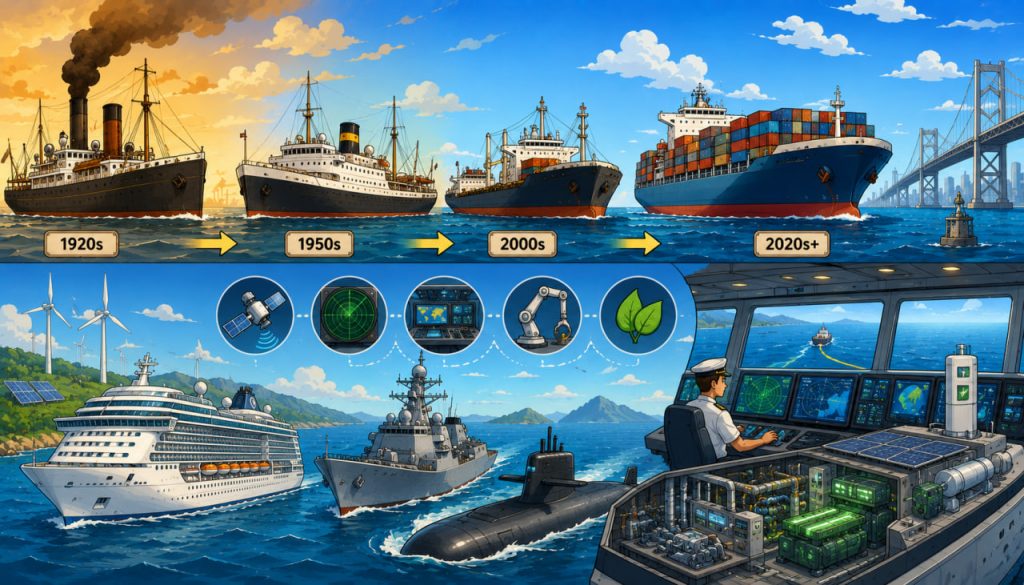
Ships have played a crucial role in human civilization for thousands of years, connecting continents, transporting goods, enabling exploration, and supporting global trade. Over the past century, ship technology has evolved dramatically. Modern vessels are faster, safer, larger, more efficient, and far more technologically advanced than ships from the early 20th century. Understanding these changes reveals how engineering, automation, and globalization transformed maritime transportation.
Ships 100 Years Ago
At the beginning of the 20th century, most large ships relied on:
- Steam engines
- Coal fuel
- Manual navigation systems
Ships were smaller and less efficient compared to modern standards.
Common vessel types included:
- Steamships
- Early battleships
- Cargo freighters
- Ocean liners
Navigation depended heavily on human skill and basic instruments.
The Shift From Coal to Oil
One of the biggest technological changes was the transition from coal-powered engines to oil-based fuels.
Oil engines offered:
- Greater efficiency
- Longer range
- Reduced manual labor
Coal-powered ships required crews to continuously feed fuel into boilers, while oil systems simplified operations.
Modern Engine Technology
Today’s ships use advanced propulsion systems.
These include:
- Diesel engines
- Gas turbines
- Nuclear propulsion (for some military vessels)
- Hybrid electric systems
Modern engines are:
- More powerful
- More fuel-efficient
- More environmentally controlled
Some modern ships can cross entire oceans with remarkable efficiency.
Changes in Navigation
Navigation technology has transformed completely.
A century ago, sailors relied on:
- Maps
- Compasses
- Celestial navigation
Modern ships use:
- GPS
- Radar
- Satellite communication
- Automated navigation systems
These technologies dramatically improve accuracy and safety.
Automation and Artificial Intelligence
Modern ships contain advanced computer systems.
Automation now controls:
- Engine monitoring
- Route optimization
- Fuel efficiency
- Safety systems
Some vessels are even being tested as partially autonomous ships.
Size and Cargo Capacity
Ships today are vastly larger than those of the past.
Modern container ships can transport:
- Tens of thousands of containers
This became possible due to:
- Improved engineering
- Stronger materials
- Global shipping standardization
Modern shipping is the backbone of global trade.
Expert Insight
Naval historian Sal Mercogliano has explained:
“Containerization and modern ship engineering completely changed the global economy by making international trade faster and cheaper.”
This highlights how maritime innovation reshaped the modern world.
Safety Improvements
Early ships faced significant risks:
- Storms
- Collisions
- Fires
- Navigation errors
Modern ships include:
- Advanced weather systems
- Fire suppression technology
- Emergency communication systems
- Reinforced hull structures
Safety standards are far stricter today.
Environmental Changes
Environmental concerns now strongly influence ship design.
Modern ships increasingly use:
- Cleaner fuels
- Emission reduction systems
- Improved fuel efficiency
Researchers are also exploring:
- Hydrogen-powered ships
- Wind-assisted propulsion
- Electric maritime systems
The shipping industry is adapting to sustainability goals.
Military Ship Evolution
Warships have changed dramatically over the last century.
Modern naval vessels include:
- Aircraft carriers
- Guided missile destroyers
- Nuclear submarines
Technology advancements involve:
- Radar systems
- Missile defense
- Stealth design
Naval warfare now depends heavily on electronics and automation.
Passenger Ships and Cruises
Ocean liners were once the primary method of long-distance travel.
Today:
- Airplanes dominate transportation
- Passenger ships focus mainly on tourism
Modern cruise ships function like floating cities with:
- Restaurants
- Entertainment
- Advanced stabilization systems
Materials and Shipbuilding
Older ships used:
- Riveted steel construction
Modern shipbuilding uses:
- Welded steel
- Lightweight alloys
- Computer-aided engineering
These improvements increase:
- Durability
- Efficiency
- Structural strength
Why Modern Ships Matter
Modern ships are essential for:
- Global trade
- Food transportation
- Energy supply chains
Over 80% of world trade moves by sea.
Without modern ships, the global economy would function very differently.
Interesting Facts
- Some container ships are longer than skyscrapers are tall.
- GPS allows ships to navigate with incredible precision.
- Nuclear-powered submarines can remain underwater for months.
- Modern cruise ships carry thousands of passengers.
- Automated systems reduce crew workload significantly.
Glossary
- Containerization — Standardized cargo transport using containers.
- Propulsion — System that moves a ship forward.
- Radar — Technology using radio waves to detect objects.
- Hull — Main body structure of a ship.
- Autonomous Ship — Vessel capable of operating with minimal human control.