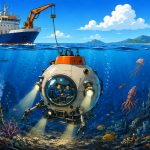
Submarines are among the most advanced engineering machines ever created. Designed to operate deep underwater for long periods, submarines combine physics, navigation systems, life-support technology, and powerful propulsion systems into a highly specialized vessel. From military defense to scientific exploration, submarines play an important role in the modern world. Understanding how they work reveals how humans mastered one of the most hostile environments on Earth — the deep ocean.
What Is a Submarine?
A submarine is a vessel capable of traveling underwater for extended periods.
Unlike ordinary ships, submarines can:
- Dive below the surface
- Remain submerged for long durations
- Navigate deep underwater environments
Submarines are used for:
- Military operations
- Scientific research
- Rescue missions
- Ocean exploration
The Main Structure of a Submarine
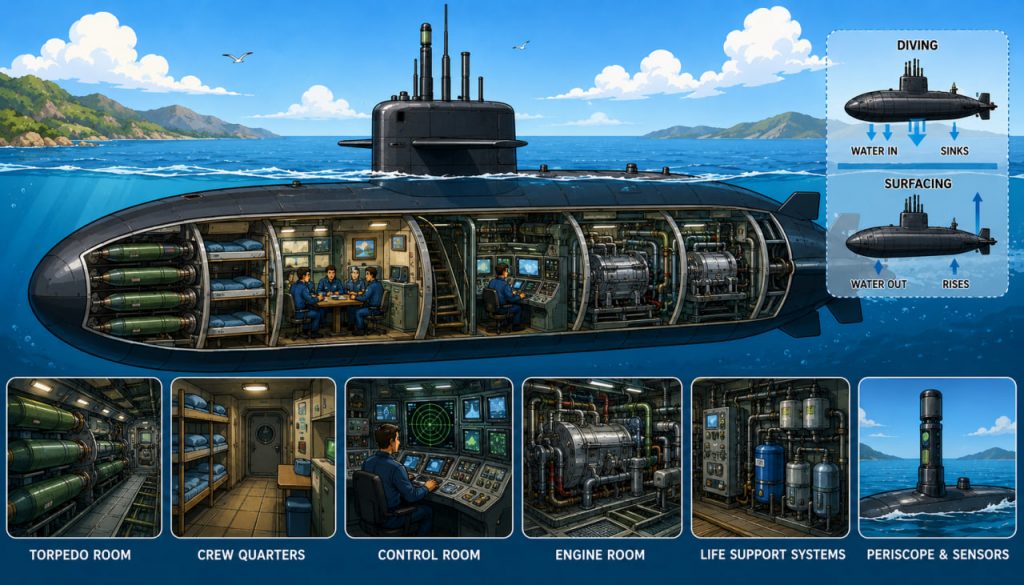
A submarine is built around a strong cylindrical body called the hull.
Modern submarines usually have:
- An outer hull
- A pressure hull inside
The pressure hull:
- Protects the crew from immense water pressure
- Maintains safe internal air pressure
The deeper a submarine dives, the greater the surrounding pressure becomes.
How Submarines Dive and Surface
Submarines control buoyancy using ballast tanks.
When diving:
- Tanks fill with water
- The submarine becomes heavier
- It sinks underwater
When surfacing:
- Compressed air pushes water out
- The submarine becomes lighter
- It rises to the surface
This principle is based on buoyancy physics.
Buoyancy and Archimedes’ Principle
Submarine movement depends on buoyancy forces.
Archimedes’ principle states:
Fb=ρgVF_b = \rho g VFb=ρgV
Where:
- FbF_bFb = buoyant force
- ρ\rhoρ = fluid density
- ggg = gravity
- VVV = displaced water volume
By changing buoyancy, submarines control depth underwater.
Propulsion Systems
Submarines use powerful propulsion systems to move underwater.
Common systems include:
- Diesel-electric engines
- Nuclear reactors
Diesel-electric submarines:
- Use batteries underwater
- Must occasionally surface or snorkel for air
Nuclear submarines:
- Can remain underwater for months
- Generate enormous energy continuously
Life Support Systems
Submarines contain advanced systems to keep crews alive underwater.
These systems manage:
- Oxygen production
- Carbon dioxide removal
- Water purification
- Temperature control
Without life support systems, long underwater missions would be impossible.
Navigation Underwater
GPS signals do not work underwater.
Submarines rely on:
- Sonar systems
- Inertial navigation
- Gyroscopes
- Maps of ocean terrain
Underwater navigation is extremely complex.
Sonar Technology
Sonar uses sound waves to detect objects underwater.
Submarines use:
- Active sonar (sending sound pulses)
- Passive sonar (listening silently)
Sonar helps detect:
- Ships
- Obstacles
- Other submarines
Expert Insight
Naval engineer Hyman G. Rickover, known as the “father of the nuclear navy,” once stated:
“Good ideas are not adopted automatically. They must be driven into practice with courageous patience.”
His innovations transformed submarine technology forever.
Crew Life Inside a Submarine
Life inside submarines is highly structured.
Crew members live in:
- Small confined spaces
- Artificial lighting environments
- Controlled schedules
Submarine crews require:
- Psychological discipline
- Technical expertise
- Team coordination
Military and Scientific Roles
Military submarines perform tasks such as:
- Surveillance
- Defense
- Missile deployment
Scientific submarines help researchers:
- Explore deep oceans
- Study marine ecosystems
- Investigate underwater geology
Safety and Risks
Operating underwater is dangerous.
Potential risks include:
- Hull failure
- Fire
- Flooding
- Equipment malfunction
Modern submarines include many emergency systems to improve safety.
Why Submarines Matter
Submarines are important because they:
- Protect national security
- Advance ocean science
- Enable deep-sea exploration
They represent one of humanity’s greatest engineering achievements.
Interesting Facts
- Nuclear submarines can remain underwater for months.
- Some submarines dive hundreds of meters deep.
- Sonar works similarly to dolphin echolocation.
- The pressure deep underwater can crush ordinary structures instantly.
- Modern submarines contain advanced computer systems and automation.
Glossary
- Ballast Tank — Compartment controlling buoyancy with water and air.
- Buoyancy — Force allowing objects to float or sink.
- Pressure Hull — Strong internal hull protecting the crew.
- Sonar — Technology using sound waves underwater.
- Nuclear Reactor — System generating energy through nuclear reactions.